


Why German importers rely on Bangladesh for their blank t-shirts
This guide to the top 7 blank t-shirt importers in Germany is built around how German buyers actually purchase: by specification, test report and measured fit set. A t-shirt manufacturer supplying Germany from Bangladesh learns quickly that tolerance tables matter as much as price, and the seven lines below are the ones German importers reorder because the data holds from sample to bulk. The same programmes run as wholesale supply for buyers in the USA, the UK, France, Canada and Australia, with German labelling and EU size grading kept to one documented standard.
All seven lines are made in Bangladesh through our manufacturing network and supplied to Germany under your label and your specification. We work as a private label supplier and exporter for distributors, workwear buyers and basics labels: samples are measured and reported before bulk, our factories sew to the approved tolerance, and final inspection checks the order against your own sheet.
- Seven specified lines from one measured supplier programme
- Classic, heavyweight, workwear and organic jersey options
- Shrinkage stated on the sample report before commitment
- Wholesale depth across a wide, lab-dipped colour range
1. Classic crew neck blanks - the wholesale reference blank
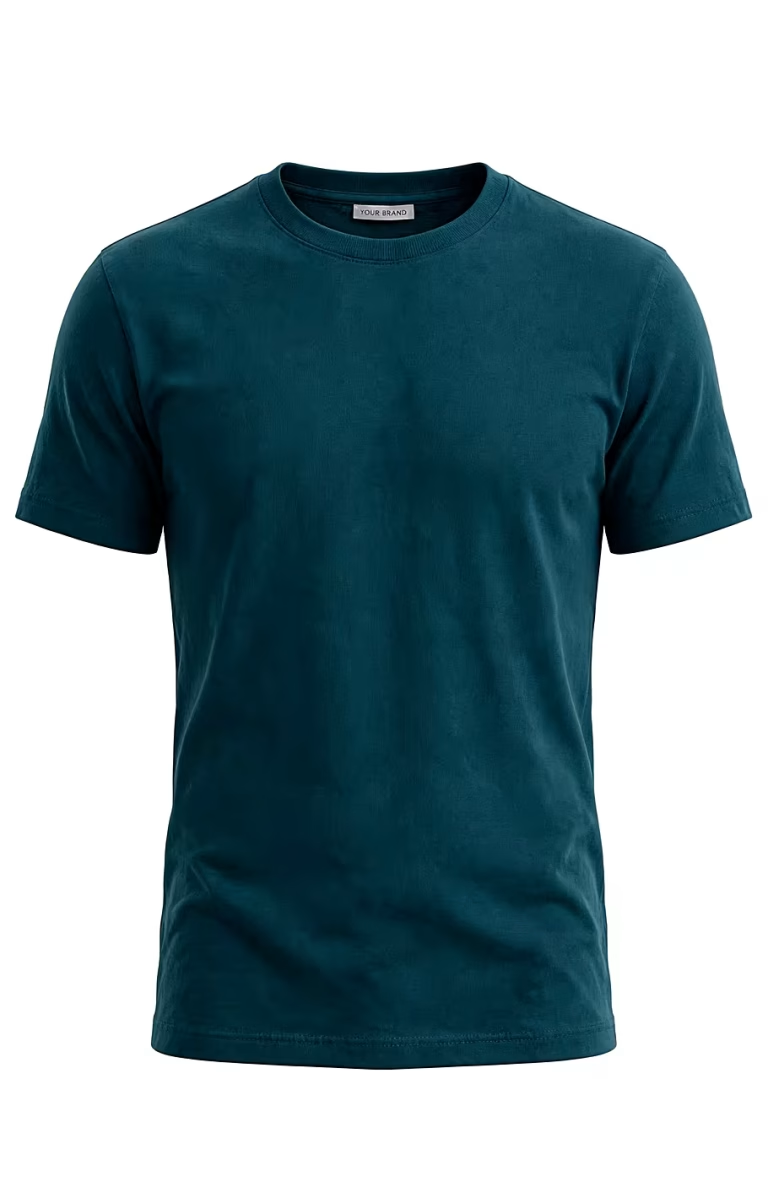
The reference blank of the German trade. Our classic crew neck runs in single jersey at 160-180 GSM, combed and compacted, with shrinkage controlled and stated on the sample report before you commit. Ribbed collar with shoulder-to-shoulder taping, side-seamed construction, and regular and relaxed fit blocks graded to German size expectations and confirmed on a measured fit set. Promotional distributors and basics labels order it in depth across a wide colour range, each colour lab-dipped and approved by you before dyeing, with bulk checked against the dip so repeat orders match shade for shade. Promotional distributors and wholesale buyers measure this 160 to 180 GSM crew against their tolerance sheet before it enters any catalogue.
2. Premium heavyweight blanks
German fashion and workwear-inspired labels ask for a blank with substance: dense jersey at 220-240 GSM, a dry structured hand feel, a higher tighter collar and a straight or boxy body cut to your pattern. Pre-shrunk fabric keeps the retail fit stable through washing, and the weight carries print and embroidery without distortion. This is the line German buyers choose when the shirt itself carries the price - and because the quality is easy to verify by hand, it is also the line that builds a label's reputation fastest. Fashion and workwear labels buy this 220 to 240 GSM blank as a retail shirt, and our exporter packing follows German carton standards.
3. Print-ready blanks
Germany's print houses run high volumes and notice immediately when a blank fights the ink. This line uses a tight, smooth jersey surface with low fibrillation, so screen prints sit cleanly, fine halftones hold and DTG output stays sharp across long runs. The same base handles water-based, plastisol, puff and discharge work, matched to artwork and fabric so colours stay true and prints flex instead of cracking. Strike-offs are approved before bulk printing, and standard placements - chest, back, sleeve, all-over - are routine. High-volume print houses and merchandise suppliers choose the smooth jersey surface for halftones that hold across long runs.
4. Workwear blend blanks
Corporate and workwear programmes are a pillar of German blank demand, and pure cotton is not always the right tool. This line covers cotton-polyester and CVC jerseys that hold colour and shape through industrial washing, with stitching options specified for garments that will be worn and laundered weekly for years. We state fibre content and test results in writing with every fabric, and we will tell you honestly which blend suits your customer's laundry regime - and which does not - because a blank that greys or twists in the wash ends a supply contract faster than any price argument. Workwear suppliers and uniform buyers specify the cotton-polyester blend where wash counts and colour hold are contract terms.
5. Organic cotton blanks for private label manufacturers
German retail and public-sector buyers increasingly specify certified fibres, and this line answers with documents. Sewn from certified organic cotton jersey, with chain-of-custody paperwork kept with the order from yarn to carton, it supports the claims your customers print on hangtags and tenders. Undyed and garment-dyed options are available, and labels, hangtags and packaging can follow the same low-impact brief, including recycled boards and reduced-plastic packing where your programme requires it. Eco labels order this certified organic line from a supplier who files the certificates and test reports with the order.
6. Long sleeve blanks - a supplier line for clubs
A German catalogue sells twelve months a year, and this line covers the cold half: long sleeve crew and V-neck blanks, henleys with placket buttons and thermal-knit layering styles. Sleeve length, body length and cuff fit are graded as carefully as on short sleeve styles, tolerances are checked against the specification at inspection, and the ribbing is knitted to recover so cuffs stay at the wrist. Sharing fabric and colour cards with our short sleeve blanks lets a distributor hold one colour story across both sleeve lengths without doubling approvals. Clubs and outdoor retailers reorder these long sleeve styles from the same factory programme, graded to German size tables.
7. Kids and club blanks
Germany's club, school and family market is a steady blank buyer, and children's garments carry their own rules. This line runs kids' crew necks, printed styles and matching family sets from toddler to teen, graded on children's blocks rather than scaled-down adult patterns. Fabrics are soft-hand and azo-free, print options use child-safe inks, and every style is checked against the safety and labelling requirements of the destination market. Clubs and schools reorder these blanks season after season because sizes, colours and quality stay constant from one order to the next. School suppliers and sports clubs use these kids blanks for private label team and class ranges across Germany.
Consistency is the product German importers actually sell
Ask a German distributor what their customers punish fastest and the answer is never price - it is variation. A blank that arrives two percent smaller, half a shade lighter or twenty grams lighter than the last delivery breaks a print programme, a uniform contract or a retail size run, and the importer carries the cost.
Germany anchors the programme, but the same blanks are specified for other markets every week. France expects EU labelling in French, the UK works to its own size charts, and the USA and Australia run inch-based sizing with different care label rules and opposite seasons. Our exporter team writes those differences into the specification before sampling starts. Belgium orders are consolidated for Brussels distribution, Denmark winter ranges are graded for Aarhus and Copenhagen buyers, and Spain summer programmes are packed light for Barcelona heat. One wholesale supplier across that map means one test file and no second factory to audit.
That same discipline extends to how ranges are built. German catalogues are long-lived: a successful blank may sit in a distributor's programme for a decade, refreshed by colour rather than replaced by fashion.
- Tolerance tables checked at in-line and final inspection
- Test reports and delivery notes filed with every order
- Long-lived catalogue lines refreshed by colour, not replaced
What German buyers ask before their first blank order
Tolerances come first: how closely will bulk match the approved sample in measurement, weight and shade? Our answer is a process - measured fit sets, lab dips retained on file, in-line and final inspection against the signed sample, with results recorded per order. Second, testing: shrinkage, colourfastness to washing and rubbing, and fabric weight are tested before cutting and reported on the sample sheet, so your specification rests on numbers. Third, reliability of supply: production is planned backwards from your delivery date into Hamburg, Bremerhaven or your nominated warehouse, and repeat programmes are scheduled against your forecast so the line is there when your customers call for it. That is why German importers treat us as a long-term garment supplier and OEM partner rather than a spot exporter: one relationship with our manufacturing network covers sampling, bulk and repeats.
- Seven blank lines from one t-shirt manufacturer, measured against your specification
- Classic, heavyweight and workwear fabrics from 160 to 240 GSM
- Shrinkage and tolerance figures stated on the sample report
- Private label neck prints, woven labels and your own carton marks included
- Wholesale pricing for catalogue, workwear and club programmes
- Exporter documentation prepared for EU entry, checked order by order
There is also a paperwork culture to respect. German buyers file everything: test reports, delivery notes matched to orders, certificates where specified. Our export and quality teams treat documentation as part of the product, prepared and checked with the same care as the garments, so your incoming-goods inspection and your customers' audits find a complete, consistent file waiting for them. It is unglamorous work, and it is exactly the work that keeps a supply relationship alive for a decade. And when anything in a delivery ever does fall short of the file, the same records let both sides trace it to a batch and a date instead of arguing about it.
How we work, from first sample to final carton
Every order on this list follows the same path. You send a tech pack, a sample or even a clear photograph with notes; we counter-sample in the correct fabric and return it for approval; bulk only starts when you have signed the sample off. Production is checked in line, mid-line and at final inspection against that approved sample, and packing - folding, tagging, polybagging or plastic-free packing, carton marks - follows your instructions, not our habits. Catalogue buyers who reorder on contract use us as their standing t-shirt supplier and OEM manufacturer, with one exporter contact accountable for the specification.
Our shirts ship to Germany, the United Kingdom, France, Belgium, the Netherlands, Spain, the United States, Canada, Australia and the United Arab Emirates, and our export team prepares the paperwork each of those markets needs. Quantities are agreed style by style - a first trial in a new line is a normal way to start - so talk to our team about what you are planning rather than guessing at a minimum. The full specification of our lead line is on the premium t-shirt page, and the questions buyers ask us most are answered on the FAQ page.
- Measured fit sets approved before bulk cutting
- Production planned backwards from your delivery date
- Exporter documents prepared for Hamburg or Bremerhaven
That is the offer behind this list of the top 7 blank t-shirt importers in Germany: seven real lines, sewn every week through our facilities, measured against approved samples and packed under your label. As your t-shirt manufacturer and exporter, we keep wholesale and private label programmes exact: pick a line, approve a measured sample, and the next thing from Bangladesh is a carton that matches your specification sheet.