

Uniforms are a system, not a pile of garments
Buyers researching the Top 10 Workwear Uniforms Manufacturers Suppliers in Bangladesh usually need one thing above all: the tenth delivery matching the first, site after site. A uniform programme succeeds or fails on consistency: the same colour, the same fit and the same standard arriving for the tenth site exactly as they did for the first. Bangladesh supplies uniform programmes to the world because its garment districts combine every piece of the system in one place - woven and knitted fabrics, embroidery and print, careful grading across wide size ranges, and export operations used to shipping scheduled volumes to Canada, the USA, the UK, Germany, France and Australia. Employers and uniform suppliers build their programmes here to get that system at a factory price.
This page does not list other companies. The ten entries below are the ten workwear uniform lines produced and supplied through our manufacturing network at SiATEX Sourcing, where our facilities act as manufacturer, wholesale supplier and OEM exporter for private label uniform programmes, organised the way uniform buyers plan: by the programme you need to run. Each line is sampled in the correct fabric, approved by you, and then held as your standard, so every reorder, new starter and replacement comes back to the same specification.
- Corporate, industrial, healthcare, school and hotel programmes from one supplier
- One approved specification held across every site and repeat order
- Private label branding with embroidery, print and woven labels
- OEM grading from workforce data across wide uniform size ranges
- Wholesale replacement and new-starter volumes planned in advance
1. Corporate and office uniform programmes
The front-of-house standard. This line covers shirts and blouses, tailored trousers and skirts, knitwear layers and soft tailoring in fabrics that look pressed through a working day. Colours are matched across woven and knitted pieces so a reception team, a sales floor or a branch network reads as one identity. Embroidery and woven labels carry the company mark discreetly. Corporate suppliers build office programmes on this line because tailoring, knitwear and shirting come from one factory standard, with OEM branding set at sampling.
2. Industrial workwear uniforms from a wholesale manufacturer
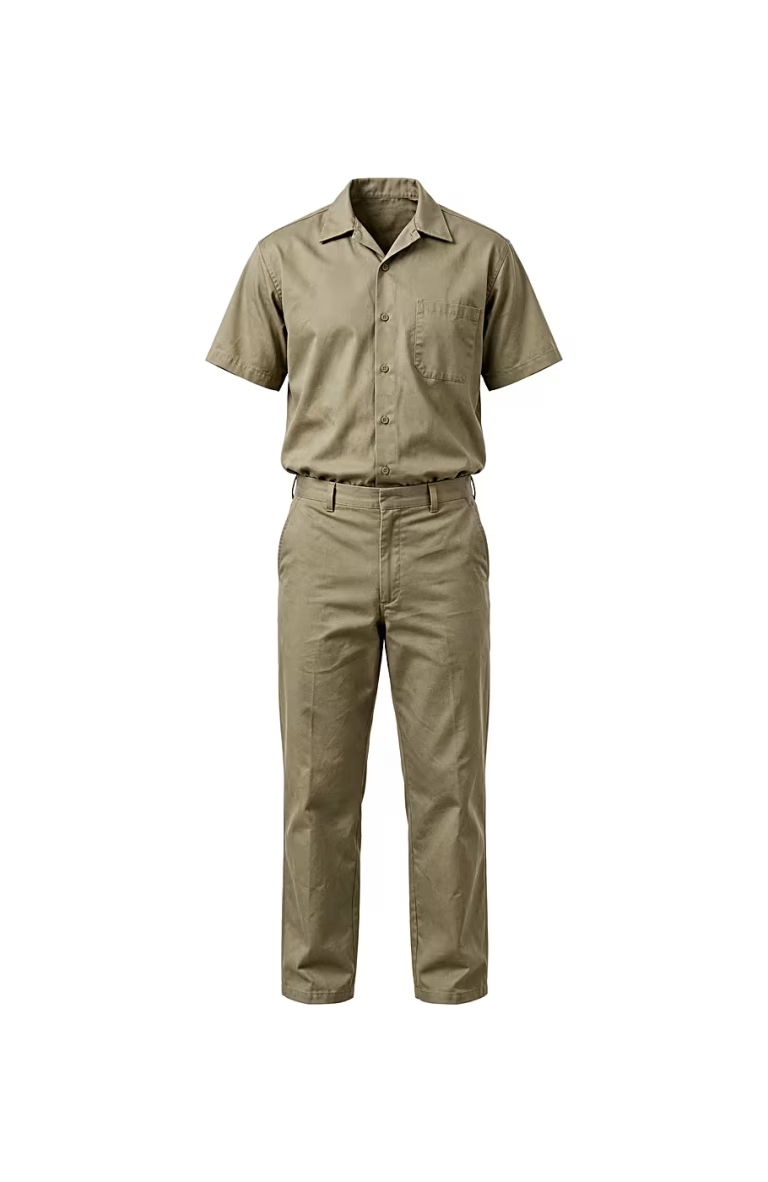
For plants, workshops and depots, the uniform has to work as hard as the wearer. High-visibility elements can be built into the same specification where the site requires them. Colours are held across the full set so old and new issues can be worn together without a visible two-tone workforce. Industrial groups order this line as a standing programme with scheduled replacement cycles planned in from the start.
3. Healthcare uniforms and scrubs
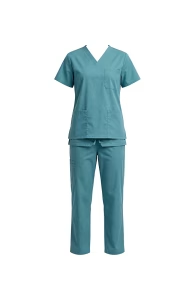
Clinical clothing is washed more than any other uniform, and this line is built for the laundry first: scrub tops and trousers, tunics and clinical coats in fabrics that tolerate hot, frequent washing and keep their colour through it. Cuts are graded for long shifts and constant movement, with pocket layouts drawn for the role. Colours can be coded by department or grade, and embroidery carries names and titles cleanly. Hospitals and clinics use this line because the specification never drifts and repeat scrubs match the first order. Healthcare wholesalers in the USA and the United Kingdom order scrubs as a repeat wholesale line, so colour and fabric standards are locked before the first bulk run.
4. School uniform programmes
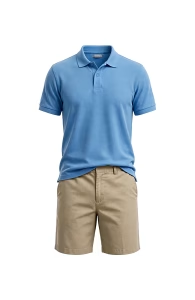
Schools and outfitters need uniforms that survive children, which is the toughest test in clothing. This line covers polos, shirts, trousers, shorts, skirts and knitwear in hard-wearing fabrics, graded on proper children's blocks from small sizes to teen. Colour continuity matters across years, not just orders, because a school blazer bought this year must match the trousers bought next year - so colour standards are held with us for the life of the programme. School suppliers and academy groups use this line for full-range supply, packed by school or by size run to make outfitter distribution simple.
5. Hospitality and hotel uniforms for private label programmes
A hotel uniform is part of the guest experience. This line covers front desk and concierge tailoring, housekeeping tunics and dresses, restaurant service shirts and aprons, and kitchen whites - one property, one identity, supplied as a single programme. Fabrics are chosen by department: stain release and hot washing for kitchens, crease resistance for guest-facing roles, comfort for housekeeping staff who move all day. Multi-property groups use this line to hold one brand standard across every site, with new openings kitted from the same approved specification as the flagship.
A uniform programme crosses borders more easily than fashion, but the details still change by market. The USA and Canada use North American care labelling and letter sizing on many lines, the United Kingdom, Germany and France follow EU fibre rules and centimetre grading, and Australia orders lighter fabrics for warm service environments. Norway hotel groups in Oslo and Bergen run hospitality programmes through our network, Poland uniform suppliers in Warsaw source industrial sets for regional employers, and Hong Kong buyers in Hong Kong manage multi-site corporate programmes with wearer-level packing - each specification held to one approved standard.
6. Security uniforms
Security staff must be identifiable instantly and look authoritative for a full shift. This line covers formal shirts with epaulettes, tailored trousers, knitwear, ties-compatible styles and all-weather outer layers in the sector's dark, consistent colours. Embroidery carries company and role markings, and fabrics are selected to hold a pressed look through long hours. Security uniform suppliers need instant recognition and durable cloth, and our exporter team packs complete sets by officer or site for simple issue.
7. Chef and kitchen uniforms
Kitchens judge uniforms on heat, splashes and laundry turnaround. This line covers chef jackets with cloth knot or stud buttons, bib and waist aprons, kitchen trousers in plain and checked fabrics, and skull caps and neckerchiefs where the house style uses them. Fabrics are picked for stain release and repeated hot washing, and whites are held to a brightness standard across reorders so a brigade looks matched. Restaurant groups, caterers and hotels combine this line with front-of-house service uniforms in one order, keeping kitchen and dining room in a single supply relationship.
8. Salon, spa and service uniforms from garment suppliers
Beauty and wellness staff need uniforms that look calm and clean at close range. This line covers tunics, dresses and trouser sets in smooth, colourfast fabrics with a soft finish, cut for a full day of standing and reaching. Colours run to the muted, professional palette the sector prefers, and embroidery carries salon branding subtly. Because clients see these garments at arm's length, finishing standards are high: clean seams, no loose threads, and a pressed presentation in the pack. Chains and independent groups alike use this line to keep every branch's team looking like the same brand.
9. Driver, delivery and field service uniforms
Staff who work out of a vehicle are the company, as far as the customer at the door is concerned. This line covers polos, softshells, padded jackets, trousers and hi-vis layers built as one branded set, in fabrics that handle cab heat, yard cold and constant movement. Branding is prominent and durable, because these garments are advertising as well as clothing. Logistics firms and service fleets use role-based packing, so each new driver receives the complete correct kit without mixed depot stock.
10. Full programme management: one specification, every site
The tenth entry is the structure behind the other nine. Replacement cycles, seasonal layers and new-location openings are planned rather than improvised. For uniform suppliers and multi-site employers, this turns garment buying into garment management and keeps year three as sharp as the launch. Programme buyers treat records as part of the product: our supplier team files patterns, lab dips and size data so every factory reorder reproduces the approved uniform.
What makes a uniform programme go wrong - and right
Programmes fail in predictable ways: a colour approved on screen instead of a lab dip, a fabric changed between orders without re-approval, sizes graded from one sample size instead of a full fit set. They go right when the opposite habits hold - physical approvals, written specifications, samples washed and worn before bulk, and every repeat checked against the original standard. That is how we run sampling on every line above, because a uniform buyer is not buying garments once; they are buying the same garments, correctly, for years. Buyers comparing manufacturers and suppliers should test the record keeping behind the range: our factory partners hold the specification, patterns and packing plan together, so a wholesale programme survives staff changes on both sides and OEM updates are sampled before they ship.
- One approved specification held across every site and reorder
- Corporate, industrial, healthcare, school and hotel programmes
- Private label branding with embroidery, print and woven labels
- OEM size grading from workforce measurement data
- Wholesale replacement and new-starter volumes planned in advance
- Colour matched from lab dips, never from screen images
- Wearer, site or style packing to match your issue system
Two practical questions follow from that. The first is sizing: we grade each style across a wide size range and supply fit sets before bulk, because a uniform must fit the whole workforce. The second is continuity of supply: employers cannot pause a uniform while a factory re-learns it, so your labels, trims and packaging are held with your specification, and reorders are quoted and scheduled against the standing standard rather than redeveloped. Tell us your replacement cycle and expected new-starter volume at the start, and the programme can be planned around both.
How we work, from first sample to final carton
Send us your current uniform, a tech pack or a brief, and we counter-sample in the correct fabrics for your approval. Bulk production starts only on sign-off, runs with in-line, mid-line and final checks against the approved sample, and is packed to your issue system - by style, by site or by individual wearer. Our supplier team confirms each milestone.
- Send your inquiry with a current uniform, tech pack or brief
- Approve counter samples made in the correct uniform fabrics
- Confirm colours, branding and packing by site or wearer
- Bulk production with in-line, mid-line and final specification checks
- Sets shipped by our exporter team to your programme schedule
Our uniforms ship to the United States, the United Kingdom, Germany, France, Canada, Australia, the United Arab Emirates, the Netherlands and Spain. Quantities are agreed style by style, and a pilot programme for one site is a normal first step - talk to our team about yours. The lead range is specified on the uniforms page, and common questions are answered on the FAQ page. That is why this Top 10 Workwear Uniforms Manufacturers Suppliers in Bangladesh shortlist is built on programme lines run through our manufacturing network: tell our exporter team about your sites and the next step is a sampled set in your branding.