

What a real school uniform factory has to be able to do
Choosing among school uniform factories is not like choosing a fashion supplier: a uniform programme runs for years, and a failure shows up in September in front of hundreds of parents. Buyers in the USA, the United Kingdom, Germany, France, Canada and Australia therefore judge a school uniform factory on whether its production can hold a colour, a fit and a delivery date across a whole school, year after year. Bangladesh answers that test with deep fabric supply in the same districts as the sewing lines. The ten entries below profile the production lines that strong school uniform manufacturers and garment exporters build their programmes on.
The ten entries below are the ten production lines our school uniform programme at SiATEX Sourcing runs every season - the capabilities a buyer should check, all present in one place, and each line can be sampled, priced and put into bulk production for you.
- Woven, knit, tailoring and embroidery lines in one factory system
- One colour standard held across every garment type
- Fabric testing for shrinkage, colourfastness and pilling before cutting
- Full age-range grading on children's and teen blocks
- Set packing by school, size and house colour
- Private label and OEM options for uniform retailers
1. The woven shirt and blouse line
Every uniform factory starts with the shirt. Our woven line sews school shirts and blouses in poly-cotton poplin and oxford, with fused collars that keep their edge, button-through cuffs, and seams finished for industrial washing. Shirts are the highest-volume item in most programmes, so the line runs its own in-line checking at collar, cuff and buttoning stages. Wholesale buyers rate this factory line first.
2. The knit and polo line inside full-range school uniform factories
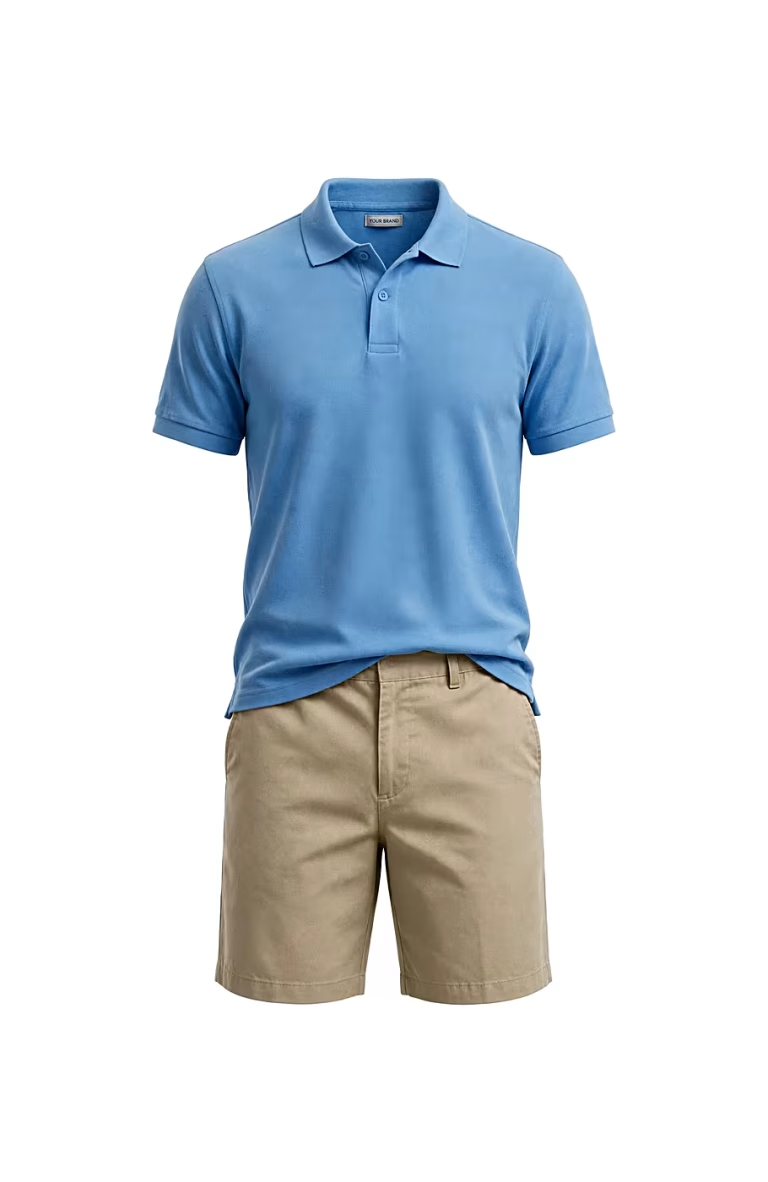
Knit capacity is what separates a uniform factory from a shirt maker. Our knit line produces polo shirts in cotton piqué and CVC, jersey tees for PE, and knit polo dresses, all knitted, dyed and sewn within the same programme so colours match across garment types. Collars and cuffs are flat-knitted with lycra in the rib, so a polo still looks like a uniform after a year of washing. School uniform manufacturers who knit and sew in connected facilities shorten sampling, because the polo, the sweater and the woven shirt are approved against one colour file.
3. The trouser, shorts and skirt line
Bottoms take the hardest wear in the uniform, and this line is built for it: poly-cotton and poly-viscose twills with reinforced seat and knee seams, bar-tacked pocket corners, adjustable waists on the younger sizes and pleats heat-set so they survive tumble drying. Trousers, shorts, skirts and skorts are cut from the same cloth standards so a school's grey or navy is identical across every bottom in the range. Fabric for this line is specified heavier than fashion trousers and tested accordingly. That discipline is what a school uniform supplier promises.
4. The dress and pinafore line
Girls' dresses need their own skills - pleating, gathering, check matching - and this line specialises in them: pinafores, tunics, gingham summer dresses, collared shifts and knit polo dresses. Checks are cut so the pattern matches at the seams, pleats are set before sewing, and zips and buttons are specified for small hands and weekly washing. The line works to the same colour standards, so a dress, a cardigan and a polo bought in different months still form one uniform. Retailers buy it as a private label range.
5. The blazer and tailoring unit
A blazer is tailored clothing, not sewing, and it needs its own unit: canvas and fusing work, structured shoulders, lined bodies, and braid and piping applied by people who do nothing else. Our tailoring unit makes school blazers in poly-viscose and poly-wool blends with the school's braid, buttons and lining, cut on boys' and girls' blocks across the full age range. Blazers are the most expensive item parents buy, so fit sets are sampled across sizes and approved before bulk. The exporter reserves programme cloth so reorders match.
These factory lines also serve mid-size European programmes. In Hungary, school groups around Budapest order full uniform sets with EU size grading and local-language care labels, while Belgium buyers consolidate mixed cartons through Brussels for bilingual school shops. In Denmark, Copenhagen uniform retailers ask for certified fabrics and plastic-free packing as standard, and the factories supplying all three markets hold fabric from one dye lot for a whole season. Australia and Canada programmes on the same lines run to opposite school calendars, which keeps the sewing schedule balanced across the year. USA and France school groups use the same balance in reverse, booking winter-weight sets while southern programmes take summer sets.
6. The PE kit and sportswear line
Sports kit fails differently from classroom uniform - it is washed hotter, worn harder and lost more often. This line makes PE tees, shorts, tracksuits and house-colour kits in performance polyester and poly-cotton knits with moisture management, matched to the school's house colours under the same lab-dip discipline as the main uniform. Because replacements are bought all year, fabrics and colours stay as running standards, so a single replacement short in February matches the kit issued in September. Wholesale orders ship from the same factory stock.
7. The knitwear line for wholesale uniform programmes
Sweaters and cardigans complete the winter uniform, and knitwear is its own trade: fine-gauge V-necks, cardigans and slipovers in acrylic and cotton-blend yarns, with the school's stripe knitted into the neck where the design calls for it. The hard part is colour - knit yarn and woven cloth take dye differently - so this line dips yarn against the same master standard as the fabrics and the two are approved as a set. Buyers get one colour across the whole uniform, not a jumper in a near-miss navy.
8. The embroidery and badging unit
A crest is a school's identity, and it sits in the middle of the chest. Our in-house embroidery unit runs multi-head machines for crests, house badges and name tapes, with every design struck off and approved before bulk and placement templated across all sizes. Keeping embroidery in-house matters more than it sounds: the crest file, thread list and placement standard stay with the order permanently, outsourced embroidery is where colours drift and badges wander, and a uniform factory that badges its own garments can hold the whole programme to one standard. Private label retailers use the same unit.
9. The fabric testing and colour control lab
Behind every line sits the part buyers rarely see: incoming fabric is tested for weight, shrinkage, colourfastness and pilling before it is allowed into cutting, and every school colour is lab-dipped and approved against the buyer's physical standard. Shade bands are checked again at bulk dyeing, and finished garments are measured against the size chart the buyer publishes. This lab is why a programme holds together across years: the promise that next year's garments match this year's is kept in testing, not in sewing. A manufacturer reading those results can cut with confidence. A factory lab that tests every fabric lot is what lets garment suppliers guarantee colour continuity to schools without holding buffer stock of finished uniforms.
10. The set-packing and export unit
The last line is the one the school shop feels: uniforms packed as parents buy them. This unit folds, tags and packs by size, builds complete uniform sets - shirt, trousers, sweater - into single retail packs, applies barcodes and school-shop labelling, and cartons by school, size or store as instructed. For export programmes, cartons are marked for direct distribution so a container can split to multiple schools without re-handling. It is unglamorous work, and it is the difference between a delivery and a problem. Suppliers who pack this way save the school shop hours.
What to check before you trust a factory with a uniform programme - an exporter's checklist
Buyers ask us what separates a safe factory choice from a risky one, and three checks matter most. First, ask whether the factory tests fabric before cutting and keeps lab dips on file - if colours are approved from a screen or a memory, reorders will drift. Second, ask who does the embroidery and the knitwear: programmes fragment when badges and jumpers come from outside suppliers with their own colour standards. Third, ask about the back-to-school peak: every school order lands in the same months, so a serious factory plans production slots by season and will tell you honestly when your order needs to be confirmed to make the September delivery. Our own programme runs through our manufacturing network, where one exporter coordinates the woven, knit, tailoring and embroidery units as a single factory system. That gives wholesale buyers and private label retailers one sample set, one colour standard and one shipment, instead of managing separate suppliers for every garment in the uniform.
- Ask whether fabric is tested before cutting starts
- Check who handles embroidery and knitwear colour control
- Confirm seasonal slots for the back-to-school peak
- Keep approved lab dips on file for reorders
- Use one exporter for woven, knit and tailoring units
- Give wholesale buyers one sample set and one shipment
How we work, from first sample to final carton
Every programme on this page follows the same path. You send a tech pack, sample garments or even clear photographs with notes; we counter-sample in the correct fabrics and return them for approval; bulk only starts when you have signed the samples off. Production is checked in line, mid-line and at final inspection against the approved samples, and packing - folding, tagging, set packing, carton marks - follows your distribution instructions, not our habits.
- Send your inquiry with a tech pack or sample garments
- Receive counter-samples in the correct approved fabrics
- Approve fit, colour and crest strike-offs in writing
- Bulk production starts only after your written approval
- In-line, mid-line and final QC against approved samples
- Set-packed to your instructions and shipped as export cartons
Our uniforms ship to the United States, the United Kingdom, Germany, France, Canada, Australia, the United Arab Emirates, the Netherlands and Spain, and our export team prepares the paperwork each of those markets needs. Quantities are agreed style by style - a first trial school or a single garment line is a normal way to start - so talk to our team about what you are planning rather than guessing at a minimum. The full range is set out on the school uniforms page, and the questions buyers ask us most are answered on the FAQ page.
A top 10 list is only useful if the production behind it is real. Ours runs every season. Tell us what your programme needs, and the next thing you receive from Bangladesh will be samples with your school's crest in them. Work with school uniform factories that prove that system on samples first, and the manufacturer, supplier and exporter roles behind your programme become your advantage.