

Fabric Selection for Clothing Orders from Bangladesh: Cotton, Jersey, Fleece, Denim and Blends Chosen by Swatch, Weight and Your Own Specification
1. How Do You Choose the Right Fabric for a Clothing Order from Bangladesh?
Start with the garment, not the fabric roll. A T-shirt, a hoodie and a pair of trousers each ask for a different cloth, and we work backwards from the finished piece.
- Start from the garment you plan to sell
- Tell us the season the range is for
- Cold markets usually take heavier fabric weights
- Light cloth suits summer lines and warm markets
- Share the price point you must land at
- Fabric choice drives most of your garment cost
- Send a reference garment if you have one
- A tech pack fabric page helps us match
- No tech pack? Plain words work fine too
- We answer with fabric options that fit
- Each option named by fibre, weight, finish
- You compare hand feel from real swatches
- Nothing is ordered before you approve fabric
- Approved fabric goes on your order file
- Sample and bulk follow that same file
- One fabric file serves your whole programme
- See how to place an inquiry to start
- Fabric selections with a manufacturer start from your garment
- Our BGBA membership is listed on the BGBA website
2. Which Cotton Fabric Selections Can You Choose for T-Shirts and Polos?
Cotton is where most programmes begin. It breathes, it prints well, and buyers in every market already know how it feels on the skin.
- Single jersey cotton for classic T-shirts
- Cotton piqué for polo shirts and collars
- Combed cotton gives a cleaner, smoother surface
- Carded cotton keeps costs lower for basics
- Cotton suits tees, polos, babywear and underwear
- Prints sit sharp on cotton jersey
- Embroidery holds well on cotton piqué
- Cotton takes garment dyeing evenly
- Pre-shrunk options for stable sizing
- Cotton elastane for a little wearing stretch
- Natural fibre requests discussed at sampling
- Bright shades and soft pastels both possible
- Melange and heather effects in cotton blends
- Cotton weight set by your target garment
- Swatches posted before you commit to bulk
- Your approved swatch stays on file
- Cotton is the safe first-order choice
- Repeat orders match the first approved swatch
3. What Is the Difference Between Single Jersey, Interlock and Rib Knits?
Knit construction changes stretch, thickness and how a garment hangs. The constructions below cover most knit orders we sew, from vests to hoodies.
- Single jersey: light, stretchy, everyday knit
- Jersey curls slightly at cut edges
- Interlock is thicker, smooth both sides
- Interlock holds shape better after washing
- Rib knit stretches wide, recovers well
- Rib suits cuffs, collars, fitted styles
- Piqué knit shows a small textured pattern
- French terry has loops inside
- Fleece is brushed soft on one face
- Jacquard knits carry pattern in the cloth
- Stripe knits are knitted in, never printed
- Each construction sews and finishes differently
- Construction picked to suit your style
- Ask for two constructions swatched together
- Compare stretch by hand before deciding
- Construction recorded on your fabric file
- Thicker knits hide print show-through better
- Thin knits suit layering and summer ranges
- Fabric selections from a supplier should suit your garment construction
4. Which Fleece and French Terry Fabrics Suit Hoodies and Sweatshirts?
Hoodies live or die by their fabric. Buyers feel the inside of the cloth first, so fleece and terry choices get extra care here.
- Brushed fleece for warm hoodies, sweatshirts
- Unbrushed fleece for a cleaner outer look
- French terry sits lighter than fleece
- Terry loops absorb sweat inside
- Heavier fleece suits northern winter ranges
- Midweight terry suits spring, autumn lines
- Cotton fleece feels soft, natural, breathable
- Polyester fleece dries fast, holds colour
- Blended fleece balances warmth and price
- Hood fabric matched to body fabric
- Rib cuffs and hems matched in shade
- Kangaroo pockets need stable, firm cloth
- Drawcord areas need extra fabric strength
- Weight chosen with your market in mind
- Germany and Canada often take heavier cloth
- Swatch both fleece faces before approving
- Fabric questions answered on our FAQ page
- Fleece samples show the true hand feel
5. Which Stretch Fabrics Work Best for Sportswear and Leggings?
Activewear cloth has to move with the body and dry fast. Stretch blends do that job, and the blend ratio is set by your specification.
- Polyester spandex for leggings, gym tops
- Cotton spandex for softer training wear
- Mesh panels bring airflow to sports styles
- Interlock stretch for firm, opaque leggings
- Four-way stretch for full movement ranges
- Moisture-moving finishes available on request
- Squat-proof opacity checked at sampling
- Bright colours stay strong on polyester
- Sublimation prints need polyester-rich cloth
- Elastic content set by your own spec
- Waistband elastic matched to fabric stretch
- Recovery tested on the sample garment
- Sports bras need firmer, denser knits
- Team kits usually run in polyester jersey
- Send your stretch target in your spec
- Counter-swatch made when your fabric is unusual
- Stretch samples sewn before bulk fabric books
- Your approved stretch feel stays on file
- Fabric selections for garment exporters balance stretch, weight and cost
6. Which Woven Fabrics Can You Select for Shirts, Trousers and Denim?
Wovens give structure that knits cannot. Shirts, trousers, shorts and denim all start from woven cloth chosen by weave, weight and finish.
- Woven cotton for formal, casual shirts
- Poplin for light, smooth shirting
- Oxford weave for a textured shirt face
- Twill for chinos and work trousers
- Denim in several weights for jeans
- Light denim for shirts, summer styles
- Heavy denim for classic five-pocket jeans
- Canvas for tote bags and workwear
- Flannel for warm checked shirts
- Seersucker for summer shirts and dresses
- Woven checks and stripes woven in colour
- Stretch denim with a little elastane
- Washes change denim feel after sewing
- Wash target approved on a sample leg
- Woven fabric shrinks differently from knits
- Shrinkage allowed for inside the pattern
- Woven swatches posted with the knit options
- Your weave choice recorded before booking
7. How Is Fabric Weight Chosen for Your Garment and Your Market?
Weight is written as GSM, grams per square metre. It decides warmth, drape and cost, so we settle it with you before any fabric is booked.
- GSM means grams per square metre
- Light jersey for summer tees, vests
- Midweight jersey for year-round basics
- Heavy jersey for premium-feel T-shirts
- Fleece weights climb for winter markets
- Denim weights run light to heavy
- Same style, two weights, two markets
- United States buyers often split weights seasonally
- United Kingdom ranges usually sit midweight
- Heavier cloth costs more per garment
- Heavier cloth also costs more to ship
- Weight affects how prints sit, feel
- Your target weight goes on the file
- Tolerance agreed before bulk fabric arrives
- Weight checked again at fabric inspection
- No silent weight changes between seasons
- A heavier sample can be sewn first
- Weight advice given in plain cost terms
8. How Do Cotton Polyester Blends Change Feel, Cost and Care?
Blends mix the softness of cotton with the strength of polyester. The ratio is yours to set, and each ratio behaves a little differently.
- Cotton-rich blends feel soft, breathe well
- Polyester-rich blends dry faster, crease less
- Blends usually cost less than pure cotton
- Colours hold longer on polyester content
- Prints cure fast on blended cloth
- Heather effects come from blended yarns
- Tri-blends add viscose for extra drape
- Viscose blends feel cool against skin
- Linen blends suit summer shirts, dresses
- Blend ratio written on your fabric file
- Ratio stays fixed across repeat orders
- Care labels follow the final blend
- Washing behaviour checked on the sample
- Send your preferred ratio in your spec
- No spec? We suggest ratios by garment
- Suggestions explained in plain cost terms
- Blend swatches show both face and back
- Your ratio never changes without your word
- Fabric selections with a factory keep blend ratios fixed
9. How Are Fabric Colours Matched with Swatches and Lab Dips?
Colour is approved in stages, never guessed from a screen. A swatch starts it, a lab dip refines it, and bulk fabric follows the approved dip.
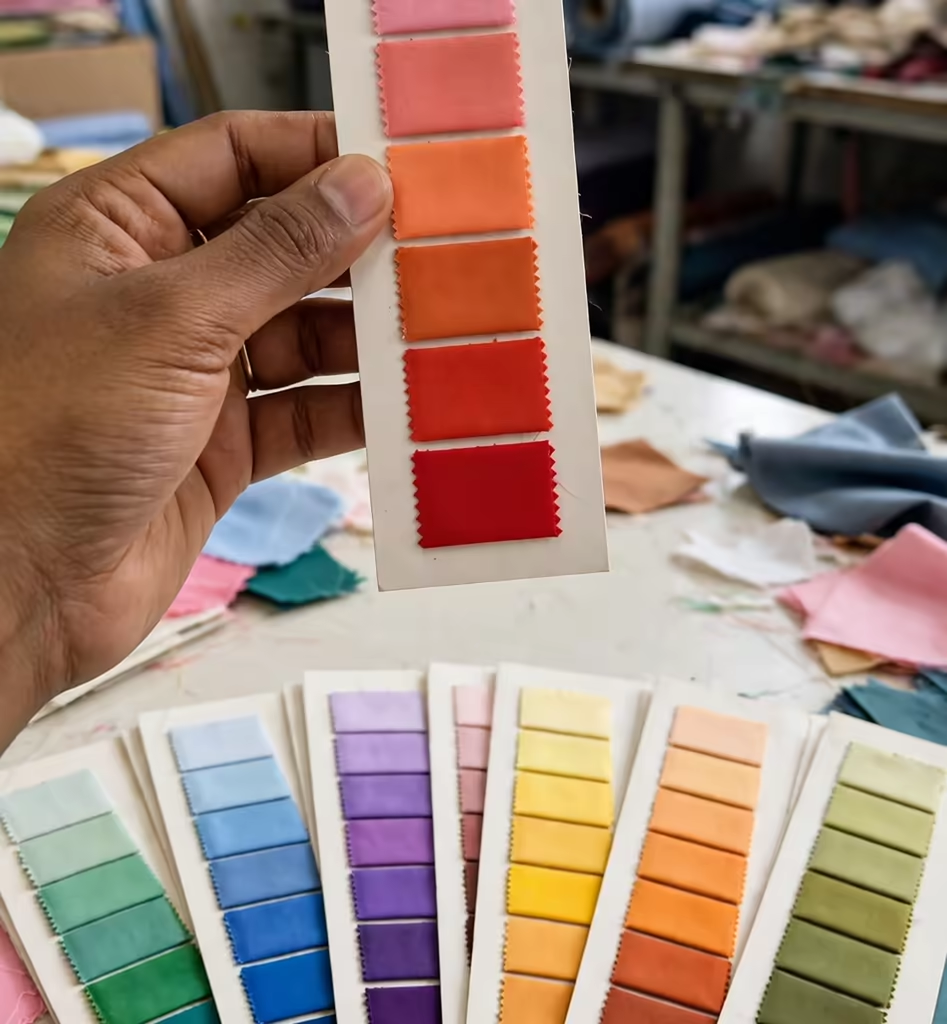
- Send a physical swatch for closest matching
- A Pantone reference also works well
- Screen colours are never trusted alone
- Lab dips made in your chosen fabric
- Dips checked under daylight first
- Store light can change a shade's look
- You approve one dip in writing
- Approved dip becomes the bulk standard
- Bulk fabric compared against that dip
- Shade bands checked roll by roll
- Slight band variation handled before cutting
- Trims dyed to match the body fabric
- Thread, drawcords and rib matched too
- Reorder colours matched from your file
- Old dips kept for season comparisons
- Dips travel with the sample for approval
- See sample development for the approval steps
- No bulk dyeing before your dip approval
10. Can You Send Your Own Fabric Specification or Reference Sample?
Yes, and many buyers do exactly that. Some arrive with a written spec, others post us a garment they already sell and want matched.
- Written specs accepted in any format
- Tech pack fabric pages work well
- Post us a reference garment anytime
- We measure its weight and construction
- Fibre content checked by hand and test
- A counter-swatch is prepared for you
- Counter-swatch posted for your approval
- Differences from your original explained plainly
- Price difference explained before sampling starts
- Your spec stays private to your file
- Specs never shared with other buyers
- Own-spec fabrics may take longer to arrange
- Timing confirmed before you commit money
- Partial specs completed together with you
- Photos of your garment help us start
- Ask anything through our contact page
- Your fabric target leads, we follow
- Matching is judged on the sewn sample
11. How Is Your Chosen Fabric Checked Before Cutting Starts?
Fabric earns its place on the cutting table. Rolls are opened and checked against your approved swatch before a single panel is cut.
- Rolls checked against the approved swatch
- Shade compared roll to roll
- Weight spot-checked on arrival
- Faults marked and cut around
- Holes and stains rejected at inspection
- Fabric rested before cutting for stability
- Shrinkage behaviour noted for the pattern
- Stretch recovery checked on knit rolls
- Print placement checked on printed cloth
- Failed rolls go back, never into production
- Replacement rolls re-checked the same way
- Checking mirrors our clothing quality control habits
- You hear about fabric problems early
- No surprises saved for shipping day
- Inspection notes kept on your order file
- Photos of checked fabric shared on request
- Only passed fabric reaches the cutting table
- Your approved standard is the pass mark
12. How Does Fabric Choice Affect Price, Timing and Repeat Orders?
Fabric is the biggest single cost inside a garment. Choosing it well at the start keeps the price steady and the seasons repeatable.
- Fabric drives most of your unit price
- Rare fabrics cost more, take longer
- Common fabrics move faster through production
- Your fabric file makes reorders simple
- Same cloth, same feel, season after season
- Weight changes change the price honestly
- Blend changes explained in cost terms
- Colour changes rarely change the price
- New fabric means a new sample first
- Sample approval protects the bulk order
- Australia reorders matched from stored swatches
- Netherlands and Spain buyers reorder by file
- Choose once, carefully, with swatches in hand
- Fabric booked only after your approval
- Booking stage explained before you pay anything
- Why buyers stay is on why buyers stay with us
- Your fabric file grows with every season
- Steady fabric means steady garment quality
- Fabric selections with an exporter keep reorders consistent every season