
T-Shirt Manufacturing
Why Are T-Shirts Made in Bangladesh
Why are t-shirts made in Bangladesh? The short answer is skill at scale: few countries can knit, dye, cut and sew a t-shirt as well, as fast or as fairly priced. This page explains the reasons one by one, from cotton and knitting to the sewing lines at our facilities in Bangladesh. Buyers in the USA, UK, Germany, Canada and Australia use the same facts when they plan a programme. Moreover, every claim here can be checked against a sample sewn on the real cloth.
- Most basics are made by manufacturers who sew knitwear all year round.
- Cotton jersey is knitted and dyed close to the sewing lines.
- Skilled operators keep stitch quality steady across long runs.
- Fair labour costs hold the price without cutting cloth quality.
- Deep size and colour runs are made for wholesale programmes weekly.
- Port access moves finished cartons to buyers on regular sailings.
- Samples are sewn on the real cloth before any bulk order starts.
Simply The Best
PORTFOLIOS











Product Details
Why Are T-Shirts Made in Bangladesh?
Why Are T-Shirts Made in Bangladesh? The Short Answer
Why Are T-Shirts Made in Bangladesh is a fair question, because the label appears in wardrobes everywhere. The short answer has three parts. First, the skills are here: millions of operators sew knitwear every working day. Second, the supply chain is here: yarn, knitting, dyeing and sewing sit close together. Third, the cost balance works: a well-made shirt leaves here at a price buyers can sell. Most basics on the world's rails were made by manufacturers in this one country, and that is no accident.
- Deep sewing skills, built over four decades of knitwear work.
- Knitting and dyeing close to the sewing lines, not overseas.
- Fair costs that hold quality without cutting the cloth.
- Huge capacity: whole seasons sewn for many brands at once.
The 7 Reasons Behind the World's T-Shirt Orders
Reason 1: A Workforce That Sews Knitwear All Year
T-shirts are made in factories here because the workforce knows knitwear deeply. Operators handle stretchy jersey all day, every day, and their hands learn its habits. A new style still needs training, of course. However, a line that sews jersey year-round reaches full speed far faster than a line learning from zero.
Reason 2: The Whole Chain Sits in One Country
Yarn spinning, knitting, dyeing, cutting and sewing all happen within a short drive of each other. So a colour problem found at cutting goes back to the dye house the same day. In many rival countries, one of those stages sits overseas. Every extra border adds days, cost and one more chance for a mistake.
Reason 3: Costs That Leave Room for Quality
Labour costs here are lower than in Europe, the USA or coastal China. That gap lets a buyer spend on better cotton and stronger stitching instead of on wages alone. Basics made for wholesale programmes still carry good cloth, because the sewing cost does not eat the whole budget. Price matters, but the honest point is balance, not cheapness.
Reason 4: Scale That Absorbs Big Programmes
When a retailer needs the same shirt in nine colours and eight sizes, capacity decides who can take the order. Shirts here are made by factory groups that run many lines in parallel. One colourway sews on one line while another colourway sews next door. Consequently, a whole season's programme finishes inside one delivery window.
Reason 5: Duty Access to Major Markets
Bangladesh holds preferential trade access to several large markets, including the European Union and the United Kingdom. Qualifying garments enter those markets at reduced or zero duty. That saving lands directly on the shelf price. Buyers in Canada and Australia also work with established routes from here, and the paperwork is routine for our export teams.
Reason 6: Compliance Systems Buyers Can Audit
International safety and social programmes reshaped factory standards here over the last decade. Buildings were inspected, wiring was renewed and worker committees were formed. Today, buyers audit our facilities against their own codes before they place an order. You can read about the industry's structure at the BGMEA, the national garment manufacturers association. Audits are not a favour; they are a normal cost of exporting.
Reason 7: Merchandising Teams Who Speak the Buyer's Language
Behind every smooth order sits a merchandiser who answers emails in clear English and tracks the order daily. Tech packs, strike-offs and courier samples move without drama. Moreover, problems are raised early, while they are still small. Many shirts are made for exporters' own labels here precisely because that daily communication rarely breaks down.
How a T-Shirt Is Actually Made in a Bangladesh Factory
The process itself is simple to describe and hard to do well. Jersey arrives from the dye house and rests, so the knit relaxes. Then panels are cut: fronts, backs, sleeves and neck ribs. Lines sew the shoulders, set the sleeves and close the sides. Necks are ribbed, hems are covered and every shirt is checked before pressing. A plain tee looks easy only because skilled people repeat hard steps perfectly.
- Cloth rested before cutting, so sizes stay true after washing.
- Shoulder tape sewn in, so the neck keeps its shape.
- Side seams matched stripe to stripe on patterned cloth.
- Every shirt inspected, pressed and folded by hand.
Most tees for export are made in factories that run this sequence thousands of times a week. Repetition is the real technology. It turns a basic garment into a reliable one, carton after carton.
T-Shirt Manufacturer in Bangladesh for USA Brands
American brands order basics in depth: many colours, wide size ranges and strict shade control. As a T-Shirt Manufacturer in Bangladesh for USA Brands, we plan those programmes backwards from the selling season. US buyers also test heavily, from shrinkage to colourfastness, and results travel with the order file. In addition, many American programmes are made for wholesale channels, where the same shirt serves hundreds of smaller retailers. Consistency matters more than novelty in that world.
- Wide size ranges graded to American fit expectations.
- Lab results for shrinkage and colourfastness on file.
- Shade continuity held across repeat orders and seasons.
- Cartons marked for US distribution centres on arrival.
T-Shirt Exporter in Bangladesh for Germany Retailers
German retailers are famous for precise specifications and calm, exact paperwork. As a T-Shirt Exporter in Bangladesh for Germany Retailers, we answer with measurement reports and honest delivery dates. German programmes often favour organic or recycled yarns, and the certificates must be genuine and current. Meanwhile, the sewing standard stays the same: shirts made by factory teams who know the retailer's last audit by heart. Precision is respected here, because it protects both sides.
- Measurement reports shared with your quality team.
- Certified yarn options with genuine, current paperwork.
- Delivery dates stated honestly and tracked weekly.
- Packing lists matched line by line to the order.
The Honest Limits: What Bangladesh Does Not Do Best
An honest answer also names the limits. Very small runs suit countries with faster, nearer sampling, because freight from here eats the saving. Ultra-fast fashion drops, measured in days, also fit nearshore production better. Heavy automation is another limit: sewing still depends on skilled hands here, not robots. Finally, shipping takes weeks, so a buyer who plans late will feel the distance. None of this cancels the seven reasons. It simply marks where other countries answer better.
- Tiny runs: freight can erase the price advantage.
- Days-fast drops: nearshore sewing answers sooner.
- Long sea routes reward buyers who plan a season ahead.
- Highly technical garments may need specialist machinery elsewhere.
What This Means When You Buy T-Shirts
For a buyer, the conclusion is practical. If you need reliable basics at a fair price, this country belongs on your shortlist. Ask for a sample sewn on the real cloth. Check the stitching, wash it three times and measure it again. Most export shirts are made by manufacturers who welcome that test, because the garment passes it. Our own facilities in Bangladesh sew to order in your colours, sizes and labels, and we are glad to be judged the same way.
- Judge a sewn and washed sample, not a catalogue promise.
- Ask which stages happen inside the country.
- Confirm shade and size testing before bulk cutting.
- Plan a season ahead to use the cost advantage fully.
The Knitwear Districts: Where the Shirts Are Actually Made
Most shirts are made in factories clustered around Dhaka, Gazipur, Narayanganj and Chattogram. The clustering is not random. A shirt made by manufacturers in Gazipur can be dyed twenty minutes away and finished in the same district. A shirt made in factories near Narayanganj sits beside some of the oldest dyeing and finishing plants in the country. Geography shortens every loop in the process.
- Gazipur: large knitwear lines and modern dye houses.
- Narayanganj: the historic heart of knitting and dyeing.
- Chattogram: sewing capacity beside the main seaport.
- Dhaka: merchandising, sampling and head offices.
Clustering also builds skill. An operator who leaves one line finds another nearby, and her experience stays in the district. Supervisors, mechanics and quality staff grow up inside the same few square miles. Consequently, knowledge that took decades to build does not scatter. A basic shirt made by factory teams in these districts carries all of that shared experience in its seams.
From Cotton Bale to Finished Shirt: Why the Chain Matters
A t-shirt begins as cotton, much of it imported, some of it grown at home. Spinning mills turn it into yarn, and knitting units turn yarn into jersey. The best jersey for export shirts is made by suppliers who knit to a stated weight and width, not by eye. Then dye houses colour the cloth, and finishing units set its width and hand feel. Each stage is a separate business here, competing on quality and speed.
- Spinning: yarn counts matched to the target cloth weight.
- Knitting: jersey, rib and interlock from the same districts.
- Dyeing: shade matched under daylight lamps before cutting.
- Finishing: width, softness and shrinkage set before sewing.
Because the stages sit together, a problem found at sewing travels backwards fast. A shade fault returns to the dye house the same week. A knitting fault returns to the mill with the roll still labelled. In contrast, a shirt made in factories that import finished cloth waits weeks for a replacement roll. The chain is the quiet reason quality here stays steady at very large volumes.
Made for Programmes: How Export Orders Are Organised
Export shirts are rarely made for a single shop. They are made for wholesale programmes that serve whole retail chains. They are made for exporters who consolidate many smaller buyers into one production plan. They are also made by suppliers working under a brand's audit, season after season. The programme system suits this country, because its lines are built for long, steady runs of the same style.
- Retail programmes: one style, many colours and sizes.
- Label programmes: the buyer's own brand at the neck.
- Promotion programmes: fixed dates planned backwards.
- Repeat programmes: the same shirt, improved slightly each season.
Our own orders follow the same pattern. A programme is made by factory lines assigned to one buyer at a time, so shades and labels never mix. Cartons are marked for the buyer's warehouse before they leave the district. Meanwhile, the merchandising team reports progress against the plan every week. When a delay appears, it is reported while it is still small enough to fix.
A Short History: How the T-Shirt Workshop Grew
The industry began modestly in the late 1970s, with a handful of pioneering factories. In the 1980s, training arrangements with Korean producers taught local teams the export trade. Shirts were then made by manufacturers learning as they shipped, order by order. The 1990s brought scale: knitwear especially grew fast, because jersey needs less ironing, less fuss and suits everyday fashion. By the 2000s, whole districts were made by factory growth, street after street of sewing and dyeing.
- Late 1970s: the first export garment factories open.
- 1980s: foreign training builds the first export skills.
- 1990s: knitwear expands faster than any other category.
- 2000s onwards: compliance and scale define the modern industry.
Each decade solved a different problem. First came basic skills, then capacity, then quality, then compliance. Today the questions are about design support, speed and greener production. Through all of it, the basic shirt remained the industry's training ground. A simple tee made by suppliers here taught the country how to serve the world's hardest buyers.
The Emerald Green Shirt in Our Pictures
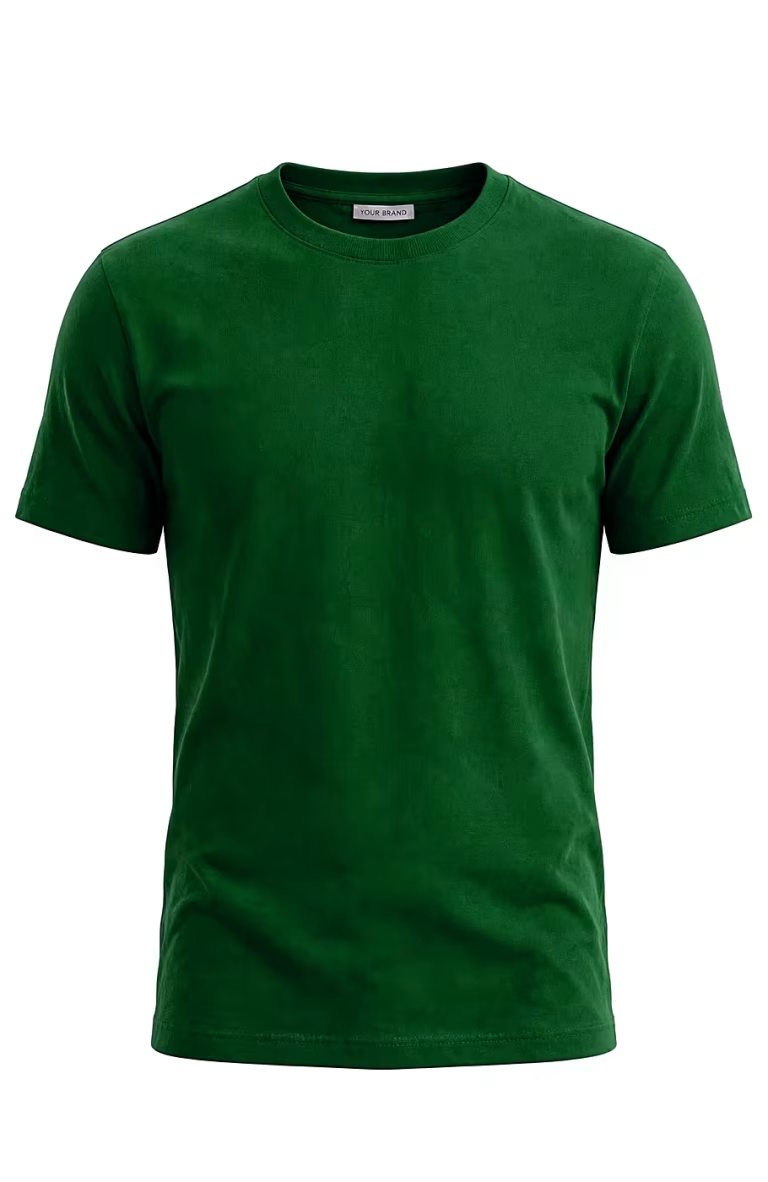
Our pictures show one ordinary shirt, and that is the point. It is an emerald green crew-neck tee in cotton jersey, photographed from the front and the back. The fabric view shows the knit grain and the even dye. The label view shows the space where a buyer's own label sits. This shirt was made by factory sewers on a standard line, at standard speed, with no special treatment.
- Front view: crew neck, shoulder tape and an even shade.
- Back view: plain panel with the same true colour.
- Fabric view: cotton jersey with a clean, tight knit.
- Label view: the buyer's label space at the back neck.
An ordinary shirt is the hardest test of a system. A fancy garment can hide weak basics under decoration. A plain tee hides nothing: every stitch, seam and shade shows. Shirts made for wholesale buyers are judged exactly this way, on the plainest style in the range. If the plain tee is right, the rest of the programme usually follows.
Short Answers to the Follow-Up Questions
Are the shirts made by hand or by machine?
Both, in sequence. Cloth is cut by machine, then each shirt is made by factory sewers guiding powered machines. Hands do the judging; machines do the stitching.
Who are the shirts made for?
They are made for exporters, retail chains and label owners in many countries. A single style is often made for wholesale distribution and sold under several different labels.
Could they be made in the buyer's own country instead?
Yes, and some are. But at scale, a shirt made by manufacturers here costs less to sew well. That saving is the whole story behind the label in your wardrobe.
- Cut by machine, sewn and judged by skilled hands.
- Made for exporters, chains and private labels alike.
- Cost, skill and scale explain the country's role.
- A washed sample proves the point faster than any argument.
Why Are T-Shirts Made in Bangladesh? Judge From a Sample
The fullest answer is a shirt in your hands, sewn and washed the way your customers will wear it. If you would like to test one, reach us through the contact page, and read common questions on the FAQ page. We will sew your sample at our facilities and let the garment argue for its country. That is how most long buying relationships here begin.