
T-Shirt Buying Guide - Bangladesh
Which Brand T-Shirt Is Best in Bangladesh
Which brand t-shirt is best in Bangladesh? Honestly, no single name wins for every buyer, because the best shirt depends on cloth, fit and budget. This guide shows how experienced buyers judge quality for themselves. It lists the checks that separate a shirt that lasts from one that twists after three washes. Moreover, it explains what a brand label does and does not guarantee. The same checks run on every order at our facilities in Bangladesh.
- No single brand wins for every buyer, cloth and budget.
- Judge the cloth first: weight, knit and hand feel.
- The best manufacturers pass the same wash tests every season.
- Stitch density and seam strength show in the first wash.
- The best factories publish colourfastness results for every dye lot.
- Fit blocks and grading decide how a size set wears.
- A sewn sample tells you more than any catalogue claim.
Simply The Best
PORTFOLIOS












Product Details
Which Brand T-Shirt Is Best in Bangladesh?
Which Brand T-Shirt Is Best in Bangladesh? The Honest Short Answer
Which Brand T-Shirt Is Best in Bangladesh has no single answer, and any page that names one winner is selling something. The best shirt depends on the cloth you choose, the fit you need and the price you can pay. What can be answered honestly is how to judge. Experienced buyers ignore the label at first and test the garment itself. The best manufacturers welcome that approach, because their shirts survive it. This guide gives you the same tests.
- No single brand wins for every buyer, cloth and budget.
- The label tells you who designed and sold the shirt.
- The garment itself tells you how well it was made.
- Seven simple checks separate lasting shirts from weak ones.
Why No Single Brand Can Win for Every Buyer
A brand is a design, quality and pricing system, not a sewing location. The same factory line can sew shirts for several labels in one week. One label asks for heavy cloth and tight stitching. Another asks for light cloth and a lower price. Both shirts leave the same building with different names at the neck. So the honest question is not which name is best. It is which specification is best for your purpose, and which maker holds it honestly.
- Labels differ in specification, not always in sewing location.
- A premium name can still order a lightweight cloth.
- A plain label can hide a very well-made shirt.
- Your own checks beat any reputation, including ours.
This is also why outlet and supermarket shirts sometimes outlast famous ones. The buyer behind them specified a strong cloth and checked the production. Meanwhile, a famous label chasing a price point can thin its cloth quietly. The garment always tells the truth in the end. Your job is to read it before you pay, not after the third wash.
The 7 Checks That Reveal the Best Shirt
Check 1: Cloth Weight and Knit Quality
Weigh the shirt or read its grams per square metre. A heavier jersey usually lasts longer, while a very light one can twist and thin quickly. Hold the cloth to the light and look for even knitting. Moreover, rub the surface: a clean, tight knit feels smooth, not hairy. The best factory teams knit or buy cloth to a stated weight and hold it lot by lot.
Check 2: Stitch Density
Count the stitches along five centimetres of seam. More stitches per length generally means a stronger, neater seam. Then look at the neck and hem, where weak stitching shows first. A shirt from the best supplier carries the same density on the inside seams as on the visible ones. Consistency is the real signature of care.
Check 3: Seam Strength and Finishing
Pull the side seams gently and watch for grinning stitches. Check the shoulder tape, which keeps the neck from sagging. Look inside for loose threads and skipped stitches. In addition, examine the armpit joins, the hardest point on the garment. Clean finishing inside is where the best manufacturers quietly separate themselves from the rest.
Check 4: Colourfastness
Rub a damp white cloth against a dark shirt and see what transfers. Then wash the sample and compare the shade with an unwashed piece. Good dyeing holds under both tests. Poor dyeing fades at the folds first. Buyers running the best wholesale programmes repeat this test on every new colour, not only the first one.
Check 5: Shrinkage and Twisting
Measure the sample before washing, then wash it three times and measure again. A well-made shirt shrinks a little and evenly. A poor one twists, so the side seam creeps towards the front. Twisting comes from rushed knitting and cutting, and no pressing can fix it later. This single test exposes more shortcuts than any factory tour.
Check 6: Fit and Grading
Try the size set, not only the medium. Grading decides whether the large fits like a large or like a longer medium. Check the neck opening, the sleeve angle and the body length across sizes. The best factory blocks are graded by people who understand bodies, not only spreadsheets. Your returns rate will thank you for this check.
Check 7: Labels, Packing and Presentation
Finally, judge the small signals. Is the size label accurate and readable? Is the shirt folded evenly, with the collar protected? Small care at packing usually mirrors care at sewing. The best factory treats packing as the last inspection, not as an afterthought. However, treat presentation as supporting evidence, never as the verdict. The first six checks decide; this one only confirms.
T-Shirt Manufacturer in Bangladesh for Canada Retailers
Canadian retailers often buy basics for long winters of layering. As a T-Shirt Manufacturer in Bangladesh for Canada Retailers, we grade for layering fits and sew labels in English and French where a range sells across both markets. Canadian buyers also test shrinkage strictly, because tumble drying is common at home. In addition, they value steady repeat quality over novelty. A t-shirt that matches last season's exactly is a feature, not a failure.
- Layering fits graded across the full size range.
- Bilingual labels where your market requires them.
- Shrinkage tested for tumble-dry households.
- Repeat shades and blocks held season after season.
T-Shirt Supplier in Bangladesh for Spain Brands
Spanish brands bring strong colour stories and a warm-climate eye. As a T-Shirt Supplier in Bangladesh for Spain Brands, we dye to lively shade cards and keep the hand feel light. Summer ranges lean on breathable jersey and shorter sleeves. Meanwhile, Spanish buyers judge colourfastness under strong sun, so our dye testing follows that reality. The best supplier for a Spanish programme is one who treats colour as the product, not as a detail.
- Lively shade cards dyed and matched in jersey.
- Light, breathable cloth for warm-climate ranges.
- Colourfastness tested for strong-sun markets.
- Short-sleeve and relaxed summer blocks on offer.
What the Label Does and Does Not Guarantee
A label guarantees a system stood behind the shirt: a design team, a specification and a returns promise. It does not guarantee the cloth weight, the stitch count or the dye quality on its own. Those live in the specification the label's buyers wrote and checked. So a careful buyer reads the garment, then reads the label. Certification is one more signal in that reading: standards published by GOTS describe how certified organic garments are produced and labelled. Signals help, but your own wash test still decides.
- A label promises a system, not a specification.
- Specifications are written and checked by the buyer.
- Certification adds evidence; it never replaces testing.
- Your wash test remains the final word.
The Violet Shirt in Our Pictures, Judged by the Same Checks
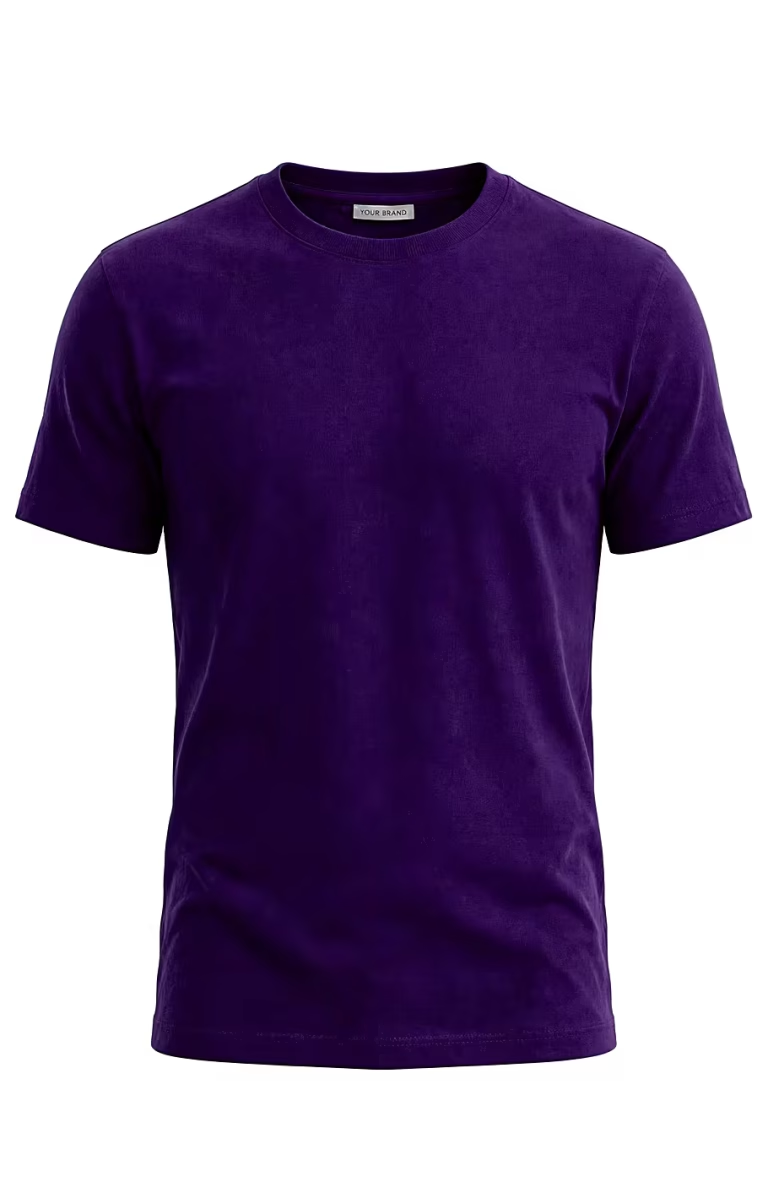
Our pictures show a men's violet premium t-shirt, photographed from the front and the back. Run the checks on it mentally. The jersey hangs evenly, with no twist at the sides. The neck sits flat and ribbed, the shoulders are taped, and the shade is deep and even. The fabric view shows a tight, clean knit. The label view shows the space where the buyer's own label belongs. We present it plainly, because plain is how the best wholesale buyers judge.
- Front view: flat ribbed neck and an even deep shade.
- Back view: plain panel, same colour, no twist.
- Fabric view: tight cotton knit with a clean surface.
- Label view: the buyer's own label at the back neck.
One photograph cannot prove a shirt, of course. It can only invite the real test. That is why we sew samples on the actual cloth for any serious buyer. Hold the sample, wash it three times and run all seven checks. If it passes, the label question answers itself: the best shirt is the one that passes, whoever sewed it.
How Our Facilities Approach the Word Best
We do not claim the word best for ourselves. Instead, we publish our specification, sew to it and invite inspection. Our facilities in Bangladesh make t-shirts to order in your colours, sizes and labels. Samples are sewn on the real cloth before any bulk cutting. Test results travel with the order file, and failed pieces are separated, never packed quietly. That system, repeated honestly, is the closest thing to best that any maker can offer.
- Specifications stated in writing before sampling.
- Samples sewn on the real cloth for your testing.
- Results and reports shared with your quality team.
- Failed pieces separated, never hidden in cartons.
How the Best Makers Are Organised Behind the Scenes
Organisation explains most quality differences. The best factory keeps its sample room beside its production lines, so lessons travel metres, not emails. The best manufacturers separate failed pieces in red bins that everyone can see. Nothing about that is glamorous. It is housekeeping, repeated daily, and it shows in the cartons. When you visit a maker, look at the floors, the bins and the notice boards before you look at the showroom.
- Sample rooms beside the lines, not in another building.
- Failed pieces separated visibly, never quietly reworked.
- Notice boards showing today's targets and defects.
- Mechanics and quality staff on the floor, not on call.
Records tell the same story. The best supplier keeps shade cards, test reports and measurement sheets order by order. Ask for last season's file on a style like yours. A maker with real systems finds it in minutes. A maker without them finds excuses instead. That small request, made early, is one of the sharpest tools a buyer owns.
Price Traps: When a Low Price Hides a Weak Shirt
Every buyer wants a fair price, but the cheapest quote often hides the weakest shirt. The saving usually comes from somewhere: lighter cloth, fewer stitches or faster, rougher dyeing. The shirt still photographs well. It fails later, in your customer's wash, where your label takes the blame. The best wholesale buyers therefore compare cost per wear, not cost per piece. A shirt worn fifty times beats a shirt worn five times, at almost any price gap.
- Ask what the low quote removed: cloth, stitches or time.
- Compare cost per wear across your last two seasons.
- Count returns and complaints inside the true price.
- Let the wash test arbitrate between two close quotes.
There is an honest middle ground. The best factory quote explains itself line by line: cloth, trims, sewing, testing and packing. When a maker shows the build-up calmly, negotiation becomes arithmetic instead of theatre. Both sides then improve the specification rather than squeeze it. That is how durable buying relationships here are actually built.
A Scoring Card You Can Copy for Your Next Sample Round
Turn the seven checks into a simple card. Score each check from one to five, and require a minimum total before any order. Weigh cloth and washing results double, because customers feel those first. Then invite the best manufacturers on your shortlist to sew the same style, in the same cloth, for the same date. Identical briefs make the scores comparable, and comparable scores end arguments.
- Score cloth and wash results double on your card.
- Give every maker the same brief and the same date.
- Photograph each sample beside its score sheet.
- Keep the winning sample as the production reference.
Keep the card for repeat orders too. The best supplier next season is the one whose scores hold, not the one whose first sample impressed. Scores drift when attention drifts, and attention drifts when buyers stop measuring. A five-minute card, used every season, protects your label better than any promise a maker can make, including the promises on this page.
What Best Means Changes With the Buyer
For a fashion brand, the best manufacturer is the one who protects drape, shade and fit across a whole season. Fashion buyers forgive many things, but never a colour story that drifts. For a workwear buyer, the best factory is a different animal: seams must survive industrial washing, and sizes must stay honest for reorders years apart. Workwear shirts are tools, and tools are judged on endurance.
- Fashion: shade and drape protected across the season.
- Workwear: seams and sizes that survive hard service.
- Promotions: dates kept exactly, colours matched to artwork.
- Retail basics: the same shirt, identical, every season.
For a promotion company, the best supplier is the one who never misses the event date. A perfect shirt delivered late is worthless to them. For a basics retailer, the best wholesale programme is the one whose medium is always the same medium. Each buyer is right, within their own world. That is the deepest reason no single brand or maker can be best for everyone, and why your own checks must define the word.
Our advice is simple. Write your definition of best before you request samples. Share it with every maker on your shortlist. The best manufacturers will answer it point by point, and the rest will answer with adjectives. You will learn more from that one exchange than from a month of catalogues. Then sew, wash, measure and let the garments settle the argument.
Two Questions Every Buyer Asks Us
Can a small label really outrank a famous one?
Yes, on your own table it can. The best shirt in a wash test wins, whatever the neck label says. A small label sewn by the best factory teams, to a strong specification, beats a famous label sewn thin.
Should we simply buy the heaviest shirt available?
Not always. The best manufacturers match weight to purpose: heavy for workwear, lighter for summer fashion. The best supplier will ask about your customer before recommending a cloth. Weight is a choice, not a virtue.
- Judge on your table, not on reputation.
- Match cloth weight to the shirt's real job.
Which Brand T-Shirt Is Best in Bangladesh? Run the Checks and Decide
Take the seven checks to any sample, from any maker, and the answer will appear on your own table. If you would like one of our samples in that comparison, reach us through the contact page, and read common questions on the FAQ page. The best suppliers are glad to be judged beside anyone. That confidence, more than any label, is what this page exists to explain.