
Wholesale Clothing Guide - Dubai
Where to Buy Wholesale Clothes in Dubai
Where to buy wholesale clothes in Dubai? You have two honest routes: the trading districts, where Dubai wholesale traders sell ready ranges off the rack, or a factory-direct programme sewn to order at our facilities in Bangladesh. Traders win on speed for small top-ups. Moreover, the factory route wins on unit price, sizes and your own label inside every garment. This guide walks through both routes plainly, so you can judge which fits each part of your range.
- Dubai wholesale districts sell ready stock, fast but at trader prices.
- Factory-direct ordering puts your label inside every garment.
- Core ranges planned ahead cost less per piece than rack buying.
- Traders cannot change a size curve, a colour or a fabric.
- Samples are sewn on the real cloth before bulk cutting begins.
- Programmes are made to order, with nothing held as ready stock.
- Cartons land in Dubai packed by size, colour and store.
Simply The Best
PORTFOLIOS












Product Details
Where to Buy Wholesale Clothes in Dubai
Two Honest Routes to a Full Rail
Ask any shopkeeper in Deira and you will hear the same answer. Dubai sells clothes at wholesale from its trading districts, quickly and in person. However, a growing number of retailers now order the core of their range directly from a factory overseas. Both routes are real. Moreover, both routes do a different job, and mixing them well is what keeps a shop stocked at the right margin.
- The trader route gives you garments today, from stock that already exists.
- The factory route gives you your own styles, sizes and label, planned ahead.
- Most strong shops use traders for top-ups and factories for the core range.
- Each route prices risk differently, so the cheaper rail is not always the cheaper garment.
The Dubai wholesale market rewards buyers who know which route fits which garment. A fashion top that must hang in the window this week belongs with a trader. In contrast, a core t-shirt line that sells all year belongs on a factory programme. This guide walks through both routes in turn. First, it maps the districts. Then, it shows how factory-direct ordering works from Bangladesh.
Where to Buy Wholesale Clothes in Dubai: The Trading Districts
The old textile souk near Baniyas Road is where Dubai wholesale trade began. Small shops there sell fabric, ready garments and mixed lots across narrow lanes. Nearby, Deira holds floors of showrooms where traders display imported ranges. Dragon Mart, out on the Hatta road, adds a vast Chinese-supplied hall. Each district suits a different kind of buying trip.
- Baniyas and the textile souk suit fabric buyers and small mixed lots.
- Deira showrooms suit retailers who want to touch and compare ready ranges.
- Dragon Mart suits price-led basics in large pre-packed quantities.
- Free-zone traders suit re-export buyers shipping onward to Africa and the Gulf.
Traders earn their margin honestly: they carry the stock risk, so you do not have to. But that margin stacks. A garment may pass through an overseas agent, a Dubai importer and a showroom before it reaches your rail. Also, the range is fixed. You choose from what exists, in the sizes that exist, with the label that already sits inside it.
Where to Buy Wholesale Clothes in Dubai: 7 Checks Before You Pay
Whichever route you choose, run the same checks before money moves. These seven checks protect a small shop as much as a chain. They take an afternoon, and they save a season.
Check 1: Whose Label Sits Inside?
A trader garment carries someone else's label, or none. If you are building a shop name, that matters. Your own label turns a one-off sale into a repeat customer. So ask first whether the route lets your brand sit inside the garment.
- Your label builds repeat business; a stranger's label builds none.
- Care labels must match the rules of the market where you sell.
Check 2: Can the Size Curve Change?
Dubai shoppers do not match a standard European curve. Shops here often need more medium and large, fewer small. Traders sell the curve they imported. In contrast, a factory cuts the curve you ask for, store by store if needed.
- Ask for last season's sell-through by size before you order.
- Cut the curve to your customers, not to a distant warehouse.
Check 3: What Does the Garment Really Cost Landed?
The ticket price is not the cost. Add freight, duty, clearing and the margin of every hand the garment passed through. Then compare like with like. A factory quote looks bare beside a trader ticket, yet it often lands lower per piece.
- Write every cost on one line before you compare two routes.
- Compare the same fabric weight and stitch standard, not two different garments.
Check 4: Can You Reorder the Winner?
A style that sells out in nine days is a small tragedy if it cannot return. Trader stock ends when the carton ends. However, a factory keeps your patterns and cloth spec, so the winner comes back in the same colour and fit.
- Keep the winning style's spec sheet with your own records.
- Agree the reorder route before the first order, not after the sell-out.
Check 5: Who Checked the Cloth?
Hold the fabric to the light and wash a sample hard. Some cheap lots fade or twist after three washes, and the returns land on your counter. Certified cloth standards, such as those published by the BGMEA member factories in Bangladesh, give you a paper trail a market stall cannot.
- Wash one piece three times before you commit to a lot.
- Ask for the fabric composition in writing, every time.
Check 6: How Fast Can It Reach Your Rail?
Speed cuts both ways. A trader hands you stock today, which wins for emergencies. A factory needs cutting and sewing time, then sea freight to Jebel Ali. Therefore, plan the core range early and keep the trader for surprises.
- Sea freight suits planned ranges; air freight suits small urgent lots.
- Build your calendar backwards from Ramadan, Eid and the winter season.
Check 7: What Happens When Something Is Wrong?
Short counts and faulty seams happen in every trade. The question is who answers for them. A good factory replaces or credits faulty pieces against clear inspection records. With a market lot, the answer is usually a shrug. So agree the fault process before the first carton, in writing.
- Photograph faults on arrival and report them the same week.
- Keep one sealed sample from every lot as your reference.
Clothing Manufacturer in Bangladesh: The Factory-Direct Route
Our facilities in Bangladesh sew the core ranges that Dubai shops reorder season after season. As a clothing manufacturer in Bangladesh working directly with Gulf retailers, we cut your size curve, sew your label inside, and pack by store. The route skips the middle hands, so the saving shows in your unit price. Moreover, the garment itself improves, because the spec is yours.
- T-shirts, polos and shirts form the core of most Dubai programmes.
- Hoodies and light jackets cover the Gulf winter and air-conditioned malls.
- Kidswear sets sell steadily to family stores across the Emirates.
- Every style is sampled on the real cloth before bulk cutting.
Dubai manufacturers of ready garments exist, yet most local units sew uniforms and tailoring rather than fashion ranges. That gap is why Dubai retailers look overseas for volume clothing. Bangladesh fills it with deep knitwear capacity and long practice in Gulf programmes. The cloth, the labour and the export routine are all in one place.
Clothing Exporter in Bangladesh for Canada Retailers
Canadian retailers run a version of the same calculation. As a clothing exporter in Bangladesh for Canada retailers, we ship winter-weighted ranges on a calendar set by their short selling season. The method mirrors the Dubai route: sample first, cut to the store curve, pack by location. Only the freight leg and the season change.
- Fleece and hoodies lead Canadian orders from our lines.
- Cartons are marked by store, so distribution centres sort them fast.
- Reorders follow the same patterns, cloth and colours.
Clothing Wholesaler in Bangladesh for Spain Importers
Spanish importers buy closer to the fashion calendar, with smaller drops and faster turns. Working as a clothing wholesaler in Bangladesh for Spain importers, we hold their approved patterns and cloth specs ready, so a repeat drop starts sewing quickly. Again, the principle matches Dubai: the buyer who plans the core range pays the factory price, not the stacked one.
- Smaller, more frequent drops suit the Spanish high-street rhythm.
- Approved samples stay on file, so repeats match the first drop.
- Labels and tickets follow each importer's own retail standard.
Custom Clothing Manufacturing in Bangladesh: Labels, Sizes and Colours
The factory route only works if the details are truly yours. So we treat three details as the heart of every programme. First, your woven label and care label go inside every garment. Second, the size curve follows your customers, not a template. Third, colours are dyed to your approved swatch and held across the order.
- Labels are woven to your artwork and sewn in during production.
- Size curves can differ between your Dubai stores and your Sharjah store.
- Dye lots are checked against the approved swatch before cutting.
- Trims, buttons and zips match the sample you signed off.
These details sound small until a rail of mixed shades reaches your shop. Then they are the whole business. Dubai suppliers who sew to order will tell you the same: consistency is the product. The garment is simply where consistency becomes visible.
What Dubai Shops Sell Fastest
Every market has its workhorses. In Dubai, the t-shirt leads all year, in cotton jersey that breathes through the summer. Polos follow for casual and staff wear. Light woven shirts sell to office workers and tourists alike. Then the winter weeks, mild as they are, move hoodies and thin jackets to residents who feel the evening cool.
- Crew-neck t-shirts in white, black and sand shades sell in every district.
- Pique polos serve cafés, salons and delivery teams as light uniforms.
- Poplin shirts in pale colours suit the office and hotel trade.
- Kids' sets move steadily in family stores and souk shops.
Dubai exporters who re-ship to East Africa add another layer: hard-wearing basics in bright colours. If your shop serves that trade, tell us at sampling stage. We adjust cloth weight and stitch strength for garments that will be washed hard and worn daily. One spec does not fit every rail, and honest advice here costs nothing.
How the Money Works: Trader Margin Versus Factory Price
Follow one t-shirt through both routes. The trader route might cross an overseas buying agent, a shipping consolidator, a Dubai importer and a showroom. Each hand adds a margin and a handling cost. The factory route crosses one maker and one freight bill. That is the whole secret, and it is not really a secret.
- Every middle hand adds cost without adding a single stitch.
- Factory pricing shows cloth, labour and trims as open lines.
- Planned sea freight to Jebel Ali keeps the landed cost low.
- Your margin grows because the stack of margins shrinks.
However, the factory route asks something of you: planning. Cloth must be knitted or bought, dyed, cut and sewn. That takes weeks, not days. Dubai wholesale buyers who plan a season ahead keep the saving. Buyers who order in a panic pay the trader, and fairly so, because the trader carried the risk for them.
Planning Orders Around the Dubai Selling Calendar
Dubai sells to its own rhythm. Ramadan shifts shopping into the evenings and lifts family clothing sales. Eid brings a sharp peak in new garments. The winter months add tourists and outdoor evenings. A factory programme planned backwards from these dates lands stock when the rail needs it.
- Place Ramadan and Eid ranges first; they carry the year's peaks.
- Summer basics can ride a steady monthly reorder rhythm.
- Winter layers need ordering while the heat still feels endless.
- Keep a small trader budget for surprises the calendar hides.
We plan production at our Bangladesh facilities around your dates, not ours. Your programme joins a cutting queue with a promised window. Then cartons are packed by size, colour and store, so your team can rail them the day they clear. Finally, the sealed reference sample travels with the paperwork, ready for any dispute.
How Dubai Wholesale Buyers Judge a Factory
Experienced Dubai wholesale buyers share a short list of questions. They ask how long the factory has sewn for Gulf programmes. They ask which cloth mills supply the yarn. They also ask what happens when a dye lot drifts. Dubai suppliers who cannot answer plainly rarely win a second order. The same test applies to Dubai manufacturers of uniforms and tailoring: the answer matters more than the brochure.
- Dubai wholesale buyers ask for a sewn sample before any deposit.
- Dubai suppliers are compared on cloth honesty, not ticket price alone.
- Dubai manufacturers win repeats when reorders match the first lot.
- Dubai exporter houses are judged on paperwork accuracy at Jebel Ali.
Our own answers are simple. Samples are sewn on the real cloth, and the sealed sample stays on file. Cloth specs are written into the order, not left to memory. Moreover, Dubai wholesale buyers receive inspection photos before cartons close. That routine is why Dubai suppliers with factory backing keep accounts for years, while one-season traders vanish. A Dubai factory price means little without the routine behind it; with the routine, it means a rail you can plan around.
The T-Shirt in Our Pictures, Shown Plainly
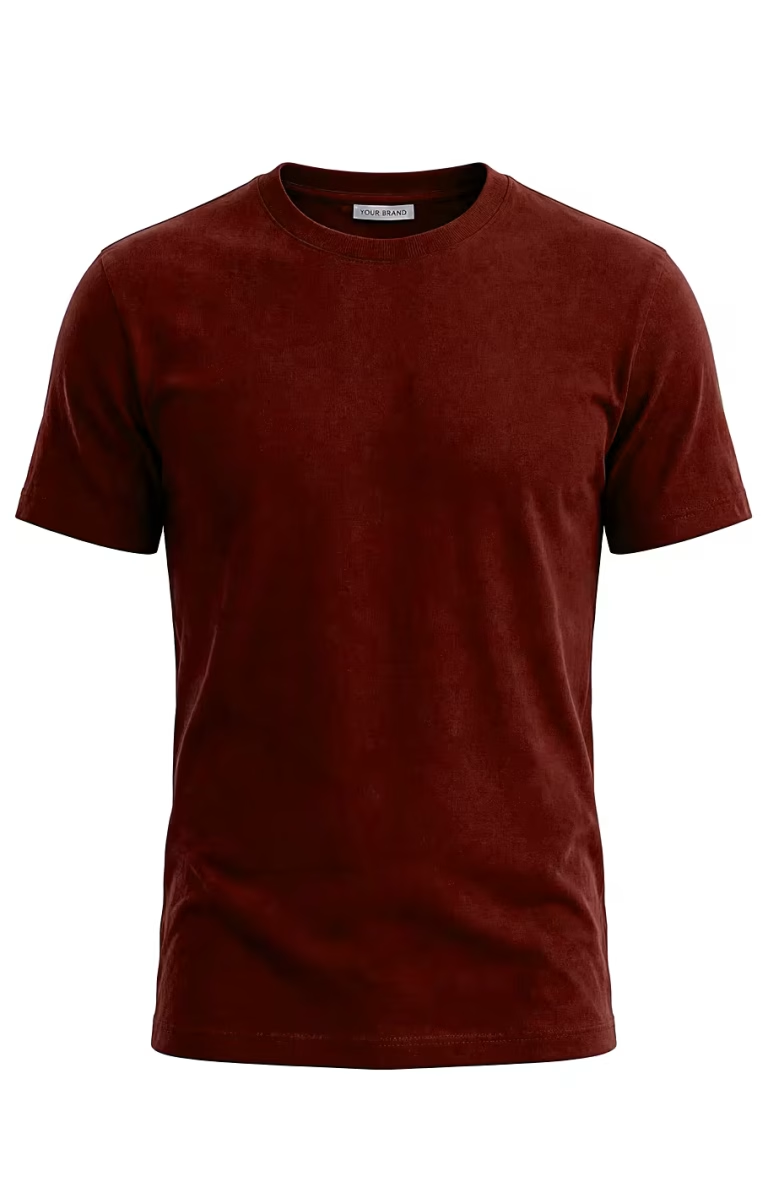
The pictures on this page show the workhorse of the Dubai trade: a crew-neck t-shirt in rust brown cotton jersey. The front view shows the ribbed collar and clean body. The back view shows the plain panel and the label tab at the neck. The close-up shows the jersey weave itself, and the final picture shows the woven label your own brand would replace.
- The front shows the collar rib and hem finish honestly.
- The back shows the plain panel your print could carry.
- The close-up shows the single jersey weave up close.
- The label picture shows where your woven label is sewn.
Reordering: Where the Factory Route Pays Twice
The first order teaches both sides the routine. The second order is where the money is saved again. Dubai wholesale buyers who reorder a winner keep the same pattern, cloth and label, so no new sampling is needed. Dubai suppliers working from a factory file simply restart the line. In contrast, Dubai manufacturers without records must guess at last season's shade, and the rail shows it.
- Dubai wholesale buyers reorder best sellers while they still sell.
- Dubai suppliers with a sample file match shade and fit exactly.
- Dubai exporter houses add little when paperwork runs direct.
- Dubai manufacturers of basics win on this repeat rhythm.
We keep your patterns, cloth specs and sealed samples on file for exactly this reason. When your message arrives, the programme restarts from record, not from memory. Dubai wholesale buyers tell us the second order feels easier than the first, and the third easier still. That is the quiet advantage no market stall can copy.
A Short Note for First-Time Buyers
If you are new to wholesale buying, start smaller than your ambition. Order one style through each route and compare the landed cost, the sell-through and the faults. The numbers will teach you faster than any guide. Also, visit the districts in person once; the education is worth the taxi fare.
- Start with one core style and one trusted route each.
- Record faults and sell-through from the very first lot.
- Grow the route that treats your customers best.
Questions about sizing, cloth or freight are answered on our frequently asked questions page. When you are ready to cost a programme, send your styles through our contact page and we will reply with open pricing lines.
Where to Buy Wholesale Clothes in Dubai?
So, where to buy wholesale clothes in Dubai? Buy speed from the districts and value from the factory. The souks, Deira showrooms and Dragon Mart serve the urgent rail honestly. For the core range that carries your name, order factory-direct and plan ahead. That mix is how the strongest Dubai clothing stores protect both their shelves and their margin.
- Use traders for top-ups, tests and emergencies.
- Dubai wholesale buyers use a factory programme for core styles.
- Dubai suppliers stay useful for speed, not for margin.
- Dubai manufacturers rarely match a planned factory price.
- Run the seven checks before money moves on either route.
- Plan around Ramadan, Eid and the winter season.