
Wholesale Buying Guide
What Are the Advantages of Wholesale Company
What are the advantages of wholesale company supply for a clothing buyer? A strong wholesale company brings a sourcing network, volume pricing, quality control, finance, logistics and compliance under one account. This guide explains six strengths to look for, and how our Bangladesh network works with buyers in the United States, the United Kingdom, Germany, Canada and Australia.
- Strength one: a sourcing network across many factories.
- Strength two: volume pricing from combined buying power.
- Strength three: quality control before stock reaches you.
- Strength four: finance and credit inside one account.
- Strength five: logistics handled from factory to door.
- Strength six: compliance and testing kept on file.
- Our factory network supplies wholesale companies too.
Simply The Best
PORTFOLIOS












Product Details
What Are the Advantages of Wholesale Company
What Are the Advantages of Wholesale Company?
The advantages of a wholesale company come from scale gathered in one place. A wholesale company buys from factories in volume, checks what it buys, finances the stock and delivers it in workable quantities. For a clothing buyer, that means one account replaces dozens of factory relationships. First, the company brings a sourcing network. Second, its combined volume pulls prices down. In addition, its quality team filters faults before stock reaches you. Finally, its finance, logistics and compliance work runs quietly behind every order. The company negotiates with manufacturers once and passes the result to every customer. The six strengths below show what to look for.
- One account instead of dozens of factory contacts.
- Volume pricing built on combined buying power.
- Quality checked before stock is offered for sale.
- Credit and payment terms inside the relationship.
- Deliveries planned around your selling calendar.
- Testing and compliance documents kept on file.
- The company stands between factories and retailers, absorbing risk.
Strength One: A Sourcing Network in One Account
No factory makes every garment well, so a strong wholesale company builds a network instead. The company works with manufacturers across knitwear, wovens, fleece and denim, and matches each order to the maker that does it best. For a buyer, that network is invisible but valuable: one call reaches many production lines. Also, when one maker is full, the company calls a supplier partner with open capacity instead. That flexibility keeps your season moving when a single factory route would stall.
- Many garment families covered through one account.
- Orders matched to the best maker for each style.
- Backup capacity when one factory is full.
- New styles sourced without new relationships.
- Network knowledge growing with every season.
- The company holds supplier capacity open for peak months.
Strength Two: Volume Pricing from Combined Buying
A wholesale company buys for hundreds of customers at once, and factories price that volume kindly. The company books factory production in full runs, then splits the output into orders that smaller buyers can take. Your per piece price carries the company margin, yet it still sits below small order factory pricing in most staple lines. Moreover, the company negotiates fabric and trim costs across its whole book, not order by order. Those savings flow into the prices you see. The company also offers wholesale terms that factories reserve for volume buyers.
- Full production runs split into workable orders.
- Fabric and trim negotiated across the whole book.
- Staple line pricing below small order levels.
- Stable prices held across the selling season.
- Volume rebates on repeat programme business.
Strength Three: Quality Control before Stock Reaches You
A serious wholesale company checks what it buys, because its name travels with every carton. The company inspects factory production during sewing, audits finished stock on arrival and pulls faulty pieces before they reach customers. That filter is a real advantage: factory faults become the company problem, not yours. For example, a shade drift caught at the warehouse never reaches your shop floor. When the company partners with a factory long term, standards rise further, because both sides protect the relationship.
- Factory inspections during and after production.
- Arrival audits on every stock delivery.
- Faulty pieces pulled before dispatch to you.
- Shade and measurement standards enforced.
- Claims settled from checked records, fast.
- The company audits its manufacturers against written standards.
Strength Four: Finance and Credit Inside One Account
Factories usually ask for deposits and payment before shipment. A wholesale company finances that gap itself, then offers its customers account terms. For a growing retailer, those terms can matter more than a small price difference, because they align payment with selling. The company also carries the currency and payment risk of importing. In addition, one account means one credit relationship to build, and a good payment record with the company strengthens your terms over time. The company pays factories before shipment, which is why factories answer its calls first.
- Deposits and factory payments financed upstream.
- Account terms aligned with your selling cycle.
- Currency and import payment risk carried for you.
- One credit relationship to build and keep.
- Terms that improve with a clean payment record.
- The company extends supplier credit checks to new accounts carefully.
Strength Five: Logistics Handled from Factory to Door
Behind every simple wholesale delivery sits a chain of bookings, customs entries and warehouse work. The company runs that chain daily, with freight partners and customs brokers already in place. Your order arrives as a planned domestic delivery, on a day your team expects. Also, the company consolidates factory shipments into one delivery, which cuts your freight per piece. When something goes wrong in transit, the company chases the carrier, not you.
- Freight and customs handled by specialists.
- Several factories consolidated into one delivery.
- Planned delivery days for your team.
- Transit problems chased by the company.
- Lower freight per piece on combined orders.
- The company books factory freight space ahead of seasons.
Strength Six: Compliance and Testing Kept on File
Modern clothing retail runs on documents: fibre content, care labelling, flammability and chemical testing. A professional wholesale company keeps those files for every line it sells, because retailers and marketplaces ask for them. The company works with manufacturers who test fabric lots and keep reports ready. For a buyer, that means a compliance question is answered with a document, not a delay. The company files supplier test reports centrally, so nothing is hunted during an audit. Our own network follows the same discipline, and certified fibre options follow recognised chains of custody.
- Fibre and care documentation held per line.
- Fabric test reports available on request.
- Labelling rules followed for each market.
- Certified fibre options with chain of custody.
- Marketplace compliance questions answered fast.
- The company keeps exporter documentation ready for customs.
How Our Bangladesh Network Works with Wholesale Companies
Siatex sits on the factory side of this picture, and wholesale companies are among our best customers. Our partner facilities produce private label lines that a wholesale company sells under its own brand, with the company handling its market and our network handling production. The company books our factory teams for full runs, then splits them for its customers exactly as described above. If you run a wholesale company, we can be your Bangladesh production arm. If you buy from one, our lines may already sit behind your stock.
- Private label production for wholesale brands.
- Full run manufacturing with split delivery options.
- Your labels, packaging and carton marks fitted.
- Test reports filed with every bulk lot.
- Trial orders welcome before programme business.
Sweatshirt Manufacturer in Bangladesh for Dutch Importers
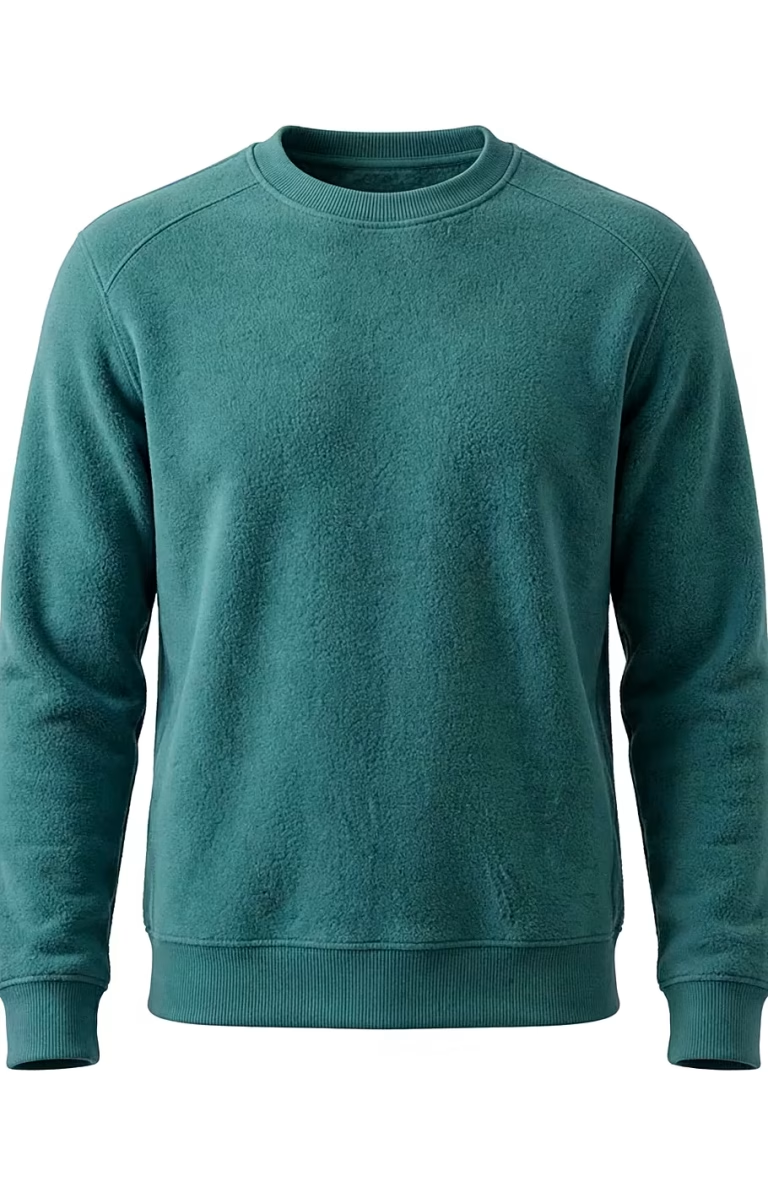
Sweatshirts show the model at work. As a sweatshirt manufacturer in Bangladesh for Dutch importers, our network sews brushed fleece sweatshirts in buyer colourways and packs them for Rotterdam distribution. Dutch wholesale buyers take our factory output for their own label programmes, because the fleece weight, rib quality and shade stay consistent across reorders. The teal sweatshirt in this page gallery is one of those core styles, checked at the same points as every bulk lot we ship. Each wholesale company checks factory fleece weights before booking its programme.
- Brushed fleece sweatshirts in your colourways.
- Ribbed collar, cuffs and hem in matching fabric.
- Shade continuity held across repeat orders.
- Cartons packed for Dutch distribution centres.
- Core styles kept open season after season.
How the Six Strengths Work Together
The six strengths support each other. The company uses its manufacturer network to win volume pricing, and volume pricing funds the quality team and the warehouse. The company offers wholesale credit because its logistics run predictably, and its compliance files stay ready because the same factories supply it season after season. Remove one strength and the others weaken: pricing without quality control is just cheap stock. Judge the whole system, not a single promise.
- Network strength funds pricing strength.
- Pricing strength funds quality and storage.
- Predictable logistics make credit terms possible.
- Steady factories keep compliance files simple.
- One weak strength weakens the whole offer.
When a Factory Beats a Wholesale Company
Honesty matters here: for proven, repeating lines under your own label, a factory usually beats a wholesale company on price and control. The company adds its margin to every piece, and stocked lines cannot carry your label or your fabric choices. The company knows its suppliers by name; the factory knows its machines. The company remains the better route for breadth, speed and testing. Many buyers run both routes side by side, and knowing which route fits which line is the real buying skill.
- Factories win on proven, repeating core lines.
- Your label and fabric need direct production.
- Companies win on breadth, speed and testing.
- Most experienced buyers run both routes.
- The company connects factories to buyers who cannot import directly.
Where Wholesale Companies Source from Bangladesh
Wholesale companies operate in every major market, and each one leans on different strengths. The nine markets below order most often through our desk. In each market, buyers judge a wholesale company by the same six strengths, then keep the ones that hold up season after season. Each wholesale company judges factory partners by the same six strengths in return.
- Wholesale and direct routes both served.
- Local labelling and packing rules followed.
- Programmes renewed season after season.
United States
American wholesale companies run deep sourcing networks and large warehouses. Our knitwear and fleece lines feed several of their private label programmes. Each company guards its manufacturer list carefully.
United Kingdom
UK wholesale companies compete on range and restock speed. Documented quality matters more each year as marketplaces tighten their rules.
Germany
German wholesale buyers judge partners on testing and paperwork first. Our factory teams keep reports with each lot for exactly that reason. A German company files supplier reports per lot as a matter of routine.
France
French wholesale companies balance trend lines with boutique basics. Colour stories rotate fast, so flexible production wins their orders.
Canada
Canadian wholesale companies serve a wide geography from few warehouses. Consolidated shipments and reliable calendars decide their factory choices. A Canadian company holds factory stock near its customers.
Australia
Australian wholesale companies value the logistics strength most. Long freight routes make one accountable production partner worth having.
United Arab Emirates
UAE wholesale companies re-export across the Gulf and East Africa from Dubai. Mixed assortments and fast documentation suit their trade. A UAE company moves factory assortments across borders every week.
Netherlands
Dutch wholesale companies run disciplined private label programmes through Rotterdam. Several produce their fleece lines with our network.
Spain
Spanish wholesale companies supply family clothing stores nationwide. Seasonal mixed cartons and steady staple pricing anchor their buying.
Wholesale buyers in Italy, Poland, Japan and South Korea apply the same six strength test, and our desk answers it in writing before quoting.
Questions Buyers Ask about Wholesale Companies
Short answers to the questions we hear most from buyers judging wholesale partners. Longer answers live on our FAQ page, and our team answers anything else in writing.
- Six strengths you can test before committing.
- Written quotations for direct programmes.
- Trial orders welcome on either route.
How do we judge a wholesale company in the United States?
Test the six strengths in order: network, pricing, quality control, finance, logistics and compliance. Ask for the factory list behind the stock, the claims record and the test files. A strong company answers with documents; a weak one answers with promises. A strong company names its manufacturers when asked.
Can a wholesale company in Germany supply our own label?
Often yes, through private label production run with partner factories like ours. The label programme needs sampling and approval time, so start the conversation a season ahead of the launch you plan.
What does the company need from us to quote?
For stock lines, just your styles, sizes and quantities. For private label production, a tech pack or reference sample helps us price exactly. We quote per piece in writing, with lead times stated plainly. The company quotes factory programmes and stock lines separately.
Is a big wholesale company always better?
Not always. Big companies win on network and finance, while smaller ones often win on attention and flexibility. Judge the six strengths against your own needs rather than choosing by size alone. A small company often visits factories more often.
Can we buy some lines direct and others wholesale?
Yes. Most experienced buyers split their range: proven cores direct, tests and fill ins through wholesale. The split protects margin on volume lines while keeping the flexibility wholesale offers.
How are faulty cartons handled?
A professional company settles claims from its checked records: credit, replacement or repair, agreed quickly. Ask about the claims process before your first order, and keep your first order small enough to test it.
A Final Word on Judging Companies
Judgement improves with a simple habit: test before you trust. Place a small first order, check the cartons against the promise, and watch how the company handles one deliberate question about its factories. The company reveals its supplier standards under mild pressure. The company that answers plainly, ships accurately and documents everything has shown you its real standard. Finally, grow volume only with companies that pass that test twice. Your future self, mid season with full shelves, will be grateful.
- Test with a small order before programme volume.
- Check cartons against the written promise.
- Ask one hard question and judge the answer.
- Grow only with companies that pass twice.
- Also, keep notes from the first order for the second one.
- Then judge the second order by the same standard again.
Looking for Production behind Your Wholesale Range?
So, what are the advantages of wholesale company supply? A network, volume pricing, quality control, finance, logistics and compliance in one account. If you run or buy from such a company, our Bangladesh network can stand behind your range as its production arm. The right company makes its factories invisible to you, in the best way. Our work follows the standards promoted by the BGMEA, and certified fibres follow the GOTS chain of custody. See our sweatshirt range or send your programme for a written quotation.
- Production capacity behind your wholesale brand.
- Your label, your fabric, your fit block.
- Sampling and approvals before bulk commitment.
- One team accountable from sample to shipment.
- Your company deserves a factory partner that answers in writing.