
Wholesale Uniform Manufacturing - UAE
Uniforms Wholesale Manufacturers in UAE
Looking for a Uniforms Wholesale Manufacturers in UAE programme? We cut, sew and pack complete uniform sets to order at our facilities in Bangladesh, sized across a whole workforce and ready to issue. UAE wholesale buyers approve a sample set on the real cloth before bulk cutting begins. Moreover, every programme is planned backwards from the date your teams must be dressed. Your branding sits on every garment, and no other name appears on the cloth.
- Made to order across your full size curve, nothing held as stock.
- Matched sets cut from single fabric lots for even colour.
- Your embroidery and branding applied before garments are packed.
- Sample sets approved on the actual cloth before bulk sewing.
- Corporate, industrial, school and hotel lines in one programme.
- Production planned at our Bangladesh facilities around issue dates.
- Packed by wearer, site and size for fast warehouse issue.
Simply The Best
PORTFOLIOS












Product Details
Uniforms Wholesale Manufacturers in UAE
What Wholesale Uniform Supply Really Means
A wholesale uniform order is a different job from a retail purchase. Thousands of garments must arrive identical, sized across a whole workforce, and ready to issue on one morning. A single wrong shade or a missing size run can stall a site opening. That is why UAE wholesale buyers judge a programme by its system, not by a sample alone.
- Every wearer must find a correct size in the first issue.
- Colours must match across shirts, trousers and outer layers.
- Replacement garments must match the original issue exactly.
- Paperwork must satisfy procurement, not just the warehouse.
Our programmes are built at that scale in Bangladesh. Matched sets are cut from single fabric lots, sewn on lines that run workwear every week, and packed in the assortments your sites actually need. Moreover, the whole programme sits in one factory file, so a reorder two years later matches the first issue.
Uniforms Wholesale Manufacturers in UAE: How a Programme Is Built
The build starts with your workforce list, not with a catalogue. We map roles to garments: who needs a shirt, who needs a coverall, who needs both. Then sizes are counted by site, because a Dubai head office and a Sharjah yard rarely share a curve. Finally, branding is placed role by role, so embroidery never lands on the wrong chest.
- Corporate programmes cover shirts, blouses and trousers.
- Industrial programmes cover work shirts, trousers and coveralls.
- School programmes pack full sets by year group and size.
- Hospitality and healthcare lines join the same production file.
UAE suppliers who work from trader stock cannot rebuild a programme this way. Their sizes end where the carton ends. A factory programme instead cuts what the workforce list says, including the awkward sizes at both ends of the curve. That completeness is what procurement teams are really buying.
From Workforce List to Warehouse in 7 Steps
Step 1: Mapping Roles and Garments
First, we turn your staff list into a garment map. Each role receives its set: shirt, trousers, outer layer, or a full coverall. Quantities per role are agreed before cloth is discussed, so nothing is guessed later.
- Role lists come from your HR or facilities team.
- Spares are added for new starters and losses.
Step 2: Cloth and Shade Approval
Next, cloth is chosen for the work, not the showroom. Industrial shirts need twill that survives hot washing. Corporate shirts need a smoother hand. Shades are approved under daylight, and one dye lot is reserved for the whole programme where possible.
- Wash tests run before the shade is approved.
- The approved swatch stays in the programme file.
Step 3: Sample Sets for Approval
A full sample set is sewn in your main sizes and sent for fitting. Your team checks length, ease and pocket placement on real wearers. Changes are written into the file at this stage, while they still cost nothing.
- Fit sessions use actual staff, not fit models.
- Every change is recorded before bulk cutting.
Step 4: Cutting Matched Sets
Bulk cutting follows the workforce map exactly. Sets are cut from the same lot so a shirt and its trousers share one shade. Bundles are ticketed by site and size from the cutting table onward.
- Single-lot cutting protects colour consistency.
- Bundle tickets follow each set through sewing.
Step 5: Sewing and Branding
Sewing lines run the programme style by style. Embroidery and badges are applied before final pressing, while garments are still in sequence. Reinforced seams go where the work demands them: pockets, shoulders and stress points.
- Embroidery positions are checked against the sample.
- Stress points receive extra bartack stitching.
Step 6: Inspection by Set
Inspection works by set, not by loose garment. A set missing one piece fails the check and returns to the line. Measurements are sampled across sizes, and shade is compared under standard light.
- Incomplete sets never reach the packing table.
- Fault records follow the programme file.
Step 7: Packing by Wearer and Site
Finally, garments are packed the way your warehouse issues them: by wearer where names are supplied, or by site and size. Carton lists match your goods-in system. The result is an issue morning without a sorting crisis.
- Named packing is available for large workforces.
- Carton contents print on the outside label.
Uniform Manufacturer in Bangladesh: Cloth That Survives the Wash
Uniforms are washed harder than any fashion garment. Industrial laundry runs hot, often, and without mercy. As a uniform manufacturer in Bangladesh, we choose twills and blends that hold colour and shape through that cycle. Each cloth is wash-tested before it enters a programme, and the results sit in the file.
- Poly-cotton twill balances comfort, strength and price.
- Colourfast dyeing keeps navy navy and black black.
- Reinforced buttons and bar-tacked pockets extend garment life.
- Spare cloth from the same lot is held for replacements.
UAE manufacturers of uniforms exist locally, mostly at tailoring scale. Programmes for thousands of wearers usually travel to Bangladesh, where the cutting capacity sits. The cloth science travels with the order, because the wash test happens before a single bulk garment is cut.
Uniform Manufacturer in Bangladesh for UAE Construction Companies
Construction workforces turn over fast and work in punishing heat. As a uniform manufacturer in Bangladesh for UAE construction companies, we build sets that breathe, wash daily and issue by gang or by crew. Sizes lean large, colours stay visible under dust, and spares are packed generously.
- Lightweight twill keeps crews cooler on site.
- Hi-vis options join the same programme file.
- Replacement sets ship against the original spec.
Uniform Exporter in Bangladesh for UAE Logistics Companies
Logistics teams dress drivers, pickers and supervisors differently, yet all three groups must read as one company. Working as a uniform exporter in Bangladesh for UAE logistics companies, we grade one design across roles: polo for drivers, shirt for supervisors, coverall for the yard. One shade, one badge, three garments.
- Role variations share cloth and colour standards.
- Cartons are split by depot for direct delivery.
- Seasonal layers join the file without redesign.
Custom Uniform Manufacturing in Bangladesh: Branding That Stays Put
A uniform carries the company name into every customer meeting. So branding is treated as construction, not decoration. Chest embroidery is stitched, not glued. Name badges are sewn or heat-sealed to survive the wash. Logo colours are matched to your brand sheet in thread, which fades differently from print.
- Thread colours are matched under standard light.
- Embroidery density is set to avoid puckering.
- Badge placement follows one template per role.
- Sample branding is approved before bulk sewing.
Production standards at audited factories, such as those recognised by WRAP, also protect the people who sew the garments. Procurement teams increasingly ask for that evidence. We keep our audit records ready for your compliance file.
How UAE Wholesale Buyers Compare Programmes
Seasoned UAE wholesale buyers compare programmes on evidence, not on promises. They ask to see a wash-tested garment, not a fresh sample. They ask how replacements are priced in year two. They also ask who answers when a carton arrives short. UAE suppliers with real factory files answer each question from records. UAE manufacturers at tailoring scale answer honestly too, but their capacity ends quickly.
- UAE wholesale buyers ask for wash results before price talks.
- UAE suppliers are judged on replacement pricing, not first price.
- UAE manufacturers rarely hold cloth for future spares.
- UAE exporter programmes are checked for document accuracy.
The comparison usually ends at the file. A programme with patterns, cloth specs and packing plans on record can be quoted precisely and repeated exactly. UAE wholesale buyers who have been burned by stock-based supply recognise the difference at once. Stock runs out; a file does not. That is why the factory route keeps winning the large tenders.
One Programme, Five Sectors
The Emirates dress more uniformed roles than most countries their size. Corporate towers in Dubai need shirts and blouses that look sharp under air conditioning. Industrial zones in Sharjah and Abu Dhabi need twill that survives dust and heat. Schools need sets that survive children. Each sector joins the same programme file with its own garment map.
- Corporate sets favour smooth cloth and a tailored fit.
- Industrial sets favour reinforced seams and spare buttons.
- School sets are packed by year group for easy issue.
- Hospitality sets carry embroidery as part of the design.
- Healthcare sets use colour-fast cloth for hot washing.
UAE wholesale orders that split these sectors across five suppliers create five shade standards and five reorder problems. One programme keeps one standard. When a school and a hotel share a buyer, their files sit side by side, and freight can be consolidated. Simplicity compounds into savings.
Replacements, Spares and the Second Year
A uniform programme is judged in its second year. Staff leave, sizes change, and garments wear out at different speeds. Our file holds spare cloth from the original lot, so a replacement shirt matches the set issued last spring. New starters receive the same garments as the team they join.
- Spare cloth is reserved when the main lot is cut.
- Replacement orders follow the original measurements.
- Size data from real issues improves the next curve.
- Faded roles can be re-issued without redesigning.
UAE suppliers who buy finished stock cannot offer this continuity. When their carton ends, the style ends. UAE wholesale buyers then re-tender the whole programme and start again. The factory file avoids that cycle entirely, which is why its second-year cost is so much lower than its first.
Where the Wholesale Price Comes From
Factory pricing is open arithmetic: cloth, trims, labour, branding and freight. Nothing hides inside a trader margin. UAE wholesale programmes also save on repetition, because the second and third issues reuse patterns, cloth specs and packing plans. The first order builds the file; later orders simply run it.
- Open cost lines show where every dirham goes.
- Repeat issues cost less to set up than first issues.
- Sea freight to Jebel Ali suits planned programme dates.
- Spares ordered with the main run share its pricing.
UAE suppliers working from imported stock price differently: each carton carries its own history of margins. When a size runs out, the replacement price is whatever the market asks that week. A factory programme removes that lottery. The price of a replacement shirt is the price in the file.
The Mauve Work Shirt in Our Pictures, Detail by Detail
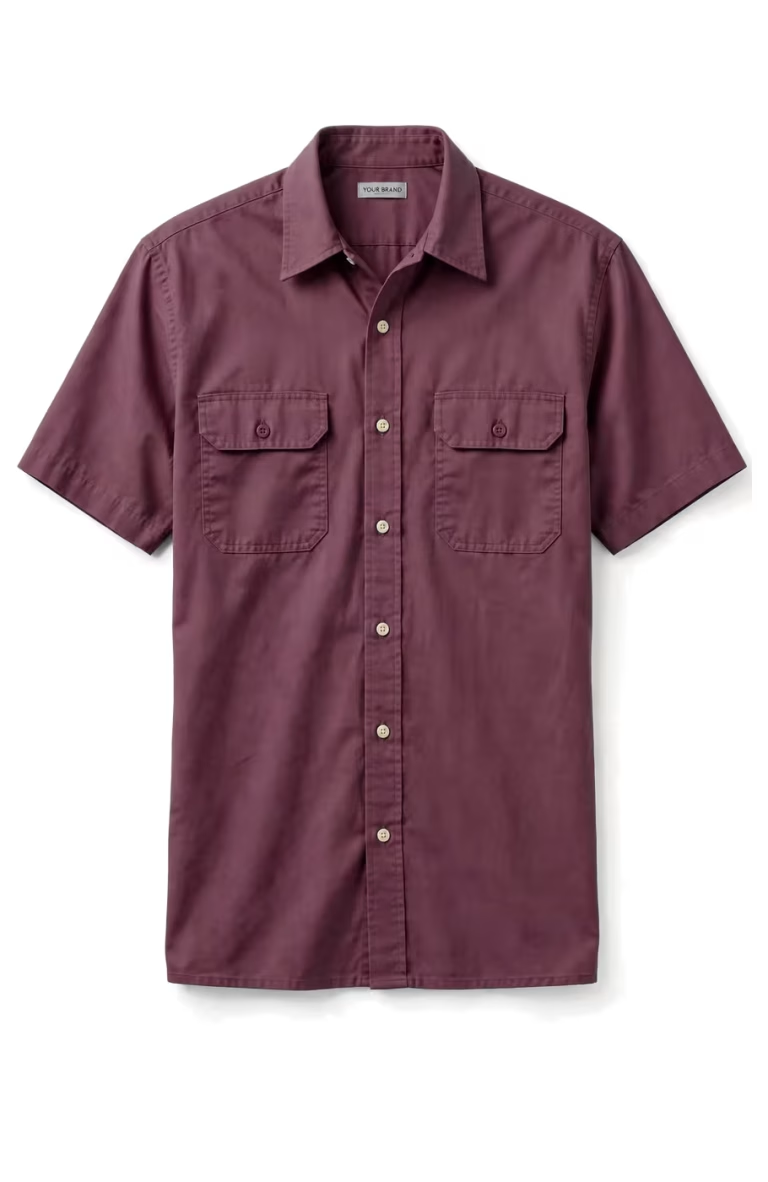
The front picture shows our programme shirt in a dusty mauve twill: short sleeves, two flap chest pockets and a clean button front. The back view shows the yoke and centre pleat that let the wearer reach and lift. The fabric picture shows the twill weave up close. Finally, the label picture shows where your company label sits inside the collar.
- Twin flap pockets carry pens, cards and small tools.
- The back pleat adds movement for physical work.
- Twill weave balances strength with a smooth hand.
- The collar carries your woven label and size tab.
Freight and Delivery Into the Emirates
Most programmes travel by sea to Jebel Ali, then clear into a free zone or mainland warehouse. Sea freight suits planned issue dates and keeps the landed cost low. For a late contract win, a first small lot can fly while the main order sails. UAE wholesale buyers usually split the shipment exactly that way.
- Sea cartons are packed by site for direct distribution.
- Air lots cover urgent first issues and photo shoots.
- Documents are prepared for UAE customs without delay.
- Delivery dates are confirmed against the vessel schedule.
UAE suppliers who consolidate mixed stock often deliver mixed quality with it. A single-programme shipment arrives uniform in every sense. UAE manufacturers' representatives sometimes promise local delivery they cannot control; our dates come from the production file itself. When the vessel sails, your warehouse team already holds the carton list. Planning, once again, is the whole service.
Planning Around Issue Dates and Growth
Uniform programmes live on dates: a hotel opening, a school year, a contract start. We plan backwards from the issue morning. Sampling, cloth and sewing each take a window, and freight closes the plan. When your workforce grows, the same file produces the new starters' sets without a fresh tender.
- Issue dates are agreed before production starts.
- Growth sets reuse the original patterns and cloth.
- Seasonal reviews adjust sizes to real wear data.
- Emergency spares can travel by air when needed.
Questions about sizing sets, cloth or freight are answered on our frequently asked questions page. To cost a programme, send your role list and rough headcount through our contact page. We reply with open pricing lines and a sampling plan.
Sizing a Workforce Without Guesswork
Size curves fail when they are copied from another country. Emirates workforces draw from many regions, so heights and builds vary widely inside one team. We therefore build the curve from your own staff data where you have it. Where you do not, a measured sample group gives a safer curve than any template.
- UAE wholesale buyers supply headcount by size where records exist.
- UAE suppliers rarely ask; they simply ship a standard curve.
- UAE manufacturers at small scale cannot re-cut a failed curve.
- UAE exporter files keep the curve for every later issue.
A wrong curve shows up on issue morning as a queue of swaps. A right curve shows up as silence, which is what you want. Our sampling stage includes a size set for exactly this reason. Measure a sample group, adjust the curve, and only then cut the bulk. The hour spent there saves a week of exchanges.
Looking for a Uniforms Wholesale Manufacturers in UAE?
If your teams need uniforms that arrive complete, matched and ready to issue, start with the workforce list. We will map the garments, sew a sample set and price the programme openly. UAE wholesale buyers who plan this way stop firefighting their uniform cupboard. The file does the remembering, and every issue simply follows it.
- Start with roles, headcount and issue date.
- Approve sample sets on real wearers.
- Let one file carry every future reorder.
- Keep your branding consistent across every site.