
Uniform Manufacturing for Ajman
Uniform Manufacturers in Ajman
Looking for a Uniform Manufacturers in Ajman programme that dresses a whole workforce from one file? We cut and sew uniform sets to order at our facilities in Bangladesh, in cotton rich twill that stands up to site work and daily washing. Buyers in the USA, UK, Germany, Canada and Australia approve a sample on the real cloth before bulk cutting begins. Moreover, every programme is planned backwards from the date your teams must be dressed. Your label sits inside every garment, and no other name appears on the cloth.
- Made to order in your colours and sizes, with nothing held as ready stock.
- Shirt and trouser sets cut from one cloth lot for even shade.
- Your woven label inside every garment, with no other name shown.
- Samples approved on the actual twill before bulk cutting begins.
- Industrial, workshop and facility lines in one programme.
- Production planned at our Bangladesh facilities around your date.
- Packed by wearer, site and size for fast warehouse issue.
Simply The Best
PORTFOLIOS












Product Details
Uniform Manufacturers in Ajman
Uniform Sets Built for Ajman Workplaces
Ajman dresses a working population that spans factories, workshops, warehouses and ports. Each site needs the same identity in different sizes, shades and quantities. A Uniform Manufacturers in Ajman programme therefore runs from one wearer file, not from scattered orders. Patterns, cloth lots and size curves stay recorded, so every issue matches the last.
- Programmes are built for repeat issue, not one delivery.
- Shirt and trouser sets are cut as matched pairs.
- Wearer lists fix quantities before cloth is cut.
- Shade records keep new starters matching old hands.
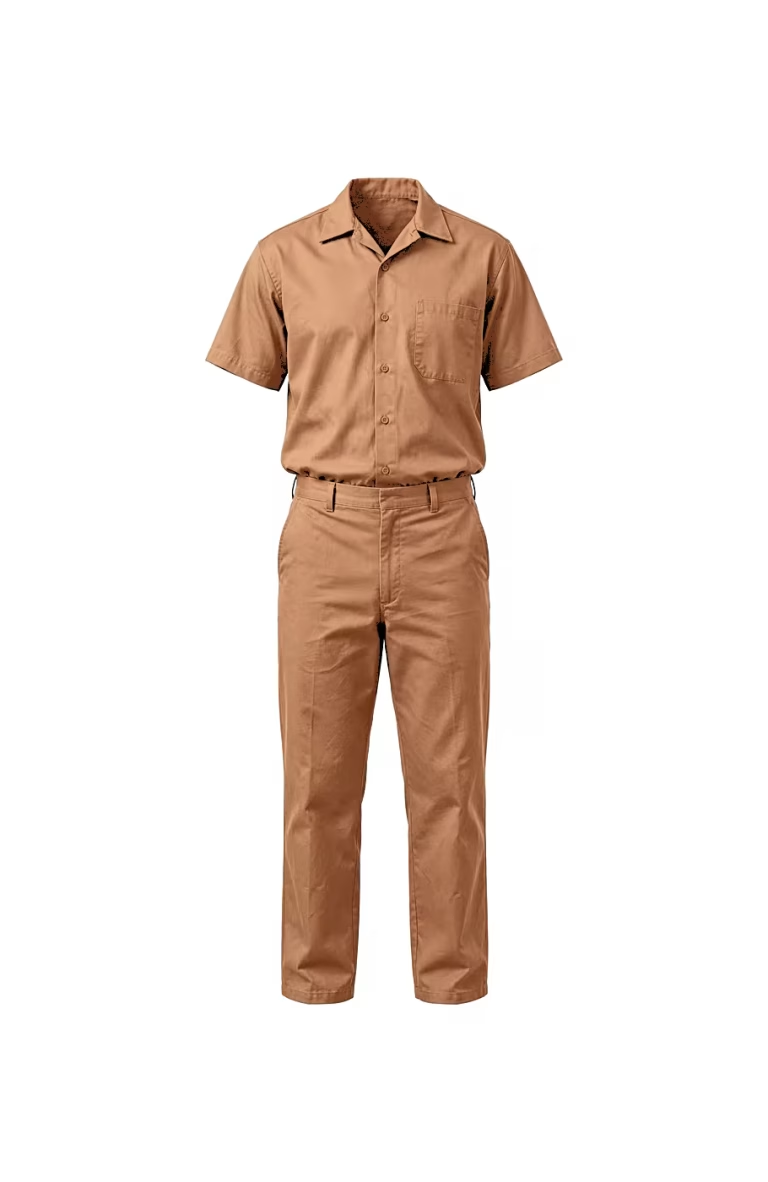
The tan set in our pictures shows the standard garment behind these programmes. It pairs a short sleeve button shirt with matching twill trousers. Moreover, the same file that cuts the first batch cuts every batch after it.
Seven Steps from Brief to Dressed Workforce
Step 1: The Brief Fixes the Wearer List
First, the brief names every team the programme must dress. Production staff, drivers, cleaners and supervisors each need different fits and quantities. The wearer list also fixes spare sets for new starters. A programme that skips this step guesses at sizes later.
- Teams and roles are listed by name.
- Size curves follow real wearer counts.
- Spares are planned for joiners and leavers.
Step 2: Twill Is Chosen for Site Work
Next, the twill weight is chosen for the working environment. Ajman summers are hot, so cloth must breathe while it resists abrasion. Cotton rich twill balances both demands well. For example, our standard set cloth keeps its shade through weekly industrial washing.
- Twill weights are matched to indoor and outdoor roles.
- Colourfastness is tested before bulk dyeing.
- Reinforced stitching covers pockets and stress points.
Step 3: The Sample Set Is Approved on Real Cloth
Then, a full sample set is sewn on the actual production twill. Buyers check the shirt fit, the trouser rise and the pocket layout. Changes are written into the pattern file at this stage. Consequently, bulk cutting never starts from an unapproved sample.
- Samples are sewn on production cloth, not substitutes.
- Fit comments are answered point by point.
- The approved set stays as the bulk reference.
Step 4: Bulk Cutting Follows the File
Meanwhile, bulk cloth is spread and cut against the approved markers. Shirt and trouser pieces for one set stay in the same shade band. Each bundle carries its size, colour and site code. This discipline keeps warehouse issue simple months later.
- Cutting follows the approved pattern file only.
- Set pieces share one dye lot per bundle.
- Every bundle is labelled by size and site.
Step 5: Sewing Holds the Uniform Details
Later, sewing teams build the details that make a uniform practical. The chest pocket is sized for a phone and a pen. Trousers carry belt loops and two back pockets. Similarly, bar tacks reinforce every point that daily work pulls at.
- Pockets are sized for real site tools.
- Stress points are bar tacked as standard.
- Buttons are sewn for laundry survival.
Step 6: Inspection Checks Every Set
Before packing, inspectors check measurements, shade and stitching against the approved set. Faulty pieces are repaired or rejected at this stage. Sets are then counted against the wearer list. Overall, nothing leaves the line on trust alone.
- Measurements are checked garment by garment.
- Shade is compared with the retained master swatch.
- Counts are reconciled with the wearer list.
Step 7: Packing Is Done by Wearer
Finally, cartons are packed by wearer, site and size. A warehouse team can issue a full set without opening other cartons. Each carton carries a packing list in the buyer's own format. Therefore, new starters are dressed on their first day, not their first month.
- Cartons follow the wearer and site split.
- Packing lists mirror the buyer's own format.
- Spare sets travel in clearly marked cartons.
The Tan Uniform Set in Our Pictures
Our gallery shows one set from four sides, and each view answers a different buyer question. The front view shows the button shirt, its chest pocket and the matching trousers. The back view shows a clean yoke and two trouser back pockets. Furthermore, the close views show the twill and the label exactly as a wearer meets them.
- Front: tan short sleeve shirt and trousers in matching twill.
- Back: plain shirt back with yoke, trousers with back pockets.
- Fabric: tan cotton rich twill with a fine diagonal weave.
- Label: woven YOUR BRAND label inside the tan twill shirt.
The fabric close-up shows the diagonal twill weave that gives the set its strength. The label close-up shows your own brand position inside the collar area. In short, what you approve in pictures is what the bulk order repeats.
Uniform Manufacturer in Bangladesh for Industrial Buyers
Industrial buyers need a maker who plans around production, not around seasons. As a Uniform Manufacturer in Bangladesh, we hold patterns and cloth records for every Ajman programme on file. When a site expands, extra sets start from records, not from a new sample round. That speed matters when a new contract starts at short notice.
- Programmes restart quickly when sites expand.
- Pattern and cloth files stay open year round.
- Labels and trims follow your issue standards.
- Unit prices hold steady across repeat issues.
Many Ajman factory managers tell us the same story about earlier supply. Sizes drifted, shades wandered and records vanished between orders. Our file based system answers each of those failures directly.
Cloth, Colour and Laundry Testing
Uniform cloth works harder than fashion cloth. It faces sun, dust, machine oil and weekly washing. We therefore test twill for colourfastness, shrinkage and abrasion before approval. Buyers receive the test results with the sample, not after the bulk order. Honest numbers make honest programmes.
- Colourfastness results travel with every sample.
- Shrinkage stays inside the promised size tolerance.
- Abrasion tests guide cloth choice for heavy roles.
- Spare cloth is held for repairs and additions.
Ajman wholesale buyers often ask whether lighter cloth survives site work. The answer depends on the role, and we say so plainly. Office teams can wear lighter twill, while workshop teams need the heavier grade.
Uniform Sets Supplier in Bangladesh for Saudi Arabia Companies
Saudi companies often run the same uniform identity across several Gulf sites. As a Uniform Sets Supplier in Bangladesh for Saudi Arabia Companies, we align shades and size curves across those sites from one file. A worker moving between sites keeps the same fit and shade. Consistency like that protects a brand quietly.
- One file serves several sites in two countries.
- Shade standards are shared across every delivery.
- Size curves reflect each site's real workforce.
- Deliveries are split and labelled by destination.
Programmes for Ajman suppliers frequently grow into regional programmes over time. Starting with clean records makes that growth simple. Therefore, we build every first order as if a fifth order will follow.
Sizing a Whole Workforce Honestly
Workforce sizing fails when it copies a retail size chart. Real teams include every body shape, and uniforms must fit all of them with dignity. We grade patterns from actual wearer measurements supplied by the buyer. Trial sets confirm the curve before bulk cutting begins.
- Grading follows real wearer measurements.
- Trial sets test the curve on actual staff.
- Longer and shorter trouser lengths are offered.
- Size exchanges are planned into spare quantities.
Ajman manufacturers of food, furniture and building materials all size differently. Their workforces differ, so their curves differ too. Our files keep each curve separate and accurate.
Uniform Exporter in Bangladesh for Oman Importers
Omani importers serve industrial buyers who reorder on contract cycles. As a Uniform Exporter in Bangladesh for Oman Importers, we pack and document sets for smooth clearance and fast onward delivery. Contract renewals then repeat without new sampling. Records carry the programme across years.
- Export documents are prepared before vessels sail.
- Cartons are labelled for onward regional distribution.
- Renewal orders run from the open programme file.
- Lead times are quoted against contract dates.
Several Ajman OEM buyers ask us to hold buffer sets against urgent joiners. We hold finished spares only by agreement, packed and listed separately. That honesty keeps stock figures clean for both sides.
Compliance, Audits and Open Lines
Uniform buyers carry duties for worker safety and honest sourcing. We support those duties with tested cloth and open paperwork. Our production is audited under WRAP principles, and buyers may review reports before ordering. Test results and audit summaries travel with the programme file.
- Fibre and trim declarations are supplied per style.
- Colourfastness and shrinkage reports stay on file.
- Needle and metal detection run before packing.
- Audit visits are welcomed by appointment.
Every programme here runs at our facilities under one management system. Buyers speak with the team that cuts and sews their sets. However, one named contact still answers every question, so nothing is lost between departments.
Freight, Lead Times and the Gulf Calendar
Gulf delivery planning must respect heat, holidays and port rhythms. We plan production backwards from the issue date the buyer gives us. Sea freight suits planned programmes, while air freight covers urgent starter sets. Both routes are quoted with the order itself. Buyers see the full landed picture early.
- Production calendars run backwards from issue dates.
- Sea and air options are quoted together.
- Ramadan and holiday periods are planned around openly.
- Documents are prepared before the vessel sails.
Ajman supplier networks often consolidate our cartons with other cargo. Our packing lists follow that consolidation plan exactly. Consequently, clearing and warehousing stay simple at the other end.
What a Uniform Programme File Contains
Every programme leaves our office with a complete file. The file holds patterns, cloth specs and approved shade swatches. It also holds wearer lists, size curves and packing instructions. A buyer can audit any delivery against this file at any time.
- Patterns and graded size charts for every garment.
- Cloth weight, composition and dye lot records.
- Wearer lists with site and role splits.
- Inspection reports and final measurement tables.
These records explain why Ajman factory orders repeat so accurately with us. A set delivered in year three matches the set from year one. Records, not memory, guarantee that match.
The file also travels with the buyer, not only with us. A copy goes to your warehouse team before the first delivery lands. Your storekeepers can then check cartons against the same lists we packed from. When a size runs short, the file shows exactly which pattern and cloth lot a top-up needs. Meanwhile, Ajman factory audits use the same file during their own internal checks. Nothing needs translating between our records and yours. In addition, every change is dated, so both sides can see when a size curve or shade standard last moved, and who approved the change.
How Ajman Programmes Grow with a Business
Most programmes start small and widen steadily. A single workshop orders first, then sister sites join the same file. Ajman manufacturers in food, furniture and metalwork all follow this pattern. Ajman supplier networks then carry the identity into new locations. Ajman wholesale buyers ask us to hold the shade standard centrally. Ajman factory orders grow from fifty sets to five hundred without new sampling. Each stage uses the same records, the same cloth and the same grading.
- Programmes widen site by site from one file.
- Shade standards stay central as volumes grow.
- New sites inherit proven size curves.
- Growth never forces a new sample round.
Growth also changes the buying route over time. Ajman OEM buyers sometimes begin with plain sets, then add embroidery later. Ajman exporter groups consolidate several sites into single shipments. Ajman manufacturers with seasonal peaks order buffer sets ahead of summer. Ajman supplier contracts renew faster when records are complete. Ajman wholesale groups audit those records before every renewal. Ajman factory managers rely on them when staff numbers change suddenly. In addition, Ajman manufacturers opening second sites reuse the first site's file entirely. Overall, growth stays calm because nothing depends on memory.
Questions Ajman Buyers Ask Us
Buyers usually ask about minimums first. Minimums depend on cloth and colour count, and we quote them per programme. They also ask whether trousers and shirts can ship in different ratios. Indeed, set ratios follow the wearer list, not a fixed pack.
- Can shirts and trousers run in different ratios? Yes.
- Can one programme cover three sites? Yes, from one file.
- Can we add a logo embroidery? Yes, positions are sampled first.
- Can urgent starter sets fly ahead? Yes, by agreement.
Some Ajman wholesale groups ask about holding spare cloth for repairs. We hold agreed cloth quantities and record them in the file. Others ask about ladies' cuts, which our grading already covers. Finally, buyers ask who answers when a delivery question arises mid contract. One named contact answers, with the full programme file open in front of them.
Looking for a Uniform Manufacturers in Ajman?
Talk to us through our contact page with your wearer list and target date. We reply with costings, cloth options and a sampling date. The FAQ page also answers common questions about orders and delivery. Your first sample set is sewn on real cloth, so the decision rests on the garment itself.
- Send a wearer list, a tech pack or a current uniform.
- Receive costings with cloth and construction options.
- Approve a sample set on the actual production twill.
- Confirm the issue plan and delivery window.
Ajman manufacturers and service firms alike renew these programmes year after year. Bring us the workforce, and we will build the file that dresses it. In short, the wearer list decides, and our facilities deliver to it. Besides, our team answers costing questions within one working day. Meanwhile, Ajman factory teams often send a worn set for exact matching. We measure it, grade it and return a sample for approval. Ajman supplier deliveries then follow the agreed calendar without chasing. Later, Ajman wholesale accounts review the file with us each season. Therefore, a programme improves quietly year after year, while the uniform itself stays reassuringly the same for the people who wear it daily.