
Woven Shirt Manufacturing
Top Shirt Manufacturers in Bangladesh
Looking for a Top Shirt Manufacturers in Bangladesh programme where every collar sits the same? We weave, cut and sew Oxford shirts to order at our facilities in Bangladesh, with button down collars, chest pockets and a back pleat that keeps the shirt hanging cleanly. Buyers in the USA, UK, Germany, Canada and Australia approve a sample on the real cloth before bulk cutting begins. Moreover, every programme is planned backwards from your selling season. Your label sits inside every shirt, and no other name appears on the cloth.
- Made to order in your colours and size curves, with nothing held as ready stock.
- Button down collar, chest pocket and back pleat kept true to pattern.
- Your woven label inside every shirt, with no other name shown.
- Samples approved on the actual Oxford cloth before bulk cutting begins.
- Collar, cuff and placket checks on every production batch.
- Production planned at our Bangladesh facilities around your season.
- Packed folded, bagged and labelled for direct store delivery.
Simply The Best
PORTFOLIOS












Product Details
Top Shirt Manufacturers in Bangladesh
What Separates a Good Shirt from a Great One
A shirt shows its quality at the collar first. The points must sit flat, the buttons must align, and the placket must hang straight. The Top Shirt Manufacturers in Bangladesh earn that name through hundreds of small disciplines. Every discipline is checked, recorded and repeated on each order.
- Collar points are matched pair by pair.
- Buttons are sewn to survive years of fastening.
- Measurements are checked shirt by shirt, not by batch.
- Pressing finishes the garment, never rescues it.
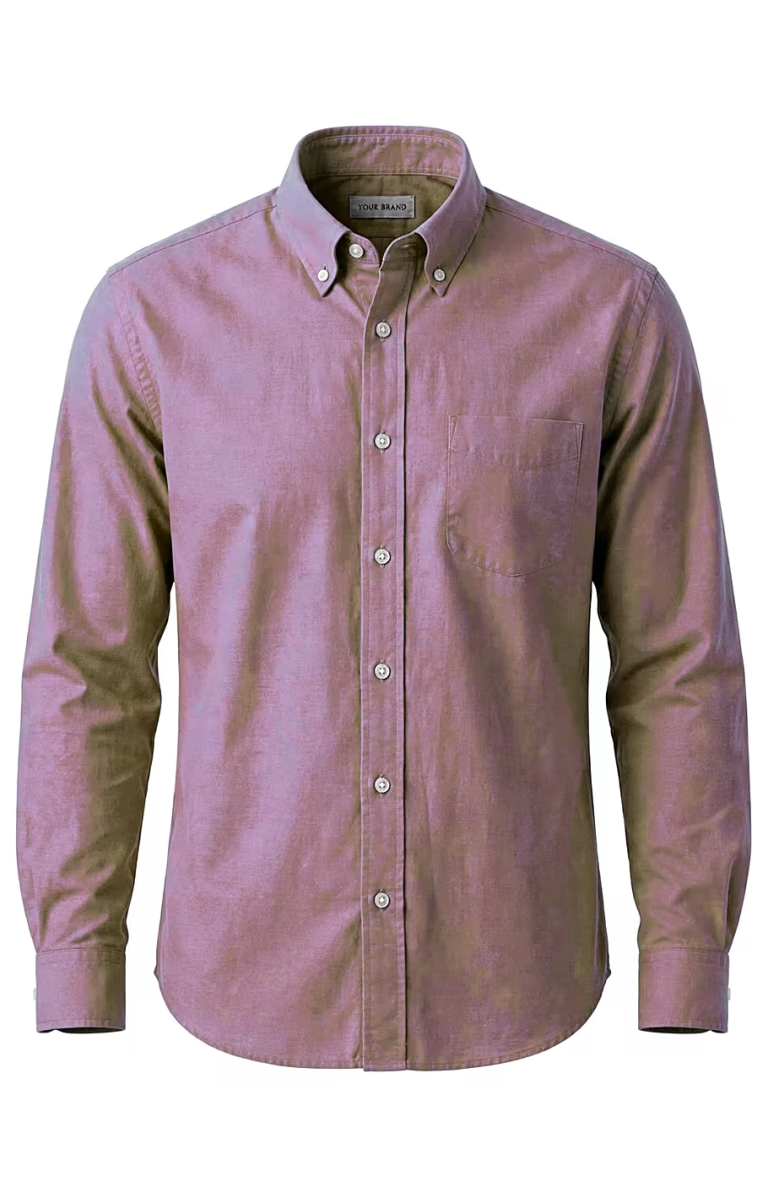
The dusty mauve Oxford in our pictures shows the standard behind these claims. It carries a button down collar, a chest pocket and a pleated back. Moreover, the same file that sews the first batch sews every batch after it.
Eight Steps from Cloth Roll to Pressed Shirt
Step 1: The Brief Fixes Fit and Details
First, the brief names the fit block, the collar style and every detail. Menswear buyers usually plan regular and slim fits in one range. The brief also fixes button type, pocket shape and cuff style. A clear brief stops arguments at the sewing line.
- Fit blocks are named before sampling starts.
- Collar and cuff styles are fixed in writing.
- Button and thread colours are specified early.
Step 2: Oxford Cloth Is Checked Roll by Roll
Next, the Oxford cloth is inspected roll by roll under daylight lamps. Weavers' flaws hide easily in a casual glance. Each roll is graded, and faulty sections are marked before cutting. For example, our standard check rejects any roll with visible slubs across the front panels.
- Rolls are inspected on a light table.
- Shade bands are compared across rolls.
- Faulty sections are marked and excluded.
Step 3: Patterns Are Graded to the Size Curve
Then, the pattern is graded across the buyer's size curve. A shirt factory earns trust when a size small and a size extra large share one fit logic. Collars grow in proportion, never by guesswork. Consequently, the range feels consistent on every body.
- Grading follows the buyer's own curve.
- Collar sizes grow in true proportion.
- Every size is sampled, not only the middle one.
Step 4: The Sample Is Approved on Real Cloth
After that, a full sample is sewn on the actual production cloth. Buyers check the collar roll, the button spacing and the back pleat by hand. A shirt manufacturer never cuts bulk from an unapproved sample. Instead, the approved sample becomes the standard for the whole order.
- Samples are sewn on production cloth.
- Collar roll is checked on a stand.
- The approved sample stays on file.
Step 5: Cutting Protects the Front Panels
Meanwhile, cutting gives the front panels the cleanest cloth in every lay. Checks and stripes are matched where the design carries them. A shirt supplier team knows the front is where customers judge quality. So the best cloth always faces forward.
- Front panels take the cleanest sections.
- Patterns are matched at pockets and plackets.
- Bundles stay separated by shade lot.
Step 6: Sewing Holds Collar and Cuff Standards
Next, sewing teams build the collar as a separate, inspected unit. Cuffs are folded and stitched with even margins on both sides. A shirt exporter line compares each garment with the sample as it leaves the machine. In addition, buttonholes are tested before buttons are attached.
- Collars are assembled and checked separately.
- Stitch density is set per operation.
- Buttonholes are cut cleanly and tested.
Step 7: Buttons, Pressing and Final Measurement
Later, buttons are sewn with thread that matches the cloth tone. Each shirt is measured against the size chart at five points. Then pressing shapes the collar and cuffs without shining the cloth. As a result, the shirt reaches the bag looking as it should.
- Buttons are pull tested on samples per batch.
- Five measurement points are checked per shirt.
- Pressing uses cloth safe temperatures.
Step 8: Packing Follows the Store Split
Finally, shirts are folded, bagged and boxed by size and colour. Cartons follow the store split in the brief. A shirt wholesale order leaves with a packing list that matches every carton. Warehouse teams can therefore check intake quickly and confidently.
- Shirts are folded to retail presentation standard.
- Cartons follow the agreed store split.
- Packing lists match carton contents exactly.
The Dusty Mauve Oxford in Our Pictures
The shirt in our gallery is a dusty mauve long sleeve Oxford with a button down collar. The front view shows the chest pocket, the even button spacing and the curved hem. The back view shows the yoke, the centre pleat and the locker loop. Meanwhile, the close views show the woven cloth and the neck label.
- Front: button down collar with chest pocket.
- Back: yoke, centre pleat and locker loop.
- Cloth: cotton Oxford weave with a soft hand feel.
- Label: YOUR BRAND woven label with size mark.
This garment is shown exactly as a buyer would sample it. Your own colours, labels and size curves replace ours on your programme. In short, the pictures show construction quality, not a fixed design.
Collar, Cuff and Placket Discipline
Most shirt faults live in three places. Collars twist when the interlining shrinks differently from the cloth. Cuffs pucker when stitch tension varies along the seam. Plackets wander when buttonholes are marked by eye. A careful shirt factory engineers all three faults out of the process.
- Interlinings are matched to the cloth weight.
- Stitch tension is set and checked per machine.
- Buttonhole positions follow a template, not eyes.
- Collar points are compared as a pair.
Besides, discipline must survive staff changes and busy weeks. Written settings travel with the style file. New operators learn the standard from the file, not from habit. That is how standards hold across a whole season.
Shirt Manufacturer in Bangladesh for Menswear Brands
Menswear brands need a Shirt Manufacturer in Bangladesh that protects fit across every repeat. We hold the approved pattern, the cloth standard and the trim list for each running style. Therefore, a repeat order starts from proven settings. Nothing is re-guessed when a range returns.
- Patterns and standards are held per style.
- Repeat orders reuse the approved file.
- New colours are lab dipped before sampling.
Brands also receive honest lead times at quotation stage. A shirt manufacturer that promises impossible dates helps nobody. Instead, we plan backwards from the selling window and say so plainly.
Fit Curves and Measurement Control
Fit is a promise a brand makes to its customers. European, North American and workwear curves grade differently at the shoulder and waist. We cut to the curve in the file, then measure sewn garments against it. As a result, a size medium feels like a medium in every market.
- Chest, waist and sleeve are measured per size.
- Tolerances are written into the programme file.
- Out of tolerance garments are pulled and corrected.
- Measurement reports are shared with the buyer.
Similarly, shrinkage allowances are built into the pattern before cutting. Washed sample measurements confirm the allowance is right. Then bulk garments land on size after the customer washes them at home.
Shirt Supplier in Bangladesh for Spain Retailers
Spanish retailers favour clean Oxford bodies in soft seasonal colours. A Shirt Supplier in Bangladesh for Spain Retailers programme therefore plans colour stories early and ships before the season turns. Retail calendars punish late cartons quickly. Accordingly, production slots are booked around the drop dates.
- Seasonal colour stories are planned at brief stage.
- Delivery dates lead the production plan.
- Cartons are split by region and store group.
Retail buyers also ask for mid season top-ups on winning colours. We keep the file open so a strong colour can return quickly. In this way, a best seller never waits for a whole new programme.
Shirt Exporter in Bangladesh for Netherlands Importers
Dutch importers buy shirts in structured, repeatable programmes. A Shirt Exporter in Bangladesh for Netherlands Importers file fixes the cloth, the trims and the packing format once. Then every repeat follows the same standard. Documentation travels with each shipment, complete and consistent.
- One file fixes cloth, trims and packing.
- Repeat orders follow the same standard.
- Shipment documents are prepared per order.
Importers also value straight reporting when something changes. If a cloth lot shifts shade, we say so before cutting. Silence costs more than honesty in a long trading relationship.
How Shirt Programmes Build Across Seasons
A good shirt range rarely changes its core fits. Instead, it refreshes colours and adds one or two new details each year. A shirt OEM file makes that rhythm easy to hold. The fit blocks stay stable while the palette moves.
- Core fits stay live across several seasons.
- Colour refreshes need only new lab dips.
- Fit blocks remain stable season after season.
- Weak colours retire without disturbing the range.
This rhythm protects the buyer as well. Testing costs fall because the cloth standard is already proven. Meanwhile, our lines keep the sewing order they already know well. Stock risk also falls, because proven styles justify their volumes with real sales history.
Testing, Compliance and Open Paperwork
Every cloth lot is tested for shrinkage, colourfastness and tear strength before cutting. Results are recorded against the cloth lot number. Our trade body membership sits with the BGMEA, and buyers may request certified cloth where their market requires it. Such requests are planned at brief stage, not added later.
- Cloth tests are recorded lot by lot.
- Wash tests follow the care label instructions.
- Metal detection covers every finished garment.
- Test reports are shared with the buyer on request.
Our facilities work to written safety and quality procedures. Audits are welcomed as part of a serious programme. In practice, open paperwork builds more trust than any promise. Needle policy and carton checks run on every order, not only on audited ones.
Pressing and Presentation Standards
A shirt is judged twice: once on the rail and once on the body. Pressing shapes that first judgement. Collars are pressed on forms so both points curve identically. Sleeves are creased cleanly, and bodies are smoothed without shine.
- Collar forms keep both points identical.
- Steam levels are set per cloth weight.
- Fold lines follow the retail presentation plan.
- Pins and clips follow the buyer's packing rules.
Presentation also protects the garment in transit. Boards and tissue keep the collar standing through weeks in a carton. When the box opens abroad, the range looks freshly prepared. Retail staff can move it straight to the rail.
Overall, these finishing minutes cost little and return much. A tired looking garment sells slowly at any price. A crisp one earns its place in the range. That simple truth guides the last table in our sewing hall.
Freight, Lead Times and the Selling Season
Shirts travel well, but timing still rules the programme. Sea freight suits full seasonal ranges with fixed drop dates. Air freight suits small top-up runs only. A shirt exporter team quotes both routes honestly at brief stage.
- Sea freight leads full seasonal programmes.
- Lead times are counted from sample approval.
- Drop dates are confirmed before cutting starts.
- Documents match the cartons exactly.
Above all, the selling season sets the calendar. We would rather decline an impossible date than miss it quietly. That honesty is why buyers return season after season. Finally, smooth warehouse intake abroad is part of the product, even though it never appears in a photograph.
What a Shirt Programme File Contains
Each programme sits in one open file that our teams and the buyer share. The file holds the approved sample record and the cloth standard. It also holds trims, labels and packing instructions. Nothing important lives in a private notebook.
- Approved sample photographs and measurements.
- Cloth weight, shade and finish standards.
- Button, thread and label specifications.
- Size curve and carton split instructions.
- Wash and test results for each cloth lot.
When staff change on either side, the file keeps the programme stable. A programme should never depend on one person's memory. The file is the memory.
Buyers receive a copy of the file summary with every order confirmation. Changes are logged with dates and initials on both sides. Nothing is agreed in corridors or forgotten in inboxes. That written discipline is dull, and it is exactly why programmes survive for years.
Questions Menswear Buyers Ask Us
Can you match our existing shirt colour?
Yes. Send a physical swatch or a pantone reference with the brief. We lab dip the shade on the actual Oxford base. Approval happens on cloth, never on a screen image.
Do you sample every size in the curve?
Yes. Fit risk hides at the ends of the curve, not in the middle. We sample the smallest and largest sizes alongside the base size. Buyers approve the full curve before cutting.
Can the shirt carry our own label?
Yes. Your woven label replaces the sample label in our pictures. Care labels and size marks follow your market rules. Everything is confirmed on the approval sample.
How do you keep collar quality consistent?
Collars are built as separate units with matched interlinings. Each unit is checked before it meets the body. Points are compared as a pair under daylight lamps.
What happens when a colour sells out early?
First, we check the held cloth position for that shade. Then a top-up run is scheduled against the open file. Because the standard is already approved, the repeat moves faster than a new programme.
How early should a seasonal programme start?
Start sampling well before the selling season opens. Cloth approval, sampling and bulk sewing each need clear time. Earlier briefs get calmer production and better dates.
Looking for a Top Shirt Manufacturers in Bangladesh?
Send us your brief, your fit curve and your drop date. We will reply with cloth options, a sampling plan and an honest production calendar. Start through our contact page or read the answers on our FAQ page first. Your next shirt range can begin with one clear conversation.
- Briefs are answered with cloth options, not forms alone.
- Samples follow the approved cloth standard.
- Production dates are confirmed in writing.