
Denim Jeans Manufacturing
Top 10 Denim Factory in Bangladesh
Looking for a Top 10 Denim Factory in Bangladesh programme where the tenth pair matches the first? We cut, sew and wash jeans to order at our facilities in Bangladesh, and we check every style at ten quality points before it leaves the floor. Buyers in the USA, UK, Germany, Canada and Australia approve a sample on the real denim before bulk cutting begins. Moreover, every programme is planned backwards from your selling season. Your label sits inside every pair, and no other name appears on the garment.
- Made to order in your washes and size curves, with nothing held as ready stock.
- Ten quality checks from cloth intake to final pressing.
- Your woven label and waistband patch on every pair.
- Samples approved on the actual denim before bulk cutting begins.
- Wash shades matched against your approved standard under daylight.
- Production planned at our Bangladesh facilities around your season.
- Packed by wash, size and store split for fast warehouse intake.
Simply The Best
PORTFOLIOS












Product Details
Top 10 Denim Factory in Bangladesh
What Makes a Denim Factory Worth Your Programme
Jeans look simple until a wash goes wrong across ten thousand pairs. Shade drift, twisted legs and shrinking waists all begin as small unchecked details. A Top 10 Denim Factory in Bangladesh programme survives because ten quality checks guard every stage. Each check is recorded, signed and repeated on every order.
- Cloth is inspected before it is ever cut.
- Shades are matched under daylight, not guesswork.
- Washes are controlled batch by batch.
- Measurements are audited on finished garments.
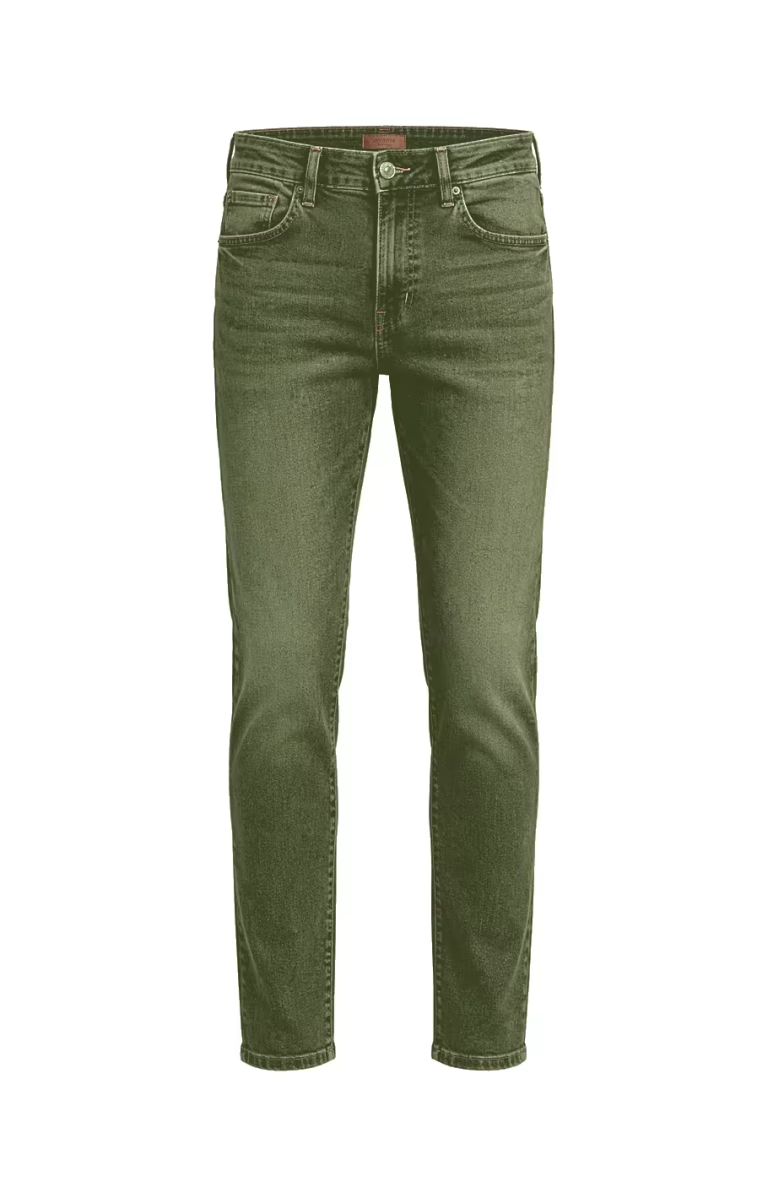
The olive jeans in our pictures show the standard garment behind these checks. They are a garment dyed five pocket style with a slim straight leg. Moreover, the same file that sews the first batch sews every batch after it.
10 Quality Checks from Cloth Intake to Final Pressing
Check 1: Cloth Intake Inspection
First, every denim roll is inspected on a light table before storage. Weaving flaws, shade bands and damaged selvedges are marked and graded. A factory that skips this check pays for it at cutting. Only approved rolls enter the programme file.
- Rolls are graded one by one.
- Faulty sections are marked and excluded.
Check 2: Shade Standard Approval
Next, the shade standard is approved against the buyer's physical reference. Denim changes character after washing, so approval happens on washed cloth. The programme holds that washed standard for every later batch. Consequently, the tenth order matches the first under daylight.
- Standards are approved after washing.
- Daylight lamps govern every comparison.
Check 3: Pattern and Shrinkage Allowance
Then, patterns carry the shrinkage allowance the cloth demands. Denim shrinks differently along warp and weft, and the pattern must know both numbers. A denim manufacturer tests the allowance on a washed sample before grading. As a result, finished sizes land where the label promises.
- Warp and weft shrinkage are measured separately.
- Allowances are proven on washed samples.
Check 4: Sample Approval on Real Denim
After that, a full sample is sewn and washed on the actual production denim. Buyers check the fit, the wash character and the stitching by hand. A serious programme never cuts bulk from an unwashed sample. Instead, the approved sample becomes the standard for the whole order.
- Samples are washed before approval.
- Fit is checked across the size curve.
Check 5: Cutting Accuracy
Meanwhile, cutting follows the marker plan with grain lines held true. Twisted legs begin here, when panels drift off grain. A denim factory check at this stage measures panels against the pattern. Therefore, legs hang straight when the jeans are worn.
- Grain lines are checked on every lay.
- Panels are measured against the pattern.
Check 6: Sewing and Stitch Quality
Next, sewing teams build the five pocket body in a fixed order. Stitch density is set per operation, from chain stitch hems to bartack reinforcement. A denim exporter line compares each garment with the sample as it leaves the machine. In addition, pocket placement is measured, never eyeballed.
- Stitch density is set per operation.
- Bartacks reinforce every stress point.
Check 7: Wash Control
Later, washing follows the approved recipe minute by minute. Water ratios, temperatures and timing decide the final shade as much as dye does. The wash team washes a pilot batch first and compares it with the standard. Only then does the full batch enter the machines.
- Pilot batches precede every full wash.
- Recipes are recorded per style and shade.
Check 8: Measurement Audit
After washing, finished jeans are measured at waist, hip, thigh and inseam. Auditors pull garments from across the batch, not only from the top carton. A denim manufacturer acts on drift immediately, while correction is still possible. The audit results join the programme file.
- Measurements follow the buyer's chart.
- Samples are pulled from across the batch.
Check 9: Metal Detection and Safety
Then, every finished pair passes through metal detection. Broken needles and stray fragments have no place in a garment. A denim OEM line also checks buttons, rivets and zips for secure attachment. Children's styles receive extra pull testing where buyers require it.
- Every pair passes the detector.
- Trims are pull tested per batch.
Check 10: Final Pressing and Packing Audit
Finally, pressing shapes the jeans without shining the cloth. Packers audit cartons against the packing list before sealing. The order leaves only when the audit matches completely. As a result, warehouse teams abroad can trust every carton count.
- Pressing uses denim safe temperatures.
- Cartons are audited before sealing.
The Olive Jeans in Our Pictures
The jeans in our gallery are an olive garment dyed style with a slim straight leg. The front view shows the five pocket body, the button fly area and the clean hem. The back view shows the patch pockets, the yoke and the blank waistband patch. Meanwhile, the close views show the olive twill cloth and the woven waist label.
- Front: five pockets with metal button and rivets.
- Back: patch pockets with a blank waistband patch.
- Cloth: olive denim twill, garment dyed.
- Label: YOUR BRAND woven label with waist size.
This garment is shown exactly as a buyer would sample it. Your own washes, labels and size curves replace ours on your programme. In short, the pictures show construction quality, not a fixed design.
Washes, Shades and Daylight Matching
Washing is where denim programmes are won or lost. The same cloth can leave the wash house as five different products. Stone washing, enzyme washing and garment dyeing each demand their own controls. A careful denim factory treats the wash recipe as part of the pattern.
- Every wash has a written, timed recipe.
- Shades are compared under daylight lamps.
- Hand feel is checked alongside colour.
- Wash standards are held for repeat orders.
Besides, shade continuity across a season needs dye lot discipline. We record which cloth lots fed which wash batches. Later batches can then be matched honestly, even months apart. Such records turn shade arguments into short conversations.
Hand feel deserves the same discipline as colour. Two batches can match in shade and still feel different on the leg. Softness comes from the wash recipe and the finishing that follows it. We check both against the approved standard, because customers notice stiffness long before they can name it.
Denim Manufacturer in Bangladesh for Jeans Brands
Jeans brands need a Denim Manufacturer in Bangladesh that protects fit across every repeat. We hold the approved pattern, the wash standard and the trim list for each running style. Therefore, a repeat order starts from proven settings. Nothing is re-guessed when a range returns.
- Patterns and wash standards are held per style.
- Repeat orders reuse the approved file.
- New washes are piloted before sampling.
Brands also receive honest lead times at quotation stage. A denim manufacturer that promises impossible dates helps nobody. Instead, we plan backwards from the selling window and say so plainly.
Denim Supplier in Bangladesh for Spain Retailers
Spanish retailers favour garment dyed colours alongside classic indigo. A Denim Supplier in Bangladesh for Spain Retailers programme therefore plans colour stories early and ships before the season turns. Retail calendars punish late cartons quickly. Accordingly, production slots are booked around the drop dates.
- Colour stories are planned at brief stage.
- Delivery dates lead the production plan.
- Cartons are split by region and store group.
Retail buyers also ask for mid season top-ups on winning washes. We keep the file open so a strong wash can return quickly. In this way, a best seller never waits for a whole new programme.
Denim Exporter in Bangladesh for Japan Brands
Japanese brands buy denim with famously exact standards. A Denim Exporter in Bangladesh for Japan Brands file fixes the cloth, the stitch specification and the packing format once. Then every repeat follows the same standard. Documentation travels with each shipment, complete and consistent.
- Stitch specifications are written per operation.
- Repeat orders follow the same standard.
- Shipment documents are prepared per order.
Precision buyers also value straight reporting when something changes. If a cloth lot shifts shade, we say so before cutting. Silence costs more than honesty in a long trading relationship.
How Denim Programmes Build Across Seasons
A good jeans range rarely changes its core fits. Instead, it refreshes washes and adds one or two new colours each year. A denim OEM file makes that rhythm easy to hold. The fit blocks stay stable while the surface moves.
- Core fits stay live across several seasons.
- Wash refreshes need only new pilot batches.
- Fit blocks remain stable season after season.
- Weak washes retire without disturbing the range.
This rhythm protects the buyer as well. Testing costs fall because the cloth standard is already proven. Meanwhile, our lines keep the sewing order they already know well. Stock risk also falls, because proven fits justify their volumes with real sales history.
Testing, Compliance and Open Paperwork
Every cloth lot is tested for shrinkage, colourfastness and tear strength before cutting. Results are recorded against the cloth lot number. Buyers can follow our social compliance work through amfori where their own customers require it. Such requests are planned at brief stage, not added later.
- Cloth tests are recorded lot by lot.
- Wash tests follow the care label instructions.
- Metal detection covers every finished pair.
- Test reports are shared with the buyer on request.
Our facilities work to written safety and quality procedures. Audits are welcomed as part of a serious programme. In practice, open paperwork builds more trust than any promise. Needle policy and carton checks run on every order, not only on audited ones.
Fit Blocks from Skinny to Straight
Fit decides whether a wash ever gets its chance. A beautiful shade on the wrong block still returns to the warehouse. We therefore grade every block across the full size curve before sampling. Skinny, slim, straight and relaxed bodies each carry their own pattern logic.
- Thigh and knee grades follow the block, not habit.
- Rise heights are checked seated and standing.
- Hem widths match the intended footwear story.
- Stretch styles are measured after recovery rest.
Stretch denim adds one more discipline. Cloth with elastane keeps growing if it is measured too early. Finished pairs rest before the audit so measurements settle honestly. That patience prevents the classic complaint of jeans that fit in the shop and sag by Friday.
Overall, fit discipline is invisible in photographs and obvious on bodies. Buyers who wear test their own samples rarely face fit surprises later. We encourage that habit and record the feedback inside the programme file.
Freight, Lead Times and the Selling Season
Denim is heavy, so freight planning matters early. Sea freight suits full seasonal programmes with fixed drop dates. Air freight suits small top-up runs only. Our team quotes both routes honestly at brief stage.
- Sea freight leads full seasonal programmes.
- Lead times are counted from sample approval.
- Drop dates are confirmed before cutting starts.
- Documents match the cartons exactly.
Above all, the selling season sets the calendar. We would rather decline an impossible date than miss it quietly. That honesty is why buyers return season after season. Finally, smooth warehouse intake abroad is part of the product, even though it never appears in a photograph.
What a Denim Programme File Contains
Each programme sits in one open file that our teams and the buyer share. The file holds the approved sample record and the wash standard. It also holds trims, labels and packing instructions. Nothing important lives in a private notebook.
- Approved sample photographs and measurements.
- Cloth, wash and shade standards.
- Button, rivet and label specifications.
- Size curve and carton split instructions.
- Wash and test results for each cloth lot.
When staff change on either side, the file keeps the programme stable. A programme should never depend on one person's memory. The file is the memory. Buyers receive a summary copy with every order confirmation, and changes are logged with dates on both sides.
New team members learn the programme from the file during their first week. That habit keeps standards steady through holidays, staff changes and busy seasons. Consistency is mostly a paperwork virtue before it becomes a product virtue.
Questions Jeans Buyers Ask Us
Can you match our existing wash exactly?
Yes, within the honest limits of a natural fibre product. Send the physical garment or a washed swatch with the brief. We pilot the wash on the actual cloth base and compare under daylight. Approval happens on cloth, never on a screen image.
Do you produce garment dyed colours like olive?
Yes. The jeans in our pictures carry an olive garment dye over a prepared base. Colour stories are lab dipped and garment dyed in pilot batches first. Only approved shades move into bulk.
Can the jeans carry our own label and patch?
Yes. Your woven label and waistband patch replace the samples in our pictures. Care labels and size marks follow your market rules. Everything is confirmed on the approval sample.
How do you stop legs from twisting?
Grain control starts at cutting and continues through sewing. Panels are checked against the pattern before they meet. Finished jeans are also inspected for leg twist during the measurement audit.
What happens when a wash sells out early?
First, we check the held cloth position for that style. Then a top-up run is scheduled against the open file. Because the wash standard is already approved, the repeat moves faster than a new programme.
How early should a seasonal programme start?
Start sampling well before the selling season opens. Cloth approval, wash piloting and bulk sewing each need clear time. Earlier briefs get calmer production and better dates.
Looking for a Top 10 Denim Factory in Bangladesh?
Send us your brief, your wash references and your drop date. We will reply with cloth options, a sampling plan and an honest production calendar. Start through our contact page or read the answers on our FAQ page first. Your next denim range can begin with one clear conversation.
- Briefs are answered with cloth options, not forms alone.
- Samples follow the approved wash standard.
- Production dates are confirmed in writing.