
Tees and Polos for the UAE
T-Shirts and Polo Shirts Supplier in Ajman Sharjah Dubai UAE
Looking for a T-Shirts and Polo Shirts Supplier in Ajman Sharjah Dubai UAE programme with honest origin? We knit, cut and sew t-shirts and polo shirts to order at our facilities in Bangladesh, and we supply Ajman, Sharjah and Dubai buyers from those facilities. Uniform, retail and trading buyers approve a sample on the real cloth before bulk cutting begins. Moreover, every programme is planned backwards from your selling season. Your label sits inside every shirt, and no other name appears on the garment.
- Our facilities are in Bangladesh, stated plainly from the first line.
- Burgundy pique polos and jersey tees on one programme file.
- Emirate packing splits made before loading.
- Your woven label inside every shirt, with no other name shown.
- Samples approved on the actual cloth before bulk cutting begins.
- Production planned at our Bangladesh facilities around your season.
- Packed by colour, size and channel for fast warehouse intake.
Simply The Best
PORTFOLIOS











Product Details
T-shirts and Polo Shirts supplier in Ajman, Sharjah, Dubai UAE
Two Shirts, One Gulf Programme
Buyers who search for T-Shirts and Polo Shirts Supplier in Ajman Sharjah Dubai UAE usually run uniform contracts, retail basics or trading ranges across the Emirates. We knit, cut and sew both bodies to order at our facilities in Bangladesh. First, the honesty point: our sewing lines sit in Bangladesh, not in the Emirates. Then the commercial point: UAE wholesale buyers compare landed cost, lead time and label quality, and Bangladesh wins that comparison on knitwear. Moreover, every claim on this page can be checked against a real sample before bulk begins.
- Burgundy pique polo as the proof garment.
- Jersey tees on the same programme file.
- Our facilities are in Bangladesh, stated plainly.
- Your label inside every shirt.
- Samples approved on the real cloth first.
- Cartons packed by emirate, store and channel.
Seven Steps from Brief to Packed Gulf Shirts
Every programme moves through the same seven steps, from the first brief to packed cartons. The steps keep collars, cloth and colours steady across thousands of shirts, batch after batch.
Step 1: The Brief Fixes Bodies and Colours
First, the brief names every body, collar style and colour in the range. Gulf buyers usually plan polos beside tees. In addition, the brief fixes sizes, label artwork and packing splits early. Clear briefs prevent slow sampling rounds later.
Step 2: Pique and Jersey Are Knitted to Weight
Second, the pique and the jersey are knitted and dyed to the approved weights. Buyers set cloth weight by climate and by price point. However, Gulf heat demands breathable cloth first. The weight is therefore proven on the sample, never on paper alone.
Step 3: Panels Are Cut to the Pattern
Next, panels are cut to the buyer pattern with collar and placket pieces marked true. Cutting follows the file, not the cutter's habit. In addition, each bundle is ticketed by size and colour. Ticketed bundles let any shirt be traced back to its cloth lot.
Step 4: The Sample Is Approved on Real Cloth
Then the sample is sewn and measured against the brief. Buyers check collar shape, placket buttons and body length on the garment itself. If a measurement drifts, the pattern is corrected before bulk. Finally, the approved sample becomes the reference for every later batch.
Step 5: Bulk Cutting Follows the File
Bulk cutting follows the approved file exactly. The same marker, the same cloth lot plan and the same size ratios apply. Moreover, cut panels rest before sewing so the knit relaxes. Relaxed panels keep the finished length honest after washing.
Step 6: Sewing Holds Collars and Plackets True
Sewing sets the knitted collar, the three button placket and the side seams in sequence. Uneven collar stitching shows at once, so operators check every neck. In addition, finished shirts are measured flat on the table. Flat measuring catches drift before packing does.
Step 7: Packing Splits by Emirate and Store
Finally, packing splits cartons by emirate, store group and channel. Ajman, Sharjah and Dubai drops are labelled separately where the buyer asks. Also, each carton carries sizes and colours on its face. Warehouse teams in the Emirates then book goods in without resorting.
The Burgundy Polo in Our Pictures
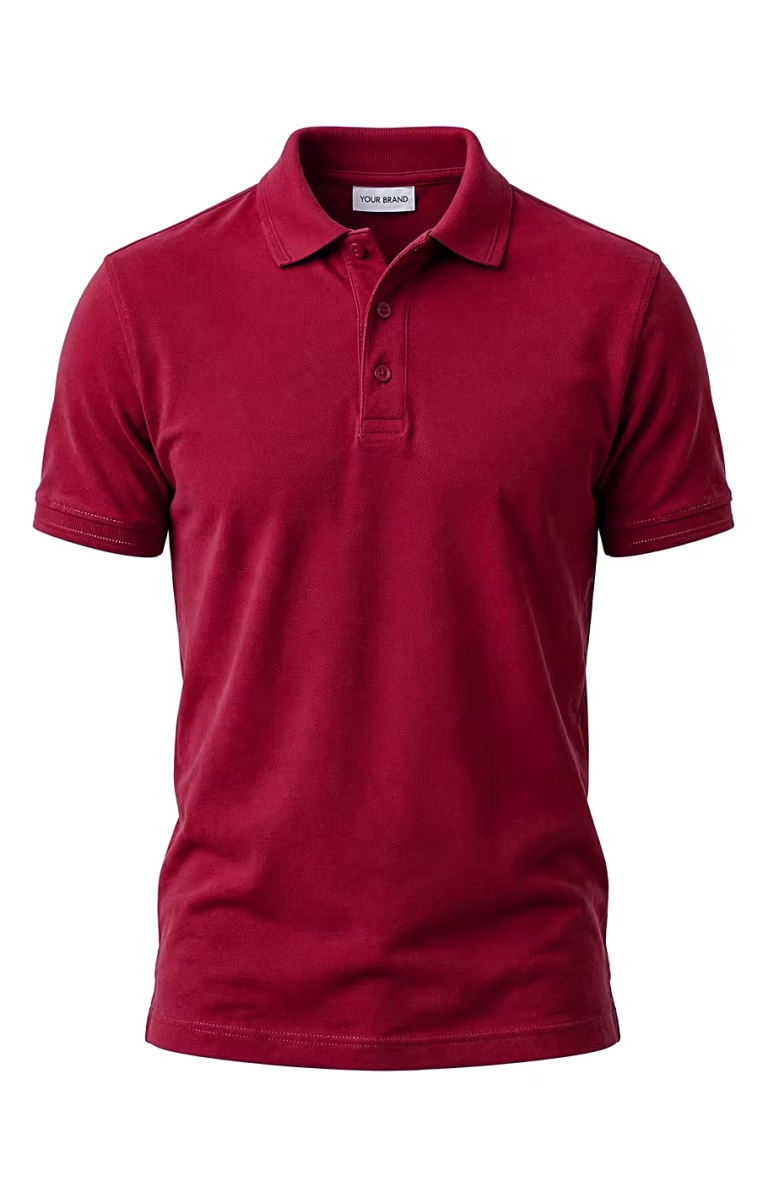
The pictures show the standard polo body honestly, in burgundy cotton pique. The front view shows the knitted collar and the three button placket. The back view shows a plain back panel with the collar band behind. In addition, one frame shows the pique texture up close, and one shows the woven label against the cloth. Your range uses your colours and label on the same body file.
- Burgundy cotton pique, knitted collar.
- Three button placket, plain back panel.
- Pique texture shown in a close frame.
- YOUR BRAND woven label at the neck.
- Tees run beside the polo on one file.
How a T-Shirt Manufacturer in Bangladesh Serves Gulf Buyers
Distance is the first question Gulf buyers ask, and it deserves a straight answer. Sea freight from Chattogram reaches Jebel Ali on a regular schedule. Therefore, programmes are planned backwards from the vessel, not forwards from the sewing line. UAE suppliers who sew nothing still quote shorter dates on paper. However, paper dates do not load vessels. Our file names the vessel week before bulk cutting starts.
- Sailing weeks named before cutting.
- Programmes planned backwards from the vessel.
- Documents prepared while sewing runs.
- One file for tees and polos together.
T-Shirt and Polo Supplier in Bangladesh for Saudi Brands
Saudi brands often buy beside their Emirates ranges, on the same colour card. The programme file therefore holds Gulf sizing and labelling together. In addition, Arabic care text can be added where a buyer supplies approved wording. UAE exporter desks have long served Saudi demand through Dubai. Our route is simpler: one Bangladesh file feeds both markets, with cartons split by country at packing.
- Shared colour cards across Gulf markets.
- Country splits made at packing.
- Care text added from buyer artwork.
- One sampling round for both markets.
Uniform Programmes for Emirates Workforces
Uniform buyers need the same polo in the same shade, year after year. Shade continuity is a dye lot discipline, not a promise. First, the approved shade is archived with its dye recipe. Then every new lot is matched back to that archive. UAE factory prices for local sewing are rarely quoted because the sewing base is thin. Bangladesh offers the depth uniform contracts need, at programme scale.
- Shade archive held for every colour.
- Dye lots matched back to the archive.
- Staff size curves graded once, then repeated.
- Spares and top ups run from the same file.
Polo Shirt Exporter in Bangladesh for Oman Wholesalers
Oman wholesalers buy through Gulf trade routes that already run on Bangladesh knitwear. The exporter paperwork therefore matters as much as the sewing. Certificates of origin, packing lists and carton marks are prepared with the goods. Moreover, UAE wholesale buyers and Omani buyers often share specifications. One export file can serve both, with final documents split by destination.
- Origin certificates prepared with the goods.
- Carton marks matched to the packing list.
- Shared specifications across Gulf buyers.
- Documents split by destination port.
What UAE Wholesale Buyers Compare
Experienced buyers compare more than a unit price. They compare cloth weight after washing, collar recovery and shade discipline. They also compare how a supplier behaves when a date slips. UAE suppliers with local showrooms still import most knitwear. Therefore, the honest comparison is between sewing countries, not between showrooms. Bangladesh answers that comparison with depth, cost and paperwork that clears.
- Cloth weight checked after washing.
- Collar recovery checked on the sample.
- Shade discipline checked across lots.
- Behaviour on dates checked before bulk.
Trading Houses, Re-Export and Honest Origin
Dubai is a trading hub, and re-export is a normal Gulf pattern. Goods sewn in Bangladesh move through Jebel Ali to East Africa and beyond. Nothing in that pattern changes where the sewing happened. UAE OEM programmes that pass through trading houses still carry Bangladesh origin on the documents. We state the origin plainly, because buyers who check deserve papers that match the goods.
- Origin stated plainly on every document.
- Re-export routes planned at booking.
- Carton marks kept neutral for traders.
- Labels carry the buyer's name only.
T-Shirt OEM Ranges Under Your Own Label
Your label sits inside every shirt, and no other name appears on the garment. The woven label is woven to your artwork, with size tabs where the range needs them. In addition, care labels carry the fibre content and washing marks your market requires. UAE manufacturer searches often end at trading desks with no labels of their own to offer. Our programme starts from your label and builds the range around it.
- Woven labels made to your artwork.
- Size tabs added where ranges need them.
- Care labels matched to your market.
- No other name on any garment.
Testing, Compliance and Open Paperwork
Gulf retail and uniform tenders ask for test evidence, not assurances. Cloth is tested for shade fastness, shrinkage and pilling against the buyer's standard. In addition, social compliance audits are welcomed under schemes such as amfori BSCI. Reports are shared openly with buyers. A supplier who hides paperwork is telling you something, and Gulf buyers know it.
- Shade fastness tested per dye lot.
- Shrinkage measured on finished garments.
- Audit reports shared on request.
- Test standards named in the file.
What a Programme File Contains
The file is the memory of the range. It holds the patterns, the cloth specification and the approved sample record. It also holds packing splits, label artwork and the shade archive. UAE factory offers that live in email threads cannot repeat a shade two years later. A held file can. Therefore, reorders start from proof, not from memory.
- Patterns and cloth specification.
- Approved sample record with dates.
- Packing splits and label artwork.
- Shade archive with dye recipes.
Reorders and Season Planning
Gulf retail runs on Ramadan, Eid and school season calendars. Programmes are therefore planned around those peaks first. First, the season calendar is fixed with the buyer. Then sampling and bulk are booked backwards from it. UAE wholesale buyers who plan two seasons ahead rarely face emergency freight. The file makes that planning easy, because every date sits in one place.
- Season calendars fixed with the buyer.
- Bulk booked backwards from peaks.
- Air freight kept as a true exception.
- Every date held in one file.
Colours That Work in Gulf Light
Strong sun changes how colours read on the rail. Deep shades like the burgundy in our pictures hold their depth in Gulf light. Pale shades need dye discipline to avoid a washed look. In addition, uniform buyers often pair a dark polo with a light tee. The colour card is therefore approved as a set, not colour by colour.
- Deep shades hold depth in strong sun.
- Pale shades matched with extra care.
- Colour cards approved as a set.
- Shade bands agreed before dyeing.
Care, Washing and Honest Labels
Care labels must survive real laundering, not just inspection. Commercial laundries wash hotter than homes do. Therefore, uniform cloth is tested at commercial temperatures before approval. The label then states what the cloth can honestly take. UAE suppliers who print generic care text leave buyers exposed. Our labels are written from test results, garment by garment.
- Uniform cloth tested at wash heat.
- Care text written from test results.
- Fibre content stated exactly.
- Washing symbols matched to the market.
Freight into Jebel Ali and Beyond
Most Gulf cartons enter through Jebel Ali, then move by road. Ajman and Sharjah drops usually clear through the same port. Therefore, packing splits are made in Bangladesh, before the container closes. UAE exporter desks charge again for resorting locally. Our cartons arrive store ready instead. Road legs to Oman and Saudi Arabia are booked from the same file.
- Emirate splits made before loading.
- Cartons arrive store ready.
- Road legs booked from the file.
- Port dates shared with the buyer.
Why Sewing Depth Sits in Bangladesh
The Emirates built trade, logistics and finance into a regional hub. Knitwear sewing at programme scale grew elsewhere, and Bangladesh grew deepest. That division is a strength for buyers, not a weakness. UAE OEM programmes gain Bangladesh sewing depth with Gulf trading speed. Moreover, the buyer deals with one file and one accountable maker. The goods simply travel a well sailed route.
- Trade strength in the Emirates.
- Sewing depth in Bangladesh.
- One file, one accountable maker.
- Well sailed freight routes.
Reading UAE Supplier Offers with Care
Gulf buyers receive many offers, and they are not all built alike. Some UAE suppliers quote from stock they hold; others trade goods they have never seen sewn. A UAE exporter who cannot name the sewing country is selling a mystery. Therefore, ask every offer the same questions: where is it sewn, what cloth, whose label, which vessel. UAE wholesale terms that survive those questions are the ones worth comparing.
- Sewing country named on the offer.
- Cloth weight stated, not implied.
- Label programme described in writing.
- Vessel week given before bulk.
Ajman, Sharjah and Dubai: Three Drops, One File
Each emirate buys a little differently. Ajman uniform buyers favour durable polos on long contracts. Sharjah traders move mixed basics at pace. Dubai retail groups demand sharper packing and faster documents. UAE wholesale buyers in all three still share one need: a maker who repeats shades exactly. UAE suppliers serving Sharjah from local stock cannot promise that. A Bangladesh file can, because the shade archive travels with every reorder.
- Ajman: uniform depth and durability.
- Sharjah: mixed basics at pace.
- Dubai: sharp packing, fast documents.
- One shade archive behind all three.
UAE OEM buyers who consolidate the three emirates into one programme save sampling rounds. UAE factory claims should always be checked against that simple test: one file, three drops, identical shades. Where a UAE manufacturer listing cannot show the file, the offer is trading, not making. Our programme shows the file on request.
UAE suppliers who sew nothing can still serve a buyer well as traders, and many do. The fault is never trading itself; the fault is hiding it. UAE exporter desks in the chain do their part openly. UAE wholesale buyers deserve the same openness from the sewing end, and that is what this page practises.
Questions Gulf Buyers Ask Us
Do you manufacture in the UAE?
No. Our facilities are in Bangladesh, and every shirt is sewn there. We supply Ajman, Sharjah and Dubai buyers from Bangladesh. The origin is stated plainly on the documents and the cartons.
Why do UAE buyers source knitwear from Bangladesh?
Bangladesh holds deep knitwear sewing capacity and skilled polo labour. UAE wholesale buyers therefore gain cost depth that local sewing cannot match. Freight into Jebel Ali is frequent and reliable. The landed result beats local making on most knit programmes.
Can polos and tees ship in one container?
Yes, both bodies run on one programme file. Cartons are split by body, colour and store before loading. In addition, the packing list separates the bodies clearly. Warehouses then book each body in without sorting.
Is the pictured polo the exact garment we would receive?
The pictures show the standard polo body honestly, in burgundy pique. Your range uses your colours, sizes and label on the same body file. Moreover, your sample is approved before bulk, so nothing rests on a photograph.
How are uniform shades kept steady across years?
The approved shade and its dye recipe sit in the file archive. Every new lot is matched back to that archive before cutting. If a lot drifts, it is corrected at dyeing, not at delivery. Finally, the archive travels with every reorder.
Looking for a T-Shirts and Polo Shirts Supplier in Ajman Sharjah Dubai UAE?
If honest origin and Gulf ready packing sound right for your range, we should talk. Send your bodies, colours and target dates through our contact page, and we will reply with a sampling plan. Meanwhile, the FAQ page answers common questions on sampling, labels and freight. Overall, UAE suppliers come and go, but a held programme file keeps your shades, sizes and labels steady season after season.
- Honest Bangladesh origin, stated plainly.
- Samples approved on real cloth first.
- Your label inside every shirt.
- Records open at every step.