
T-Shirt Pricing Explained
T-Shirt Wholesale Price in Bangladesh
Looking for a T-Shirt Wholesale Price in Bangladesh breakdown that shows its working? We knit, cut and sew t-shirts to order at our facilities in Bangladesh, and every quote is built from your brief, line by line. Buyers in the USA, UK, Germany, Canada and Australia approve a sample on the real jersey before bulk cutting begins. Moreover, every programme is planned backwards from your selling season. Your label sits inside every shirt, and no other name appears on the garment.
- Every quote built from your own specification.
- Cloth, making, trims and packing named separately.
- No invented figures on the page or in the quote.
- Your woven label inside every shirt, with no other name shown.
- Samples approved on the actual jersey before bulk cutting begins.
- Production planned at our Bangladesh facilities around your season.
- Packed by colour, size and store split for fast warehouse intake.
Simply The Best
PORTFOLIOS












Product Details
T-shirt Wholesale Price in Bangladesh
A Wholesale Price Is a Sum, Not a Slogan
Buyers who search for T-Shirt Wholesale Price in Bangladesh usually want to know what a fair quote is built from. We knit, cut and sew t-shirts to order at our facilities in Bangladesh, and every quote is built from your brief, line by line. First, a warning that protects buyers: any page that prints one fixed price for every tee is guessing. Cloth, yield and trims change the number, so the honest answer is a structure. Moreover, every programme is planned backwards from your selling season.
- Every quote built from your own specification.
- Cloth, making, trims and packing named separately.
- No invented figures on the page or in the quote.
- Your woven label inside every shirt, with no other name shown.
- Samples approved on the actual jersey before bulk cutting begins.
- Cartons packed by colour, size and channel.
Seven Steps from Brief to a Priced Programme
Every programme moves through the same seven steps, from the first brief to packed cartons. The quote grows out of these steps, so a buyer can see exactly where the money sits.
Step 1: The Brief Fixes the Specification
First, the brief names the body, cloth weight, colours and size curve. Each choice moves the price a manufacturer can honestly quote. In addition, the brief fixes trims, labels and packing early. A complete brief earns a complete quote, with no allowances hidden inside.
Step 2: Cloth Is Costed by Yield
Second, the jersey is costed by yield, not by guesswork. Yield means the cloth one shirt truly consumes, including cutting waste. However, two shirts of equal weight can yield very differently. The marker plan therefore sits behind every cloth line in the quote.
Step 3: Making Is Costed by Operation
Next, the making charge is built operation by operation. Collar setting, shoulder taping and hemming each carry minutes. In addition, checked operations like flat measuring are costed openly. Buyers can then see why a careful shirt costs more than a rushed one.
Step 4: The Sample Proves the Specification
Then the sample is sewn and measured against the brief. The sample confirms the cloth weight and the yield in practice. If the yield drifts, the quote is corrected before bulk, not after. Finally, the approved sample becomes the reference for the whole run.
Step 5: Trims and Labels Are Costed as Named
Trims are small lines that decide big impressions. Woven labels, size tabs, threads and polybags are named one by one. Moreover, buyers can upgrade or simplify each line and watch the price change. Nothing hides inside a single lump sum.
Step 6: Testing and Packing Enter the Quote
Testing and packing are real costs, and honest quotes show them. Shade fastness tests, carton strength and store splits all take labour. In addition, mixed cartons cost more minutes than plain ones. The quote says so plainly, line by line.
Step 7: Freight Terms Are Stated Before Signing
Finally, the freight basis is stated before anyone signs. Prices that wholesale buyers compare must share the same basis, or the comparison fails. FOB and landed quotes are therefore labelled clearly. Surprises at the port are a quoting failure, not a shipping one.
The Olive Green Tee in Our Pictures
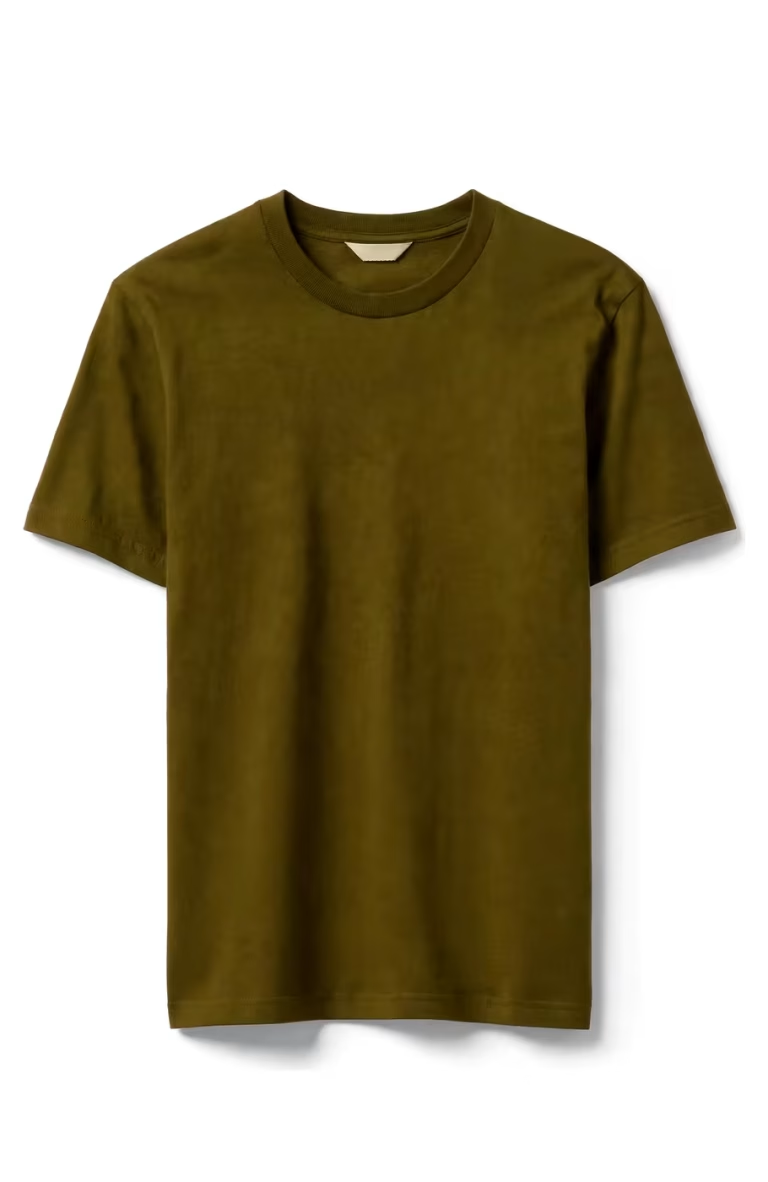
The pictures show the standard crew body honestly, in olive green cotton single jersey with a ribbed collar. The front view shows the clean, plain body. The back view shows a plain back panel. In addition, one frame shows the jersey knit up close, and one shows the woven label inside the collar. Your range uses your colours and label on the same body file.
- Olive green cotton single jersey.
- Ribbed crew collar, plain back panel.
- Knit texture shown in a close frame.
- YOUR BRAND woven label inside the collar.
- The body behind a thousand honest quotes.
Reading Two Quotes Side by Side
Two quotes for the same tee can differ for honest reasons. One may carry heavier cloth, taped shoulders and tested shades. The other may skip all three. The lower number is not automatically the better buy. Therefore, compare the specification lines before comparing the totals. The price an exporter confirms should name the same cloth, the same trims and the same tests as its rival.
- Compare cloth weights first.
- Compare trims line by line.
- Compare testing that is included.
- Compare freight basis last.
T-Shirt Manufacturer in Bangladesh for Netherlands Importers
Netherlands importers run lean, specification led buying. They ask for yield sheets and operation lists as a matter of routine. In addition, they expect the quote to survive questions. The price a supplier quotes our Dutch buyers is therefore built to be audited. Every line can be traced to a cloth lot, an operation or a carton.
- Yield sheets shared on request.
- Operation lists behind the making line.
- Quotes built to be audited.
- Lines traced to real inputs.
Run Length and the Honest Curve
Run length changes unit cost in ways buyers can verify. Shorter runs spread cutting and setup across fewer shirts. Longer runs spread them thin. However, the curve is smooth, not a cliff, and honest quotes show its shape. The price the factory sets for a repeat run also reflects the file already held. Repeats skip sampling, and the quote says so.
- Setup spread openly across the run.
- Repeat runs skip sampling costs.
- The curve shown, not hidden.
- File savings passed to the buyer.
T-Shirt Manufacturer in Bangladesh for Belgian Retailers
Belgian retailers buy smaller, more frequent programmes. Their quotes therefore carry more colour splits per carton. In addition, mixed size ratios differ by store group. The price a manufacturer quotes reflects that packing labour honestly. Retail buyers who see the packing line understand the total faster. Trust grows when small lines are explained before they are questioned.
- Colour splits costed openly.
- Store ratios held in the file.
- Packing labour shown as a line.
- Small lines explained early.
What Sits Outside a Fair Quote
Some costs never belong inside a unit price. Buyer travel, artwork design and local duties sit outside it. A quote that quietly absorbs them is padding somewhere else. Therefore, our quotes list exclusions beside inclusions. Prices wholesale buyers trust are the ones with visible edges. If a cost is not ours to carry, the quote says whose it is.
- Exclusions listed beside inclusions.
- Duties named as the buyer's cost.
- Artwork kept outside unit price.
- No padding hidden in cloth lines.
Currency, Validity and Plain Dealing
Quotes live in a moving currency world. Yarn and freight shift between seasons. Therefore, every quote carries a validity window, stated in writing. The price an OEM buyer accepts inside that window is held for the run. If the window lapses, the quote is rebuilt openly, line by line. Nobody learns about a change from an invoice.
- Validity windows stated in writing.
- Accepted prices held for the run.
- Rebuilds done openly, line by line.
- No surprises on invoices.
T-Shirt OEM Programmes Priced from Your Label
Your label sits inside every shirt, and no other name appears on the garment. Label weaving, size tabs and care printing are costed as named lines. In addition, buyers can choose woven or printed labels and see the difference. A price from a supplier should never bury your own branding inside a lump sum. Your label is your asset, priced like one.
- Labels costed as named lines.
- Woven and printed options compared.
- Care printing priced openly.
- Branding never buried in totals.
Testing, Compliance and Open Paperwork
Testing costs money, and skipping it costs more later. Cloth is tested for shade fastness, shrinkage and pilling against the buyer's standard. In addition, factory standards are maintained under schemes such as WRAP certification. Reports are shared openly with buyers. A quote that omits testing is not cheaper; it is unfinished.
- Shade fastness tested per dye lot.
- Shrinkage measured on garments.
- Test lines visible in the quote.
- Reports shared on request.
What a Programme File Contains
The file is the memory of the range and of its price. It holds the patterns, the cloth specification and the approved sample record. It also holds the quote build up, so a reorder reuses proven lines. Therefore, repeat quotes start from evidence, not from a fresh guess. Buyers can compare season against season, line by line.
- Patterns and cloth specification.
- Approved sample record with dates.
- Quote build up kept on file.
- Season comparisons made easy.
Reorders and Season Planning
Reorders are where honest pricing proves itself. The file already holds the specification and the yield. Therefore, a fresh run can be quoted quickly, from proof. First, the season calendar is fixed with the buyer. Then sampling is skipped where nothing changed. Prices that a factory quotes on repeats should fall where sampling fell away.
- Repeat quotes built from proof.
- Sampling skipped where nothing changed.
- Savings shown as their own line.
- Every date held in one file.
Colour, Cloth Weight and Cost
Deep shades and pale shades do not dye at the same cost. Heavy jersey and light jersey do not knit at the same cost either. Honest quotes show these differences instead of averaging them away. In addition, the shade card is approved as a set, so buyers see the spread before committing. Averages hide cross subsidies that somebody always pays.
- Dye costs shown by shade group.
- Cloth weights costed separately.
- Shade cards approved as a set.
- No hidden cross subsidies.
Care, Washing and Honest Labels
Care labels must match what the cloth can honestly take. The olive tee in our pictures is tested through repeated home washing before approval. Therefore, its label can promise ordinary machine washing with confidence. Fibre content is stated exactly, and washing symbols match the market. Care honesty protects the price story, because returns are the most expensive line of all.
- Cloth tested through washing.
- Care text written from results.
- Fibre content stated exactly.
- Returns treated as a real cost.
How Cloth Weight Moves the Price a Manufacturer Quotes
Cloth weight is the fastest honest lever on a tee quote. Heavier jersey consumes more yarn in every shirt. It also cuts and sews a little slower. Therefore, the price a manufacturer quotes rises with weight in a smooth, explainable way. Buyers who ask for the weight ladder see the whole picture at once. Prices that wholesale buyers compare should always state the weight beside the number.
- Weight stated beside every price.
- Yield recalculated per weight.
- Sewing minutes adjusted openly.
- The ladder shown, not hidden.
Light cloth is not cheap cloth by default. Fine yarns can cost more per kilo than coarse ones. The price an exporter confirms for a fine, light tee may therefore beat a heavier basic on logic, not on error. Honest quotes explain that instead of apologising for it.
Sample Costs, Setup and the Price an Exporter Confirms
Samples and setup are real work, and small runs feel them most. A sample round consumes cloth, labour and courier charges before one bulk shirt exists. The price a supplier quotes for a short run carries those costs across fewer units. That is arithmetic, not attitude. Buyers who see the setup line can choose to widen the run or simplify the range.
- Sampling costed as its own line.
- Setup spread across the run openly.
- Short runs explained, not penalised.
- Choices shown with their effects.
Repeat runs change the picture again. The pattern exists, the yield is proven and the sample is approved. Therefore, the price the factory sets on a repeat drops where the earlier work fell away. The drop appears as its own line, so buyers can verify it. Prices an OEM buyer negotiates on repeats should always start from that honest base.
When the Cheapest Price Costs More
The cheapest quote sometimes buys the most expensive season. Light cloth that pills, collars that sag and shades that drift all return as markdowns. The price a manufacturer quotes for tested cloth includes the cost of not failing. Buyers who total a season, not a shirt, see that clearly. A fair price is therefore the one whose lines survive washing, wearing and selling.
- Failure costs counted honestly.
- Tested cloth priced as tested.
- Season totals over unit totals.
- Lines that survive questions.
There is also a quieter test: ask what the price a supplier quotes leaves out. If testing is absent, the price is unfinished. If packing splits are absent, warehouse labour waits unpaid inside it. If the freight basis is absent, the landed comparison is fiction. Prices wholesale buyers trust answer all three questions before they are asked. The price an exporter confirms from our file answers them in writing, every time.
One more habit separates careful buyers: they keep the losing quotes. The price a factory quoted last season explains this season's lines better than any brochure. Prices that a manufacturer publishes against its own file history can be audited year after year. That audit trail is worth more than a small saving once.
Finally, judge the quote by its behaviour over time. The price a supplier holds steady across a repeat tells you the first build up was honest. Prices an exporter revises only where yarn or freight moved are prices with a memory. That memory lives in the file, and buyers can read it whenever they wish.
Questions Price Buyers Ask Us
Why do you not publish a standard price list?
Because no standard tee exists. Cloth weight, yield, trims and packing change every quote. A printed list would either overcharge simple tees or underprice careful ones. Instead, we build the price from your specification, line by line, and we show the working.
What moves a wholesale price most?
Cloth yield moves it first, then making minutes and run length. Shade group and packing splits move it next. Finally, freight basis changes the landed figure without changing the shirt. Each factor is named in the quote, so buyers can steer it.
Is the pictured tee the exact garment we would receive?
The pictures show the standard crew body honestly, in olive green single jersey. Your range uses your colours, sizes and label on the same body file. Moreover, your sample is approved before bulk, so the quoted specification is the sewn specification.
Can a quote be held while we plan the season?
Yes, inside its stated validity window. The window is written on the quote itself. If planning runs past it, the quote is rebuilt openly and the changed lines are flagged. Nobody is surprised by a silent change.
How are repeat prices handled?
Repeats start from the file: same specification, same yield, sampling removed. The saving appears as its own line. If yarn or freight moved, only those lines move. The rest of the build up stays exactly as proven.
Looking for a T-Shirt Wholesale Price in Bangladesh?
If a quote with visible working sounds right for your range, we should talk. Send your specification, colours and target dates through our contact page, and we will reply with a sampling plan and a structured quote. Meanwhile, the FAQ page answers common questions on sampling, labels and freight. Overall, the price a manufacturer earns trust with is the one whose lines all survive questions.
- Quotes built line by line.
- Samples approved on real jersey first.
- Your label inside every shirt.
- Records open at every step.
- The price a manufacturer quotes, in writing.
- Prices wholesale buyers can audit.
- The price an exporter confirms before signing.
- Prices the factory holds on repeats.