
T-Shirt Manufacturing in Bangladesh
T-Shirt Manufacturer in Bangladesh
Looking for a T-Shirt Manufacturer in Bangladesh programme built on one honest core tee? We knit, cut and sew crew neck t-shirts to order at our facilities in Bangladesh, in cotton single jersey with ribbed collars that recover after washing. Buyers in the USA, UK, Germany, Canada and Australia approve a sample on the real jersey before bulk cutting begins. Moreover, every programme is planned backwards from your selling season. Your label sits inside every shirt, and no other name appears on the garment.
- Made to order in your colours and size runs, with nothing held as ready stock.
- Ribbed crew collar that recovers after washing.
- Smooth cotton jersey surface that takes print evenly.
- Your woven label inside every shirt, with no other name shown.
- Samples approved on the actual jersey before bulk cutting begins.
- Production planned at our Bangladesh facilities around your season.
- Packed by colour, size and store split for fast warehouse intake.
Simply The Best
PORTFOLIOS












Product Details
T-Shirt Manufacturer in Bangladesh
The Core Tee Behind Every Range
Almost every knit range starts with one honest crew neck tee. Buyers who choose a T-Shirt Manufacturer in Bangladesh are really choosing a file, a cloth library and a repeat discipline. First, we fix the body, the collar and the colour card for the whole programme. Then every later decision hangs on that approved standard. Moreover, the same file that sews the first batch sews every batch after it.
- Crew neck with a ribbed collar that recovers.
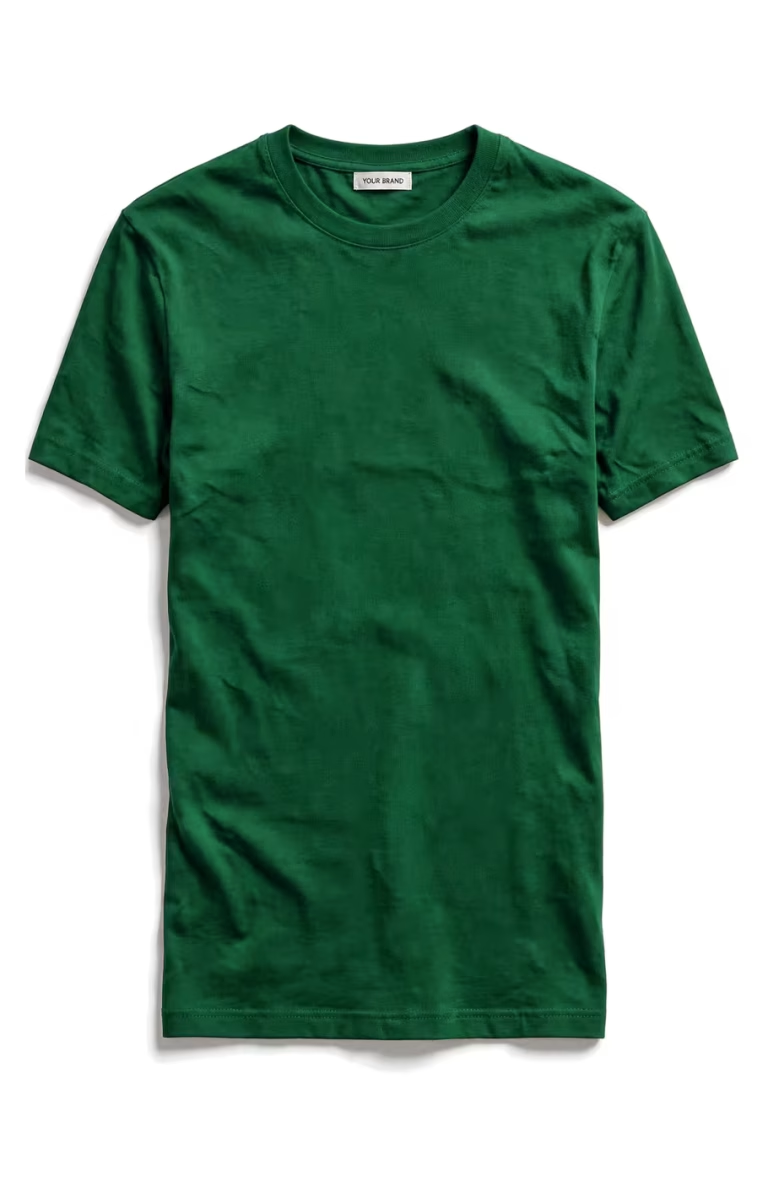
- Bottle green jersey with a smooth, even face.
- Shirt wholesale runs planned by size ratio.
- Your label inside every shirt.
- Samples approved on the real jersey first.
Seven Steps from Yarn to Packed T-Shirts
Every programme moves through the same seven steps, from yarn choice to packed cartons. The steps keep the body steady across thousands of shirts, batch after batch.
Step 1: The Brief Fixes Bodies and Colours
First, the brief names every body, colour and size ratio in the range. Retail buyers usually plan tees beside polos, fleece and shorts. In addition, the brief fixes collar style and label artwork early. Clear briefs prevent slow sampling rounds later.
Step 2: Single Jersey Is Knitted to Weight
Second, the cotton jersey is knitted and dyed to the approved weight. Buyers set the cloth weight by market and by price point. However, each lot is checked before it enters cutting. The results travel with the sample.
Step 3: Ribs and Collars Are Prepared to Match
Next, collar ribs are knitted and dyed in matched lots. The collar must match the body exactly and recover after washing. Consequently, the bottle green in our pictures reads as one colour everywhere. The collar plan then stays inside the file.
Step 4: The Sample Is Approved on Real Jersey
Then the sample is sewn from the actual production jersey. Buyers check fit, collar recovery and seam finish on the real garment. For example, the bottle green tee in our pictures began exactly this way. Only approved samples move forward.
Step 5: Bulk Cutting Follows the File
Later, bulk cutting follows the locked pattern file lay by lay. Markers are planned to hold the size ratios the brief demands. Meanwhile, cut panels are bundled by size and colour. Nothing leaves the cutting table unrecorded.
Step 6: Sewing Holds the Body Square
During sewing, line checks compare shirts against the approved sample. Shoulder tape and collar tension decide whether the neck sits flat. If a collar waves, sewing stops until the tension is reset. Thus, the last shirt matches the first.
Step 7: Packing Follows the Store Split
Finally, packing follows the buyer split by colour, size and store group. Cartons are labelled for fast warehouse intake at the other end. In short, shirts for exporters arrive ready to shelve or hand out. Records stay available for the reorder.
The Bottle Green Tee in Our Pictures
The gallery shows the core body behind these programmes. It is a men crew neck t-shirt in bottle green cotton single jersey, shown from the front and the back. In addition, one picture shows the jersey itself in close-up. The last picture shows a YOUR BRAND label inside the neck. Most shirt supplier programmes begin with one proven body like this. Buyers also set body length and sleeve length per market on this same body.
- Bottle green tee with ribbed crew collar.
- Plain back panel for prints.
- Single jersey with a smooth print face.
- YOUR BRAND label woven for the buyer name.
- Set-in sleeves with clean hems.
The Collar Decides the Shirt
A crew neck tee is judged at the collar before anywhere else. The rib must stretch over the head, recover flat and survive the wash. We knit collar ribs from matched yarn and set them under measured tension. Meanwhile, shoulder tape keeps the neckline from growing across the day. A shirt factory that rushes the collar ships wavy necks by the thousand. Therefore, we treat the collar as the signature of the garment.
- Collar ribs knitted from matched yarn.
- Tension set per cloth weight.
- Shoulder tape inside every neck.
- Recovery tested after washing.
- Finished collars checked by hand.
- Necks built to recover, wash after wash.
T-Shirt Manufacturer in Bangladesh for Canadian Retailers
Canadian retailers sell core tees through every season of the year. We build the body for that life, with collar recovery and seam strength tested before cutting. Moreover, store, web and wholesale splits are packed separately inside one order. A shirt supplier who plans channels early saves the retailer weeks of sorting. Overall, the retailer briefs once and then only approves.
- Bodies built for year-round retail.
- Channel splits packed inside one order.
- Collar recovery tested before cutting.
- Reorders matched to the first run.
Size Runs for Retail, Teams and Workwear
One tee body often serves three channels at once. Retail needs the full curve, teams need player sizes and workwear needs hard-wearing core colours. We pack each channel split separately inside one order. In addition, size ratios can differ per channel without new patterns. Shirts wholesale buyers therefore receive cartons that are already sorted. Consequently, the buyer warehouse simply shelves them.
- Channel splits packed inside one order.
- Size ratios set per channel.
- No new patterns for ratio changes.
- Cartons labelled by destination.
Shirt Supplier in Bangladesh for Netherlands Importers
Importers in the Netherlands supply retailers, printers and workwear dealers from one range. We hold the tee body steady across the season so their customers can reorder with confidence. Moreover, colour stories repeat across tees, polos and fleece where the importer wants a set. Shirts for wholesale programmes carry the buyer label inside every unit. In short, the range arrives ready to break down into smaller orders.
- Bodies held steady across the season.
- Colour stories matched across garments.
- Buyer label inside every shirt.
- Cartons ready to break down.
Shirt Exporter in Bangladesh for Australian Labels
Australian labels often combine tee ranges with tanks and shorts in one shipment. We consolidate the programme with clear carton marking by style. In addition, paperwork is prepared in the format the label requests. Shirts for exporters travel with packing lists matched carton by carton. Thus, one order behaves like one order at the border and the warehouse.
- Styles consolidated per shipment.
- Packing lists matched to cartons.
- Paperwork in the requested format.
- Core colours repeated across seasons.
How Programmes Repeat Each Season
A programme should make the second season easier than the first. The locked file carries the pattern, jersey choice, collar plan and packing rules forward. Then buyers only approve what is new, such as one added colour. Most shirt manufacturers make reorders harder than they need to be. Finally, the season starts from proof, not from hope.
- Patterns and jersey choices carried forward.
- Only new colours need approval.
- Collar plan repeated exactly.
- Season two starts from the proven file.
Colour Stories for Core Ranges
Core ranges sell on colour as much as on fit. We build a colour card per programme and dye every lot against it. Moreover, collar ribs are dyed in the same lots as the body, so necks never drift from the chest. If a lot misses the card, it is held back rather than sewn. Shirts wholesale ranges live on this discipline during long runs. Finally, the approved card stays inside the programme file.
- Colour card built per programme.
- Collar ribs dyed with the body lots.
- Missed shades held back from sewing.
- Approved card locked in the file.
Printing, Embroidery and Blank Programmes
Many tees carry chest prints, small embroidery or nothing at all. The plain back and smooth chest take screen print cleanly when the body sits square. We test print adhesion on the actual jersey before bulk work begins. Moreover, print positions are fixed in the file, so every shirt matches. Buyers running blank programmes simply skip the print step. Consequently, one body serves printed and plain ranges alike.
- Print adhesion tested on real jersey.
- Positions fixed inside the file.
- Printed samples approved before bulk.
- Blank programmes use the same body.
Testing, Compliance and Open Paperwork
Every jersey lot is tested before it enters a programme. Shrinkage, colour fastness and seam strength are recorded and shared with the buyer. In addition, our business membership work follows the standards of amfori, the global business association for open and sustainable trade. A shirt factory that opens its paperwork has little to hide. Thus, every result stays inside the programme file.
- Shrinkage and fastness tested per lot.
- Seam strength checked on sewn shirts.
- Results shared before bulk cutting.
- Records kept inside the programme file.
Freight, Lead Times and the Selling Season
Lead times are planned backwards from the selling season, never guessed forwards. Cutting, sewing and packing dates are fixed once the sample is approved. Meanwhile, freight choices balance speed against cost for each market. If a delay risk appears, buyers hear about it early with options attached. In short, shirts for exporters leave on the calendar the buyer planned.
- Dates fixed once samples are approved.
- Sea and air freight weighed per order.
- Risks flagged early with options.
- Programmes planned around selling seasons.
What a Tee Programme File Contains
The programme file is the single source of truth for the range. It holds the pattern, size curve, jersey specification, collar plan and label artwork. Moreover, it holds the test records and the packing rules for every channel. Shirt suppliers who keep one file per buyer avoid the mixed instructions that cause errors. Consequently, any buyer question can be answered from the file.
- Pattern and graded size curve.
- Jersey weight, colours and test results.
- Collar plan and label artwork.
- Packing rules for every channel.
- Approval history with dates.
Care, Washing and Collar Long Life
Care labels must tell the truth about the cloth inside the garment. We print washing guidance that matches the tested behaviour of the jersey. For instance, collars keep their shape longer with cool washes, and the label says so plainly. Buyers also choose label language per market. Finally, honest care guidance keeps shirts wholesale ranges performing longer in the wash.
- Washing guidance matched to test results.
- Label language chosen per market.
- Fibre content stated exactly.
- Brand and care labels planned together.
Bulk Runs and Steady Line Time
Volume is where this body earns its keep. Long steady runs of shirts for wholesale buyers keep line time efficient and unit costs low. Moreover, the same body across many colours spreads the sampling cost thin. A shirt exporter programme can share one file across several markets at once. Finally, steady runs also steady the collars, because the line sews one proven body all day.
- Shirts for OEM buyers with buyer labels.
- Colours sharing one programme file.
- One proven body sewn across the run.
- Unit costs fall as runs lengthen.
- Quality steadies with line practice.
Grading and Honest Sizing
Fit decides whether a tee feels tailored or sloppy. We grade the body with the collar, so a large keeps the same clean line as a small. Moreover, chest and length are measured on finished garments, not only on the pattern. Buyers receive those measurements with the sample. If a size drifts, the pattern is corrected before bulk cutting begins. Finally, honest sizing notes sit inside the file, so reorders inherit them.
- Bodies graded with the collar.
- Sizes measured on finished garments.
- Measurements supplied with the sample.
- Drift corrected before bulk cutting.
- Sizing notes kept inside the file.
- Core bodies repeated across every season.
Summer Weight and Winter Layers
One tee body can work across the calendar. In summer it sells as a core garment on its own. In cooler months the same body layers under shirts, knits and jackets. We therefore keep the body clean, without heavy trims that fight outer layers. In addition, buyers can run a lighter jersey for summer and a firmer one for layering lines. Both weights share the same pattern file. Consequently, the range stretches across seasons without new sampling.
- Summer lines in lighter jersey.
- Layering lines in firmer jersey.
- Clean body under outer layers.
- One pattern file for both weights.
- No new sampling between seasons.
- One body across the whole calendar.
Questions T-Shirt Buyers Ask Us
Can we set our own size curve?
Yes, the size curve is set in the brief and graded with the pattern. The bottle green tee shows a classic retail curve. Moreover, longer or shorter bodies run on the same file structure. Market-specific curves sit inside the same file. Approval happens on a real sewn sample.
Can the shirt carry our own label?
Yes, every shirt carries the buyer label, as the YOUR BRAND picture shows. We weave labels to the buyer artwork, with size tabs where wanted. In addition, care labels follow in the market language. No other name appears on the garment.
Can the back carry a large print?
Yes, the plain back is a clean print panel. Print adhesion is tested on the actual jersey first. In addition, print positions are fixed in the file. Every printed shirt then matches the approved sample.
How do you stop collars waving at volume?
Collar tension is set per cloth weight and checked on finished garments. Lines stop when a collar drifts, and the tension is reset before sewing continues. However, the real answer is the locked file. The standard never changes mid-run.
What happens when a colour sells out early?
The file already holds the jersey specification and the colour card. Therefore, a fresh run of shirts for wholesale buyers can start from proof. Buyers approve only quantities and dates. The colour and fit repeat exactly.
Looking for a T-Shirt Manufacturer in Bangladesh?
If your range needs a core tee body you can build seasons on, we should talk. Send your bodies, colours and target dates through our contact page, and we will reply with a sampling plan. Meanwhile, the FAQ page answers common questions on sampling, labels and freight. Overall, a shirt manufacturer should make reorders simple, and that is how we run every programme.
- Core tees with collars that recover.
- Samples approved on real jersey first.
- Your label inside every shirt.
- Records open at every step.