
T-Shirt Supply for German Buyers
T-Shirt Manufacturer Germany
Looking for a T-Shirt Manufacturer Germany programme that answers the comparison honestly? We knit, cut and sew t-shirts to order at our facilities in Bangladesh, and this page compares the two countries plainly. Buyers in the USA, UK, Germany, Canada and Australia approve a sample on the real jersey before bulk cutting begins. Moreover, every programme is planned backwards from your selling season. Your label sits inside every shirt, and no other name appears on the garment.
- Our facilities are in Bangladesh, stated plainly from the first line.
- The comparison covers cloth, landed cost and freight.
- Germany wholesale buyers served from one Bangladesh file.
- Your woven label inside every shirt, with no other name shown.
- Samples approved on the actual jersey before bulk cutting begins.
- Production planned at our Bangladesh facilities around your season.
- Packed by colour, size and store split for fast warehouse intake.
Simply The Best
PORTFOLIOS












Product Details
T-Shirt Manufacturer Germany
The Comparison Behind the Search
Most buyers who search for a T-Shirt Manufacturer Germany programme are weighing home production against the Bangladesh route. We manufacture t-shirts in Bangladesh, and this page sets out that comparison honestly. First, Germany offers proximity and speed for small premium runs. Then Bangladesh answers with range, capacity and landed cost. Moreover, every claim here can be checked against a real sample.
- Our facilities are in Bangladesh, stated plainly.
- The comparison covers cloth, cost and freight.
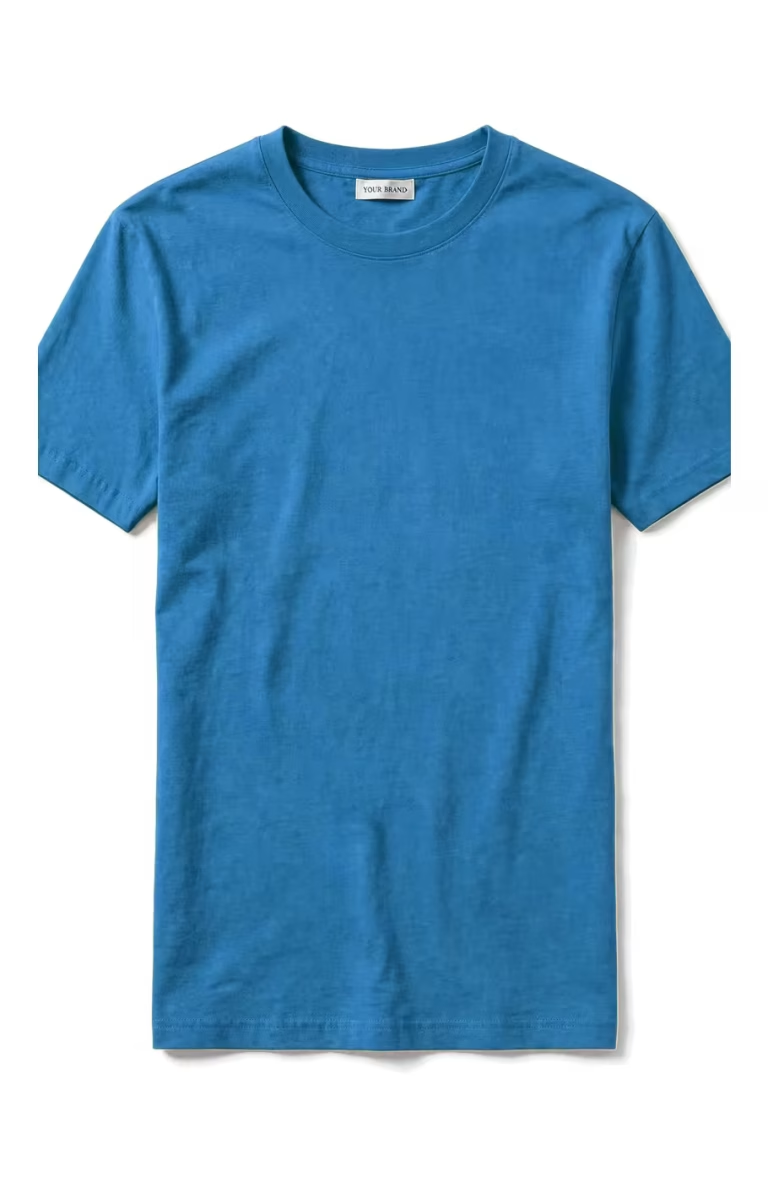
- Petrol blue crew neck tee as the proof garment.
- Your label inside every shirt.
- Samples approved on the real jersey first.
- German standards met on a Bangladesh file.
Seven Steps from Brief to Packed T-Shirts
Every programme moves through the same seven steps, from the first brief to packed cartons. The steps keep the body steady across thousands of shirts, batch after batch.
Step 1: The Brief Fixes Bodies and Colours
First, the brief names every body, colour and size ratio in the range. Retail buyers usually plan tees beside polos and fleece. In addition, the brief fixes collar style and label artwork early. Clear briefs prevent slow sampling rounds later.
Step 2: Single Jersey Is Knitted to Weight
Second, the cotton jersey is knitted and dyed to the approved weight. Buyers set the cloth weight by market and by price point. However, each lot is checked before it enters cutting. The results travel with the sample.
Step 3: Panels Are Cut to the Pattern
Next, panels are cut from the checked jersey lay by lay. The back yoke on our proof tee is cut as its own panel. Consequently, the petrol blue in our pictures reads as one colour everywhere. The cutting plan then stays inside the file.
Step 4: The Sample Is Approved on Real Jersey
Then the sample is sewn from the actual production jersey. Buyers check fit, collar recovery and seam finish on the real garment. For example, the petrol blue tee in our pictures began exactly this way. Only approved samples move forward.
Step 5: Bulk Cutting Follows the File
Later, bulk cutting follows the locked pattern file lay by lay. Markers are planned to hold the size ratios the brief demands. Meanwhile, cut panels are bundled by size and colour. Nothing leaves the cutting table unrecorded.
Step 6: Sewing Holds the Body Square
During sewing, line checks compare shirts against the approved sample. Collar tension decides whether the neck sits flat or waves. If a collar waves, sewing stops until the tension is reset. Thus, the last shirt matches the first.
Step 7: Packing Follows the Buyer Split
Finally, packing follows the buyer split by colour, size and store group. Cartons are labelled for fast warehouse intake at the other end. In short, cartons arrive ready to shelve or hand out. Records stay available for the reorder.
The Petrol Blue Tee in Our Pictures
The gallery shows the core body behind these programmes. It is a men crew neck t-shirt in petrol blue cotton single jersey, shown from the front and the back. In addition, one picture shows the jersey itself in close-up. The back carries a yoke seam across the shoulders, a small tailored detail. The last picture shows a YOUR BRAND label inside the ribbed crew collar.
- Petrol blue tee with ribbed crew collar.
- Back yoke seam across the shoulders.
- Single jersey with a smooth, even face.
- YOUR BRAND label woven for the buyer name.
- Plain front for prints or plain ranges.
What Germany Does Well, Stated Plainly
Honest comparisons start by crediting the other side. A Germany factory base reaches European buyers in days, and small premium runs suit that structure well. Germany supplier workshops also hold deep technical textile skill. However, core tee programmes at volume carry home production costs in every garment. Germany manufacturer searches usually end with buyers weighing exactly this trade. Therefore, we publish our side of the ledger in the same plain way.
- Proximity is Germany's real strength.
- Small premium runs suit home production.
- Technical textile skill runs deep.
- Volume core tees carry home costs.
- Quotes should be compared landed, not gated.
- Germany OEM work suits short runs best.
Landed Cost, Not Gate Price
A gate price is only the first line of the real cost. Freight, duty treatment and reorder speed decide what a programme truly costs per season. Germany wholesale buyers who import for resale run this maths on every range. We quote with freight options open, so the comparison stays honest. Germany exporter offers often look simple until the full route is priced. Consequently, buyers should compare landed cost per garment, season after season.
- Gate price is only the first line.
- Freight options quoted openly.
- Duty treatment checked per market.
- Reorder speed priced into the season.
- Landed cost compared per garment.
- Germany factory gate prices exclude the route.
German Buyer Standards, Met on a Bangladesh File
German buyers are famous for measurement discipline, and our programmes are built to satisfy it. Sizes are measured in centimetres on finished garments, and results are shared with the sample. Moreover, test records are kept in the format German retail auditors expect. A Germany supplier shortlist rarely offers that depth of repeat control at volume. Overall, the buyer briefs once and then only approves.
- Sizes measured on finished garments.
- Test results shared with the sample.
- Audit paperwork open to buyers.
- Core colours repeated across seasons.
- Size curves locked for reorders.
T-Shirt Supplier in Bangladesh for Netherlands Importers
Netherlands importers often run the same comparison as their German neighbours. We consolidate tee programmes with clear carton marking by style and store group. In addition, paperwork is prepared in the format the importer requests. Germany manufacturer quotes for very large runs tend to stretch lead times first. Thus, one order behaves like one order at the border and the warehouse.
- Styles consolidated per shipment.
- Packing lists matched to cartons.
- Paperwork in the requested format.
- Core colours repeated across seasons.
Programmes for Germany Wholesale Buyers
Wholesale buyers inside Germany also order from Bangladesh, and their programmes run like any other import range. Germany wholesale programmes usually centre on core tees in steady colours. We pack by store split and label cartons for Hamburg and Ruhr intake. In addition, German language care labels are printed as standard for this market. Germany OEM buyers who run private label ranges get their own woven labels inside every shirt. Thus, the border changes nothing about the discipline.
- Core tees in steady colours.
- Store splits packed inside one order.
- Care labels in the buyer language.
- Buyer label inside every shirt.
- Cartons labelled by destination.
Cloth Choices on Both Sides of the Comparison
Germany is strong in technical knits and performance cloth. Bangladesh answers with a wider everyday cloth library, from light single jersey to heavy fleece-backed knits. Buyers choose the cloth by garment, not by country slogan. We knit and dye to the approved card, then test every lot. Germany supplier programmes built on premium cloth can struggle when a range widens into basics. Finally, the approved card stays inside the programme file.
- Cloth chosen by garment, not slogan.
- Wide jersey and fleece library.
- Every lot tested before cutting.
- Colour card locked in the file.
- Heavier knits for winter ranges.
- Germany supplier cloth skill is honestly earned.
T-Shirt Exporter in Bangladesh for Danish Distributors
Danish distributors hold their tee programmes to the same testing discipline as German buyers. We answer with tested jersey, graded patterns and paperwork their auditors accept. Moreover, northern European size curves are locked once and repeated across seasons. A Germany exporter relationship rarely offers that depth at core tee volumes. Overall, the distributor briefs once and then only approves.
- Tested jersey with shared results.
- Size curves locked for reorders.
- Audit paperwork open to buyers.
- Core colours repeated across seasons.
Freight Routes and the Selling Season
Lead times are planned backwards from the selling season, never guessed forwards. Germany reaches its own buyers in days, while Bangladesh sailings run longer and are planned earlier. Meanwhile, air freight closes urgent gaps for both routes. If a delay risk appears, buyers hear about it early with options attached. Germany wholesale buyers supplying seasonal retail feel this planning difference most. In short, the calendar is agreed before cutting begins.
- Dates fixed once samples are approved.
- Sea and air freight weighed per order.
- Risks flagged early with options.
- Programmes planned around selling seasons.
- Germany exporter routes priced openly per market.
Testing, Compliance and Open Paperwork
Every jersey lot is tested before it enters a programme. Shrinkage, colour fastness and seam strength are recorded and shared with the buyer. In addition, many German buyers work through amfori, the trade association behind the BSCI audit scheme used across German retail. A Germany factory audit and a Bangladesh audit should answer the same buyer questions. Thus, every result stays inside the programme file.
- Shrinkage and fastness tested per lot.
- Seam strength checked on sewn shirts.
- Results shared before bulk cutting.
- Records kept inside the programme file.
- Audit questions answered in writing.
What a Programme File Contains
The programme file is the single source of truth for the range. It holds the pattern, size curve, jersey specification, yoke detail and label artwork. Moreover, it holds the test records and the packing rules for every channel. Germany OEM programmes that move to Bangladesh keep their artwork and size curves intact inside the file. Consequently, any buyer question can be answered from the file.
- Pattern and graded size curve.
- Jersey weight, colours and test results.
- Label artwork and care wording.
- Packing rules for every channel.
- Approval history with dates.
Reorders and Season Planning
A programme should make the second season easier than the first. The locked file carries the pattern, jersey choice and packing rules forward. Then buyers only approve what is new, such as one added colour. Germany supplier relationships often restart sampling when staff change. Finally, the season starts from proof, not from hope.
- Patterns and jersey choices carried forward.
- Only new colours need approval.
- Packing rules repeated exactly.
- Season two starts from the proven file.
- Germany supplier changes can restart sampling.
Two Knit Countries, Two Cost Shapes
Germany built its name on engineering and technical textiles, and cloth from that base carries a premium. Germany factory prices reflect skilled wages before any sewing begins. Bangladesh built its name on scale, with deep spinning, knitting and sewing capacity in one cluster. Moreover, that scale spreads fixed costs across very large programmes. Germany supplier quotes and Bangladesh quotes therefore start from different cost shapes. Freight then narrows or widens the gap by market. Southern Europe narrows it less than northern Europe does.
- Germany manufacturer premiums start at the wage line.
- Bangladesh scale spreads fixed costs widely.
- Landed cost settles the comparison honestly.
- Both routes sampled before commitment.
- Cost shapes repeated across seasons.
Sample Both Sides Before You Commit
The fairest comparison is a sewn one. Order the same body from a Germany supplier shortlist and from our Bangladesh file, then wash and measure both. Germany manufacturer samples will show careful sewing and fine cloth. Our sample shows the same body discipline at programme scale. In addition, both samples should carry the buyer label and care wording. Finally, judge the pair on landed cost per garment, not on promises.
- Same body sampled on both routes.
- Wash and measure both samples.
- Labels and care wording included.
- Judged on landed cost per garment.
- Germany wholesale buyers use this test often.
- Samples approved before any bulk order.
Care, Washing and Honest Labels
Care labels must tell the truth about the cloth inside the garment. We print washing guidance that matches the tested behaviour of the jersey. For instance, deep colours keep their depth longer with cool washes, and the label says so plainly. Buyers also choose label language per market, and northern European markets expect exact fibre wording. Finally, honest care guidance keeps garments performing longer in the wash, season after season, whoever sewed them.
- Washing guidance matched to test results.
- Label language chosen per market.
- Fibre content stated exactly.
- Brand and care labels planned together.
- Guidance kept honest on both routes.
Questions Comparing Buyers Ask Us
Do you manufacture in Germany?
No, and this page never pretends otherwise. Our facilities are in Bangladesh, where every shirt in our pictures is made. Moreover, the page exists because buyers compare the two countries. The comparison itself is the service here.
Why do buyers compare Germany with Bangladesh?
Germany offers proximity, speed and technical skill. Bangladesh offers deeper ranges, larger capacity and keen landed costs. In addition, reorder discipline differs between the two. Buyers weigh all four before they commit. Germany wholesale buyers run the same maths every season.
Can buyers inside Germany order from you?
Yes, Germany wholesale buyers import our tees like any other market. Programmes are packed by store split with labels in the buyer language. In addition, freight is planned around their selling season. The file discipline is identical.
How do lead times compare?
German domestic routes are measured in days, so planning starts later there. Bangladesh sailings run longer and are booked earlier. However, the real answer is the locked calendar. Dates are fixed once the sample is approved.
What happens when a colour sells out early?
The file already holds the jersey specification and the colour card. Therefore, a fresh run can start from proof without new sampling. Buyers approve only quantities and dates. The colour and fit repeat exactly.
Looking for a T-Shirt Manufacturer Germany?
If the comparison lands on Bangladesh for your range, we should talk. Send your bodies, colours and target dates through our contact page, and we will reply with a sampling plan. Meanwhile, the FAQ page answers common questions on sampling, labels and freight. Overall, an honest comparison costs nothing, and Germany manufacturer research often ends with a Bangladesh sample on the desk. Germany wholesale buyers who made that move keep their programmes on the same file today.
- Honest comparison before any order.
- Samples approved on real jersey first.
- Your label inside every shirt.
- Records open at every step.