
Custom Shirt Manufacturing
Standard Fit Custom Shirts Manufacturers in Bangladesh
Looking for a Standard Fit Custom Shirts Manufacturers in Bangladesh programme built on one dependable block? We cut and sew standard fit shirts to order at our facilities in Bangladesh, in cotton oxford with button-down collars. Retailers and uniform buyers in the USA, UK, Germany, Canada and Australia approve a sample on the real cloth before bulk cutting begins. Moreover, every programme is planned backwards from your selling season. Your label sits inside every shirt, and no other name appears on the garment.
- Made to order in your colours and size runs, with nothing held as ready stock.
- One standard block graded honestly across sizes.
- Button-down collar, pocket and box pleat.
- Your woven label inside every shirt, with no other name shown.
- Samples approved on the actual cloth before bulk cutting begins.
- Production planned at our Bangladesh facilities around your season.
- Packed by size, colour and store split for fast warehouse intake.
Simply The Best
PORTFOLIOS











Product Details
Standard Fit Custom Shirts Manufacturers in Bangladesh
The Dependable Body Every Range Needs
Buyers who search for Standard Fit Custom Shirts Manufacturers in Bangladesh want one dependable shirt body they can reorder without drama. We cut and sew standard fit shirts to order at our facilities in Bangladesh. First, the standard block is graded honestly across the full size set. Then the sample proves the fit on the real oxford cloth. Moreover, every claim here can be checked against a real sample.
- One standard body, graded honestly.
- Button-down collar and chest pocket.
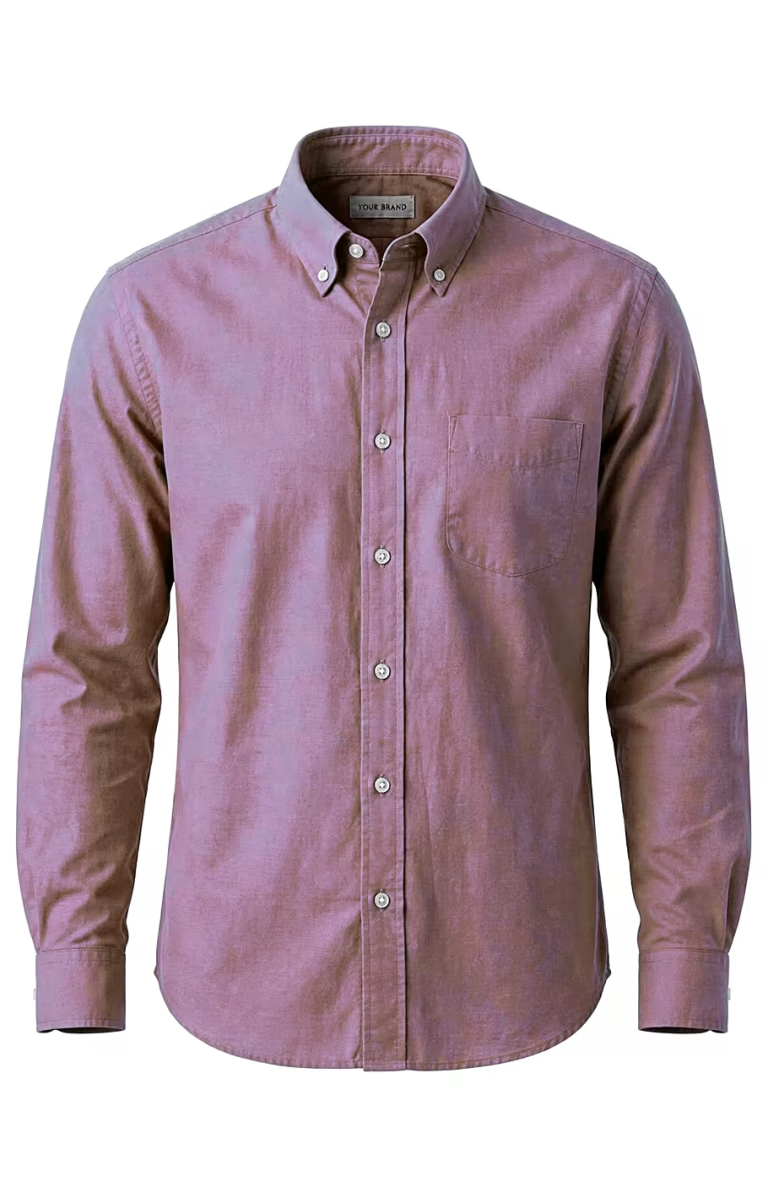
- Dusty mauve oxford as the proof garment.
- Your label inside every shirt.
- Samples approved on the real cloth first.
- Cartons packed by size, colour and channel.
Seven Steps from Brief to Packed Shirts
Every programme moves through the same seven steps, from the first brief to packed cartons. The steps keep the fit steady across thousands of shirts, batch after batch.
Step 1: The Brief Fixes Bodies and Colours
First, the brief names every colour and size ratio in the range. Retail buyers usually plan standard shirts beside polos and knitwear. In addition, the brief fixes collar style and label artwork early. Clear briefs prevent slow sampling rounds later.
Step 2: Oxford Cloth Is Woven to Weight
Second, the cotton oxford is woven and dyed to the approved weight. Buyers set the cloth weight by market and by price point. However, each lot is checked before it enters cutting. The results travel with the sample.
Step 3: Panels Are Cut to the Pattern
Next, panels are cut from the checked cloth lay by lay. The back yoke and box pleat on our proof shirt are cut as their own pieces. Consequently, the dusty mauve in our pictures reads as one colour everywhere. The cutting plan then stays inside the file.
Step 4: The Sample Is Approved on Real Cloth
Then the sample is sewn from the actual production cloth. Buyers check collar roll, cuff finish and body fit on the real garment. For example, the dusty mauve shirt in our pictures began exactly this way. Only approved samples move forward.
Step 5: Bulk Cutting Follows the File
Later, bulk cutting follows the locked pattern file lay by lay. Markers are planned to hold the size ratios the brief demands. Meanwhile, cut panels are bundled by size and colour. Nothing leaves the cutting table unrecorded.
Step 6: Sewing Holds the Fit True
During sewing, line checks compare shirts against the approved sample. Collar tension decides whether the points sit flat or curl. If a collar curls, sewing stops until the tension is reset. Thus, the last shirt matches the first.
Step 7: Packing Follows the Buyer Split
Finally, packing follows the buyer split by size, colour and store group. Cartons are labelled for fast warehouse intake at the other end. In short, cartons arrive ready to shelve or hand out. Records stay available for the reorder.
The Dusty Mauve Oxford in Our Pictures
The gallery shows the standard body behind these programmes. It is a men long sleeve shirt in dusty mauve cotton oxford, shown from the front and the back. In addition, one picture shows the oxford weave itself in close-up, with its fine basket texture. The front carries a button-down collar, a buttoned placket and a single chest pocket. The back carries a yoke with a centre box pleat. The last picture shows a YOUR BRAND label inside the back yoke.
- Dusty mauve oxford with button-down collar.
- Single chest pocket and buttoned placket.
- Back yoke with a centre box pleat.
- YOUR BRAND label woven for the buyer name.
- Oxford weave with a fine basket texture.
What Standard Fit Actually Means
Standard fit is the middle body between slim and relaxed, and honest shirt manufacturers define it in centimetres. Chest ease, waist ease and sleeve width are stated for every size. First, a standard body should move with the wearer without pulling at the buttons. Then it should still look tidy at the end of a working day. Moreover, those numbers belong in the programme file, where buyers can check them. A fit described only with adjectives cannot be reordered safely.
- Ease stated in centimetres per size.
- Buttons sit without pulling.
- Numbers kept inside the file.
- Fit checked on finished shirts.
- Adjectives never replace measurements.
Standard Fit Shirt Supplier in Bangladesh for German Retailers
German retailers run standard fit shirts as year-round basics with strict measurement discipline. We answer with centimetre grading, tested oxford and paperwork their auditors accept. Moreover, size curves are locked once and repeated across seasons. A shirt supplier who restarts sampling each season costs the retailer the range. Overall, the retailer briefs once and then only approves.
- Centimetre grading on finished shirts.
- Size curves locked for reorders.
- Audit paperwork open to buyers.
- Core colours repeated across seasons.
One Block for Retail and Uniform Programmes
The same standard body serves a fashion rail and a staff uniform programme, and that range is its strength. Retail buyers add colour stories each season. Uniform buyers hold one colour for years. We run both from the same locked block, with labels and packing split by channel. In addition, uniform orders can carry buyer embroidery under the artwork file. Consequently, one approval serves several channels at once.
- One block for retail and uniform use.
- Colour stories added per season.
- Labels split by channel.
- Embroidery under the buyer file.
- One approval, several channels.
Standard Fit Shirt Supplier in Bangladesh for French Chains
French chains buy standard shirts in deep size runs for nationwide stores. We pack by store split and label cartons for fast regional intake. In addition, care labels are printed in French where the chain requires them. A shirt factory that drifts on grading between lots breaks the chain size promise. Finally, the approved grading stays inside the programme file.
- Deep size runs graded honestly.
- Store splits packed inside one order.
- Care labels in the buyer language.
- Grading locked in the file.
Shirt Wholesale Programmes Built on One Body
Shirt wholesale orders live on repeatability, because the buyer sells the same body every season. We plan markers to hold cloth waste at the quoted level. Moreover, mixed colour cartons are only packed where the buyer asks for them. Buyers see the packing plan before production, not after. Consequently, the invoice matches the plan line by line. Wholesale discipline is mostly this honesty, repeated.
- Marker waste held at the quoted level.
- Packing plan shared before production.
- Mixed cartons only where requested.
- Invoices matched to the plan.
- Same body sold season after season.
Shirt Exporter Paperwork That Clears Cleanly
A shirt exporter is judged at the border as much as at the sewing line. Packing lists match cartons one to one, and fibre content is stated exactly. In addition, test records travel with the shipment file. Buyers in regulated markets ask for results in writing, and we answer in writing. Thus, one order behaves like one order at every checkpoint.
- Packing lists matched to cartons.
- Fibre content stated exactly.
- Test records inside the shipment file.
- Questions answered in writing.
- Carton marks agreed with the buyer.
Standard Fit Shirt Supplier in Bangladesh for Dutch Distributors
Dutch distributors consolidate shirt programmes for several retail groups at once. We answer with clear carton marking by style and destination group. In addition, paperwork is prepared in the format the distributor requests. A shirt supplier without a locked file ships drifting fits between groups. Thus, the distributor approves once and distributes with confidence.
- Styles consolidated per shipment.
- Packing lists matched to cartons.
- Paperwork in the requested format.
- One fit across every group.
Shirt OEM Ranges Under Your Own Label
Shirt OEM programmes put the buyer label at the centre of the garment. We sew woven labels inside every back yoke and print care labels in the buyer language. Moreover, the artwork is locked inside the programme file, so season two starts from proof. Buyers also choose their own size naming where their market expects it. Finally, no other name appears anywhere on the garment.
- Buyer label inside every shirt.
- Care wording in the buyer language.
- Artwork locked in the programme file.
- Size naming set by the buyer.
- Nothing else printed on the garment.
Testing, Compliance and Open Paperwork
Every cloth lot is tested before it enters a programme. Shrinkage, colour fastness and seam strength are recorded and shared with the buyer. In addition, buyer audit programmes are supported through Sedex, the supply chain platform many retail groups already use. Thus, every result stays inside the programme file.
- Shrinkage and fastness tested per lot.
- Seam strength checked on sewn shirts.
- Results shared before bulk cutting.
- Records kept inside the programme file.
- Audit questions answered in writing.
What a Programme File Contains
The programme file is the single source of truth for the range. It holds the standard block, graded size curve, cloth specification and label artwork. Moreover, it holds the test records and the packing rules for every channel. Consequently, any buyer question can be answered from the file. Shirt manufacturers who work from memory cannot offer that certainty.
- Standard block and graded size curve.
- Cloth weight, colours and test results.
- Label artwork and care wording.
- Packing rules for every channel.
- Approval history with dates.
Reorders and Season Planning
A programme should make the second season easier than the first. The locked file carries the block, cloth choice and packing rules forward. Then buyers only approve what is new, such as one added colour. Shirt suppliers who restart from zero each season burn the buyer calendar. Finally, the season starts from proof, not from hope.
- Blocks and cloth choices carried forward.
- Only new colours need approval.
- Packing rules repeated exactly.
- Season two starts from the proven file.
- Dates planned around selling seasons.
Grading Honesty Across the Size Set
A standard block earns its name in the grading, not in the brochure. We grade chest, waist, sleeve and body length together, so a large keeps the same tidy line as a small. First, the master size is proven on the sample. Then every other size is measured on finished shirts before bulk cutting continues. Moreover, shirt manufacturers who grade from averages alone ship the drift to their buyers. Our measurement records sit inside the programme file, where any shirt supplier claim can be checked against them. Buyers receive the grading table with the sample, in centimetres.
- All dimensions graded together.
- Master size proven on the sample.
- Finished shirts measured per size.
- Grading table shared with buyers.
- Records kept inside the file.
- Shirt factory checks repeated per lot.
Care, Washing and Honest Labels
Care labels must tell the truth about the cloth inside the garment. We print washing guidance that matches the tested behaviour of the oxford. For instance, deep colours keep their depth longer with cool washes, and the label says so plainly. Buyers also choose label language per market. Finally, honest care guidance keeps shirts performing longer in the wash, and shirt wholesale buyers ask for that honesty by name.
- Washing guidance matched to test results.
- Label language chosen per market.
- Fibre content stated exactly.
- Brand and care labels planned together.
Season Calendars and Honest Dates
Lead times are planned backwards from the selling season, never guessed forwards. Dates are fixed once the sample is approved, and risks are flagged early with options attached. Meanwhile, air freight closes urgent gaps where a store opening cannot move. Uniform programmes run on contract calendars instead, with delivery windows agreed a season ahead. Buyers who share their range calendar at brief stage get the calmest version of this planning, because cutting slots are reserved before the season rush begins. In short, the calendar is agreed before cutting begins, and a shirt manufacturer who plans backwards rarely apologises forwards.
- Dates fixed at sample approval.
- Risks flagged early with options.
- Air freight for urgent gaps.
- Contract windows agreed ahead.
- Calendar agreed before cutting.
- Shirt supplier dates kept in writing.
- Second seasons planned calmly from the first.
- Store openings protected by the agreed calendar.
Questions Standard Fit Buyers Ask Us
How does standard fit differ from slim fit?
Standard fit carries more chest and waist ease than a slim body, stated in centimetres per size. The sample proves the ease on the real garment. Moreover, both fits can run on one programme where the buyer plans them together. The file keeps the two blocks separate and clear.
Can the same body serve retail and uniforms?
Yes, the standard block is built for exactly that double duty. Retail colours and uniform colours run from the same graded pattern set. In addition, labels and packing split by channel at the end of the line. One approval therefore serves several channels.
How is fit checked at volume?
Finished shirts are measured size by size against the approved sample. Collar roll, body length and chest are checked on sewn garments. If a size drifts, the pattern is corrected before cutting continues. Finally, the measurement records sit inside the file.
What happens when a colour sells out early?
The file already holds the cloth specification and the colour card. Therefore, a fresh run can start from proof without new sampling. Buyers approve only quantities and dates. The colour and fit repeat exactly.
Can shirts carry buyer embroidery?
Yes, crests and names are embroidered under the buyer artwork file. Positions are approved on the sample before bulk begins. In addition, thread colours are matched to the approved card. The approved layout then stays inside the file.
Looking for a Standard Fit Custom Shirts Manufacturers in Bangladesh?
If one dependable body sounds right for your range, we should talk. Send your bodies, colours and target dates through our contact page, and we will reply with a sampling plan. Meanwhile, the FAQ page answers common questions on sampling, labels and freight. Overall, a shirt manufacturer with a locked block keeps seasons simple. Shirt wholesale buyers who moved to one block keep their programmes on the same file today.
- One block for every season.
- Samples approved on real cloth first.
- Your label inside every shirt.
- Records open at every step.