
Private Label Manufacturing
Private Label Clothing Manufacturer in Bangladesh
Looking for a Private Label Clothing Manufacturer in Bangladesh programme built around your label system? We knit, cut and sew clothing to order at our facilities in Bangladesh, and the proof garment is an olive green crew neck t-shirt in cotton single jersey. Brand owners approve samples with the full label set fitted before bulk cutting begins. Moreover, every order is planned backwards from your selling season. Your woven label sits inside every garment, and no other name appears anywhere.
- Our facilities are in Bangladesh, stated plainly from the first line.
- Olive green crew neck tees as the proof garment.
- Full label systems fitted on every sample.
- Your woven label inside every garment, with no other name shown.
- Samples approved on the actual jersey before bulk cutting begins.
- Production planned at our Bangladesh facilities around your season.
- Packed by colour, size and store for fast warehouse intake.
Simply The Best
PORTFOLIOS












Product Details
Private Label Clothing Manufacturer in Bangladesh
One Core Tee Carrying Your Label, Sewn in Bangladesh
Brand owners who search for a Private Label Clothing Manufacturer in Bangladesh often start with one core style and one clear question: whose name sits inside the garment? On this programme, only yours does. We knit, cut and sew clothing to order at our facilities in Bangladesh, and the proof garment is an olive green crew neck t-shirt in cotton single jersey. Your woven label is stitched into the neck of every tee. Moreover, every order is planned backwards from your selling season. No other name appears on the garment, the tickets or the cartons.
- Olive green crew neck tee as the proof garment.
- Cotton single jersey knitted to weight.
- Your woven label inside every neck.
- Samples approved on the real jersey first.
- Packed by colour, size and store.
Seven Steps from Brief to Packed Labelled Tees
Every programme moves through the same seven steps, from the first brief to packed cartons. The steps keep the label placement, the sizing and the colours steady across thousands of tees, season after season. Each step is recorded in the programme file, from yarn to carton.
Step 1: The Brief Fixes the Label System
First, the brief names the garment, the colourways and the full label system. Neck labels, size tabs and care labels are specified together. In addition, the brief fixes ticket and bag artwork early. A clear label brief prevents slow sampling rounds later.
Step 2: The Jersey Is Knitted to Weight
Second, the cotton single jersey is knitted to the agreed weight. Cloth that twists after washing fails the range at once. However, every weight is proven on the sample, never assumed from the yarn name. The hand feel and the weight are therefore set together in the file.
Step 3: Panels Are Cut to the Pattern
Next, tee panels are cut to the buyer pattern with the grain held straight. Cutting follows the file, not the cutter's habit. In addition, each bundle is ticketed by size and colour. Ticketed bundles let any tee be traced back to its cloth lot.
Step 4: The Sample Is Approved with Labels Fitted
Then the sample tee is sewn with the full label set fitted, washed and measured. Buyers check label position, neck shape and print space on the garment itself. If a measurement drifts, the pattern is corrected before bulk. Finally, the approved sample becomes the reference for every later batch.
Step 5: Bulk Cutting Follows the File
Bulk cutting follows the approved file exactly. The same marker, the same cloth lot plan and the same size ratios apply. Moreover, cut panels rest before sewing so the jersey relaxes. Relaxed panels keep the finished length honest after washing.
Step 6: Sewing Sets Necks, Shoulders and Labels
Sewing closes the tee in sequence, setting the ribbed neck, the shoulder tape and the woven label to fixed positions. Every clothing manufacturer on our lines works to the same measurement sheet. For example, each neck label is centred and checked before the tee is folded. Small checks early prevent large claims later.
Step 7: Packing Splits by Colour and Store
Finally, finished tees are checked, folded and packed by colour, size and store split. Your tickets and bags carry your artwork only. In addition, each carton carries a packing list that matches the order file. Straight intake saves your warehouse team hours on every delivery.
The Olive Green Tee in Our Pictures
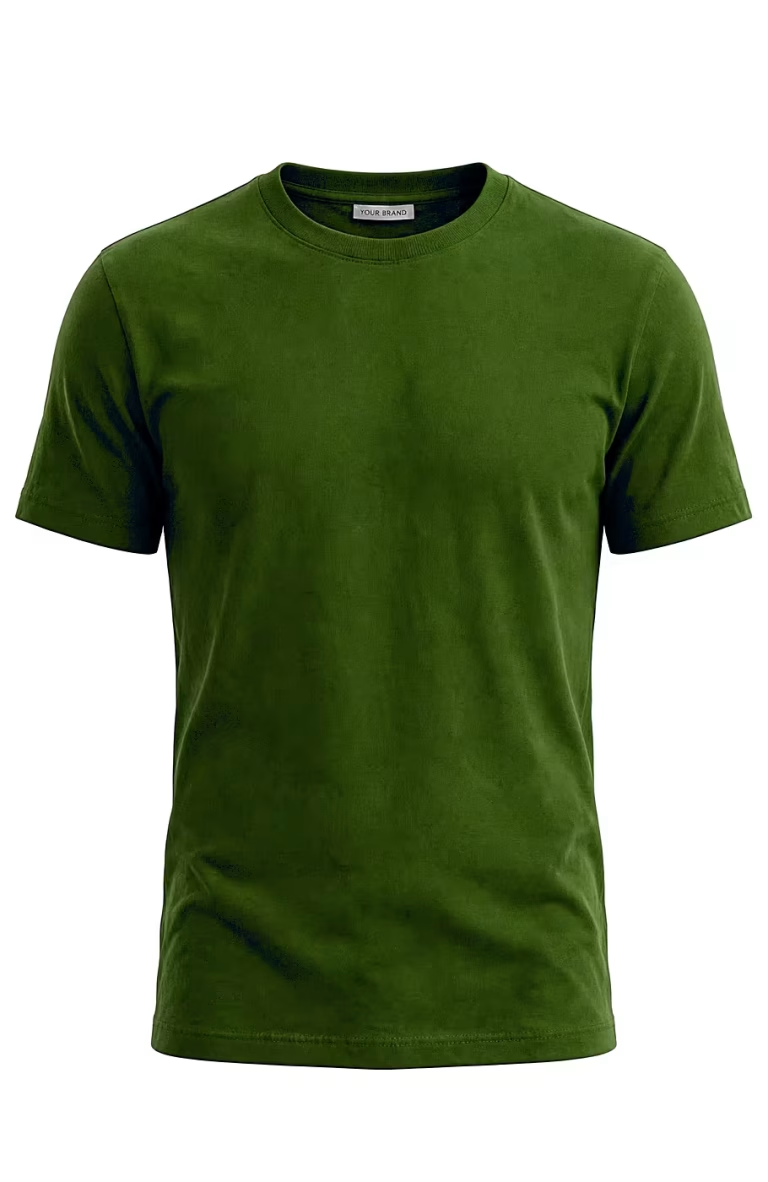
The pictured garment is a men's crew neck t-shirt in olive green cotton single jersey. It has short sleeves, a ribbed crew neck and a plain straight body. The front and back are completely plain, with no print, logo or embroidery anywhere. A white YOUR BRAND woven label is stitched inside the neck, visible in both the garment views and the close-up. No other name appears on the tee.
- Crew neck tee in olive green single jersey.
- Ribbed neck with shoulder tape inside.
- Completely plain front and back.
- YOUR BRAND woven label inside the neck.
- No print or embroidery on the pictured tee.
A Clothing Manufacturer Built Around Your Label System
A private label is more than a neck label. It is a system of woven labels, size tabs, care labels, tickets and packaging that all carry one name: yours. We build that system into the programme file before the first sample is sewn. Clothing supplier programmes fail when labels arrive late or sit crooked. Therefore, label stock is checked and counted before bulk cutting starts. Your brand leaves our lines exactly as your artwork specifies.
- Full label system fixed before sampling.
- Label stock counted before cutting.
- Placement measured on every garment.
- Your artwork followed exactly.
Private Label Clothing Manufacturer in Bangladesh for France Boutiques
French boutiques buy small, careful ranges with strong label presentation. They ask for soft jersey, clean necks and labels that sit perfectly straight. Our sampling answers each point on the real garment. Moreover, boutique orders receive the same file discipline as large chain orders. Small ranges therefore launch with the same confidence as big ones.
- Label presentation checked by hand.
- Soft jersey proven at sampling.
- Small ranges given full file discipline.
- Colours held for repeat drops.
Private Label Clothing Manufacturer in Bangladesh for Denmark Chains
Danish chains plan clothing wholesale ranges across many stores on tight calendars. They need packing splits by store and colours that repeat across drops. Our programme file carries both from the first order. In addition, chain buyers receive measurement charts for every size. Steady files keep their shelves consistent across the season.
- Packing splits by store.
- Measurement charts for every size.
- Colours repeated across drops.
- Calendars planned backwards from launch.
The Label Itself: Weaving, Placement and Law
A woven label must stay legible after years of washing. We specify damask weaving for fine lettering, folded ends for soft skin contact and stitch positions that never twist. Care labels state the true fibre content and the washing route the cloth was tested for. In addition, size tabs follow your own marking system. A clothing factory that treats labels as decoration will let you down; we treat them as part of the garment.
- Damask weaving for fine lettering.
- Folded label ends for soft contact.
- True fibre content on care labels.
- Size tabs in your own system.
Jersey That Holds Its Shape After Washing
A tee fails when the body twists or the neck sags. We knit the jersey to weight, rest the cut panels and set the neck rib with the right tension. Shrinkage and twist are tested on every cloth lot. However, honest results matter more than good promises. Therefore, test figures are shared with the sample, in writing.
- Twist and shrinkage tested per lot.
- Neck rib set to fixed tension.
- Panels rested before sewing.
- Test figures shared in writing.
Prints and Embroidery Run from Your Artwork
The pictured tee is plain, and many label owners keep their core tee plain too. When a range adds print or embroidery, it runs only from your own artwork files. Placement, size and colour count are fixed in the programme file. Moreover, a printed sample is approved before any bulk printing begins. Nothing is decorated from our own designs.
- Artwork supplied by you only.
- Placement fixed in the file.
- Printed samples approved first.
- Plain cores kept plain.
Colours That Hold Across Reorders
An olive that drifts greener on the reorder breaks a range. We hold colour with lab dips, shade bands and cloth lot records agreed at sampling. Every new lot is checked against the approved shade before cutting. In addition, clothing exporter records keep the shade history with your file. Reorders therefore match the tees already on your shelves.
- Lab dips approved before dyeing.
- Shade bands agreed at sampling.
- Lots checked against the standard.
- Shade history kept on file.
Testing, Compliance and Open Paperwork
Every programme file holds cloth test results, measurement charts and inspection reports. Buyers may request fibre and labelling support aligned with GOTS principles for organic ranges. In addition, our lines welcome buyer inspectors at any stage. Open paperwork shortens audits and builds trust. Nothing in the file is hidden from the brand that owns the order.
- Test results filed per cloth lot.
- Inspection reports kept with the order.
- Buyer inspectors welcome on the lines.
- Labelling checked against the file.
What a Programme File Contains
A programme file is the single record of your order. It holds the brief, the cloth specification, the label artwork and the approved sample measurements. It also holds the packing plan and the dispatch dates. Moreover, every change is written into the file with a date. Anyone on the team can therefore answer a query from the file alone.
- Brief, cloth and sample records.
- Label and ticket artwork copies.
- Packing plan and dispatch dates.
- Dated change log for the order.
From One Tee to a Full Label Range
Most label owners start with one proven style, then widen the range. The same file system carries hoodies, polos and fleece once the tee is proven. A clothing supplier who knows your label system can add styles without new sampling confusion. In addition, your label stock and artwork stay on record. Range growth therefore stays simple and controlled.
- Start with one proven style.
- Add styles on the same file system.
- Label stock kept on record.
- Artwork held for future ranges.
Reorders and Season Planning
Label ranges reorder by season and by selling speed. Our files keep your cloth lot, sizing, labels and packing on record, so a reorder repeats the first delivery exactly. Clothing wholesale buyers can add colourways without reopening the whole file. In addition, reorder calendars are planned backwards from your launch dates. Steady files make small brands look established.
- Reorders repeat the first delivery.
- Cloth and labels kept on record.
- New colourways added simply.
- Calendars planned from launch dates.
Care, Washing and Honest Labels
Care labels state the true fibre content and the washing route the jersey was tested for. Size labels follow your own system, whether letters, numbers or both. In addition, country of origin is stated truthfully as Bangladesh. Honest labels protect your brand with retailers and customers. Nothing is overstated on a label that leaves our lines.
- True fibre content stated.
- Washing route matched to testing.
- Origin stated truthfully.
- Size marks in your system.
Why Label Depth Sits in Bangladesh
Bangladesh knits and sews jersey clothing for labels on every continent. The depth comes from cotton jersey supply, trained sewing lines and long export practice. A clothing manufacturer here can hold small label runs and large chain orders in the same building. Moreover, the cost structure keeps young labels viable. Brand owners gain capacity without giving up control of their name.
- Jersey supply inside the country.
- Lines trained for labelled goods.
- Small and large runs held together.
- Long export record worldwide.
Clothing Factory Checks Before Any Carton Closes
Before any carton closes, the tee passes a final check against the approved sample. Checkers measure the chest, the length and the neck opening. They read every label, check its position and test the neck rib recovery. In addition, clothing OEM orders receive a label count check against the file. A carton that fails any point is opened, corrected and checked again.
- Measurements checked against the sample.
- Labels read and centred by hand.
- Neck recovery tested on samples.
- Failed cartons corrected and rechecked.
Reading Private Label Offers with Care
Brand owners compare offers on label quality, cloth weight and sampling honesty, not on price alone. Ask to see the woven label on a washed sample, not on a card. Therefore, request the full label set fitted on the sample garment. Clothing manufacturers who welcome that test are usually the ones who pass it. Our samples carry your labels from the first round.
- Judge labels on washed samples.
- Ask for the full label set fitted.
- Compare cloth weights in writing.
- Check origin statements carefully.
How Clothing Buyers Judge a Label Programme
Experienced buyers judge a label programme by the sample, not by the brochure. They wash the tee, read the woven label and check its position twice. Clothing manufacturers who fit the full label set on the first sample save the buyer a full sampling round. In addition, clothing supplier programmes are judged on colour discipline across the size curve. Clothing factory checks then confirm that labels sit centred on every garment, not only on the sample. Clothing wholesale buyers also ask how reorders repeat the first delivery. Finally, clothing exporter files that hold artwork, shades and measurements together win long term trust. Our file is built to pass exactly that reading.
- Labels judged on washed samples.
- Clothing factory checks confirm centred labels.
- Clothing OEM orders repeat the first delivery.
Questions Label Owners Ask Us
Whose name appears on the garments?
Only yours. Your woven label sits inside every garment, and your artwork covers tickets, bags and cartons. No factory name or mark appears anywhere on the goods. The pictured tee carries a YOUR BRAND label to show the placement. Your production labels carry your real brand name in the same position.
Is the pictured tee printed or branded?
No. The olive green tee is completely plain on the front and the back. It is shown unprinted so you can judge the jersey, the neck and the label placement. Prints or embroidery are added only when your range asks for them, and only from your artwork.
Can you match our existing label design?
Yes. Send your label artwork or a physical label sample, and we weave to that specification. Size, fold style and stitch position are fixed in the programme file. A labelled sample is approved before bulk sewing begins. Your existing retail presentation therefore continues without a break.
How are colours kept steady across reorders?
Colour is held with lab dips, shade bands and cloth lot records. Each new lot is checked against the approved shade before cutting. Clothing exporter files keep the shade history with your programme. Reorders therefore arrive matching the stock already on your shelves.
Can one programme grow from tees into other styles?
Yes. The label system, artwork and file discipline transfer to new styles as your range grows. Each new style is sampled and approved on real cloth first. In addition, your label stock stays on record between orders. Growth stays controlled, one proven style at a time.
Looking for a Private Label Clothing Manufacturer in Bangladesh?
Send us your label artwork, your core style and your season dates through our contact page. We will answer with a labelled sample plan and a dated programme file. Common questions are covered on our FAQ page. Clothing supplier programmes start with one approved, labelled sample. From there, the file carries every reorder under your name alone.