
Printed T-Shirt Manufacturing
Mens Printed T-Shirt Exporter in Bangladesh
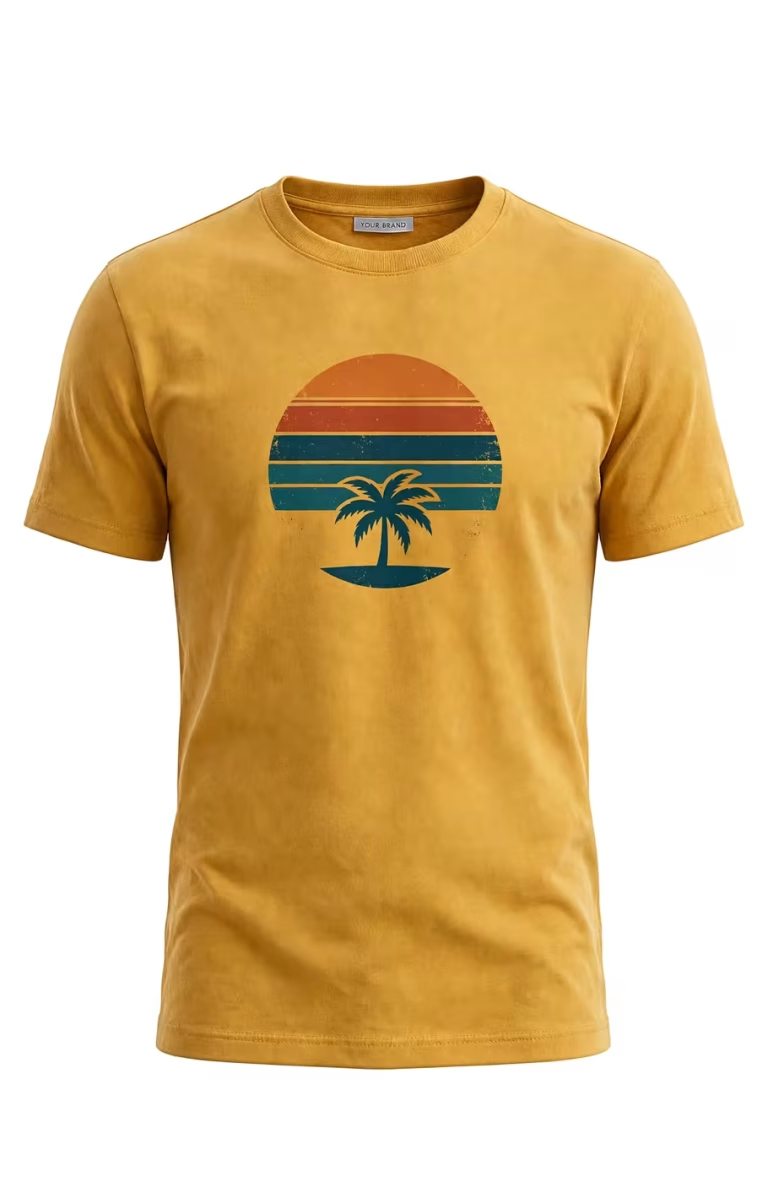
Looking for a Mens Printed T-Shirt Exporter in Bangladesh programme where the artwork is always yours? We knit, cut, sew and print t-shirts to order at our facilities in Bangladesh, then export them under your label. The mustard yellow tee in our pictures carries a sample retro sunset graphic, printed to show placement, colour strength and hand feel. Your production prints your own artwork, from your own file. Moreover, every programme is planned backwards from your selling season. Your label sits inside every shirt, and no other name appears on the garment.
- Your own artwork printed from your own file.
- The pictured graphic is a sample print, stated plainly.
- Mustard yellow jersey tees on one programme file.
- Your woven label inside every shirt, with no other name shown.
- Print samples approved on the actual jersey before bulk begins.
- Export paperwork prepared at our Bangladesh facilities.
- Packed by colour, size and channel for fast warehouse intake.
Simply The Best
PORTFOLIOS












Product Details
Mens Printed T-Shirt Exporter in Bangladesh
An Export Programme Built Around Your Artwork
Buyers who search for a Mens Printed T-Shirt Exporter in Bangladesh programme usually bring artwork and a delivery market, not just a garment spec. We knit, cut, sew and print t-shirts to order at our facilities in Bangladesh, then export them under your label. First, the picture point: the mustard yellow tee in our gallery carries a sample retro sunset graphic, printed to show placement and hand feel. Your production prints your own artwork, from your own file. Moreover, every programme is planned backwards from your selling season.
- Mustard yellow crew tee as the proof garment.
- Sample sunset graphic shown honestly.
- Your artwork printed from your file.
- Your label inside every shirt.
- Print samples approved on real cloth first.
- Cartons packed by colour, size and market.
Seven Steps from Artwork to Exported Shirts
Every programme moves through the same seven steps, from the first artwork file to loaded cartons. The steps keep print placement, cloth and export paperwork steady across thousands of shirts, batch after batch.
Step 1: The Artwork File Is Checked First
First, your artwork file is checked for size, resolution and colour separations. Weak files are flagged before any screen is made. In addition, the brief fixes print position and maximum print size per body size. Clear files prevent slow sampling rounds later.
Step 2: The Jersey Is Knitted to Weight
Second, the jersey is knitted and dyed to the approved weight. Print sits differently on thin cloth, so weight matters twice on graphic tees. However, a heavy tee is not always the right answer for summer ranges. The weight is therefore proven on the sample, never on paper alone.
Step 3: Screens Are Made from Your File
Next, screens are made from your approved separations, one per colour. Each screen is registered against the placement marks on the pattern. In addition, ink shades are mixed to your colour references. Mixed inks are then struck off on the real jersey for approval.
Step 4: The Print Sample Is Approved on Real Cloth
Then the printed sample is checked against your artwork on the garment itself. Buyers check placement, colour strength and the softness of the print hand. If a colour drifts, the ink mix is corrected before bulk. Finally, the approved print sample becomes the reference for every later batch.
Step 5: Panels Are Printed Before Sewing
Front panels are printed flat, before the body is sewn. Flat panels hold placement exactly, chest after chest. Moreover, printed panels are cured and checked before they join the cutting bundles. A faulty print is therefore caught while it is still one panel, not a finished shirt.
Step 6: Sewing Follows the Approved Body File
Sewing sets the ribbed collar, the shoulder tape and the side seams in sequence. The printed panel is handled so the graphic never cracks at the seams. In addition, finished shirts pass a needle check before pressing. Pressing then sets the final shape without touching the print with direct heat.
Step 7: Export Packing Splits by Market
Finally, packing splits cartons by design, colour, size and destination market. Export ranges often serve several countries on one order. Each carton carries a packing list that matches its contents and its documents exactly. Warehouses then book each design in without sorting.
The Mustard Yellow Tee in Our Pictures
Our pictures show one mustard yellow crew neck tee, front and back. The front carries a sample graphic: a retro sunset in orange and teal bands above a palm tree, with a soft distressed finish. That graphic is a sample print, made to show placement, colour strength and hand feel. The back is plain, with no print. Your range carries your artwork on the same body file, and the fabric and label close-ups show the jersey and the YOUR BRAND label your programme would use.
- Mustard yellow cotton single jersey body.
- Sample sunset and palm graphic on the front.
- Plain back panel with no print.
- YOUR BRAND woven label inside the collar.
- Shirt factory proof garment, shown as it is.
How a Printed T-Shirt Manufacturer in Bangladesh Runs Your File
An export programme is a file discipline before it is a sewing discipline. Your artwork, separations and ink references sit inside the programme file. Your placement marks sit there too, measured per size. When reorders arrive, the same screens and mixes are pulled from the record. The printed shirt therefore matches across seasons and across markets. That record is what separates an export programme from a one-off print job.
- Artwork and separations held in the file.
- Ink references mixed and recorded.
- Placement measured per body size.
- Reorders printed from the same record.
Printed T-Shirt Supplier in Bangladesh for Australia Brands
Australian graphic brands often run souvenir and surf ranges beside core basics. We run those ranges on the same file discipline as volume orders. First, the strike-off proves colour on the real jersey. Then the print sample proves placement on the body. Meanwhile, shade and ink records are held from day one. Reorders of a winning design then repeat without new development rounds, even across long freight routes.
- Souvenir ranges run beside core basics.
- Strike-offs proven on real jersey.
- Ink records held for winning designs.
- Cartons packed by design and market.
Ink, Hand Feel and Honest Limits
Print quality is judged by the hand as much as by the eye. A graphic that feels like plastic armour sells once and returns often. We therefore tune ink deposit so the print stays soft on the chest. For example, the sample sunset graphic uses a distressed finish that keeps the print layer thin. In addition, wash tests check cracking and fading before bulk. If a design needs a technique the cloth cannot carry, we say so at sampling, not at delivery.
- Soft hand feel tuned per design.
- Wash tests for cracking and fading.
- Technique limits stated at sampling.
- Shirt factory sampling catches weak files early.
T-Shirt OEM Print Ranges Under Your Own Label
An OEM print range lives or dies on its label discipline. Your woven label sits inside every collar, and your care label carries your wording. We hold approved label stock against your file, so reorders never wait on trims. In addition, hang tags and polybag prints follow your artwork exactly. The customer therefore sees your brand on the label and your artwork on the chest. Nothing of ours appears anywhere on the garment.
- Your woven label inside every collar.
- Label stock held against your file.
- Hang tags printed from your artwork.
- Your artwork, and only your artwork, on the chest.
Testing, Compliance and Open Paperwork
Compliance paperwork should be boring, complete and available. Our programmes follow the audit approach published by Sedex, and test reports are shared openly. Print fastness, shrinkage and seam strength are tested per programme. If a test fails, the lot is corrected before packing, not argued about after delivery. Buyers comparing shirt manufacturers will recognise the same discipline they expect anywhere. We simply refuse to treat it as optional.
- Print fastness tested per programme.
- Shrinkage measured on washed samples.
- Test reports shared without being chased.
- Failed lots corrected before packing.
What a Programme File Contains
Every programme runs from one file, and the file is the contract in practice. It holds the pattern, the cloth specification and the approved print sample record. It also holds artwork versions, ink mixes, label artwork and export packing splits. When a design changes, the file records the new version with its date. Overall, the file is why a reorder printed next year matches the shirt sold this year, in every market it serves.
- Pattern and cloth specification.
- Artwork versions with dates.
- Ink mixes and placement records.
- Export documents matched to cartons.
Reorders and Season Planning
Winning graphics get reordered, and the file makes that easy. A held file turns a reorder into a scheduling task, not a new development. We plan capacity around your selling season, backwards from your delivery date. Meanwhile, screens and ink records are pulled from the archive. If a design grows from a drop into a core range, the same file scales without new sampling. Shirt factories that hold records this way keep their buyers for years.
- Capacity planned backwards from delivery dates.
- Screens and inks pulled from the archive.
- Growth handled on the same file.
- No new sampling for straight reorders.
Colours That Hold Across Lots
Colour drift ruins graphic ranges twice: once in the cloth and once in the ink. Our dyeing lines match each cloth lot back to the archived shade standard. In addition, ink mixes are weighed and recorded, so print colours repeat exactly. A cut panel and a print strike from every lot are checked under store lighting. If either drifts, it is corrected before bulk. The mustard ground and the sunset inks in our pictures are held to that standard.
- Shade standards archived per colour.
- Ink mixes weighed and recorded.
- Lots checked under store lighting.
- Drift corrected before bulk begins.
Care, Washing and Honest Labels
Care labels must tell the truth about the cloth and the print. Our labels state the real fibre content and the washing route the printed cloth was tested under. Buyers comparing shirt exporter offers know how often that wording is copied loosely. We write it from the test report instead. Your customers then wash the shirt the way the label says, and the print survives it. Honest labels quietly protect your returns rate in every market.
- Fibre content stated from the real cloth.
- Wash wording taken from test reports.
- Print care matched to the ink system.
- Returns protected by accurate care advice.
Freight Routes from Bangladesh
Freight planning starts when the programme starts, not when cartons close. Sea freight from Chattogram serves most volume programmes. Air freight covers launch dates and late approvals. We quote both routes against your delivery window. Moreover, carton dimensions are fixed early, so freight quotes rest on real data. Export paperwork is prepared before loading, so cartons and documents travel together without customs surprises.
- Sea and air routes quoted openly.
- Carton dimensions fixed before quoting.
- Sailing schedules shared with the buyer.
- Shirt exporter paperwork prepared before loading.
Why Print Depth Sits in Bangladesh
Bangladesh built its industry on knitwear, and print capacity grew beside the sewing lines. That pairing matters: the people who print the panel understand the garment it becomes. Collar ribbing, shoulder tape and jersey weights are everyday skills here. The sample sunset graphic in our pictures shows the result: clean bands, soft hand and honest colour. Sampling is fast for the same reason. The knowledge sits on the line, not in a manual.
- Print and sewing skills on one site.
- Clean bands and soft print hand.
- Fast sampling from line knowledge.
- Graphics treated as a specialism, not a sideline.
Reading Export Print Offers with Care
A low export price can hide thin ink, rough hand feel and drifting placement. Buyers should therefore compare offers on a washed print sample, not a photograph. Ask every exporter for a strike-off on your actual cloth weight. Then wash it, stretch it and check the edges. We welcome that test, because our sample graphic survives it. Finally, check whose artwork the sample carries: an honest exporter shows sample graphics as samples, exactly as this page does.
- Compare washed print samples, not photographs.
- Demand strike-offs on your cloth weight.
- Check edges after washing and stretching.
- Sample graphics named as samples.
Choosing an Export Programme with Open Eyes
Every printed shirt exporter buyer learns the same lesson eventually: export print is a record keeping trade. A shirt exporter that sews and prints under one roof controls cloth, placement, label and documents together. Shirt exporter buyers who check those records before ordering rarely regret the order. The checks below are the ones experienced buyers run first.
- Shirt manufacturers who print in house keep placement honest.
- Shirt suppliers without print lines cannot control hand feel.
- Shirt wholesale buyers judge print by washed samples.
- Shirt exporters live on paperwork as much as print.
- Shirt OEM ranges need label and artwork discipline together.
- Shirt factory records turn reorders into scheduling.
- Printed shirt OEM discipline runs from file to carton.
Questions Graphic Tee Buyers Ask Us
Is the pictured print the design we would receive?
No. The sunset graphic on the pictured tee is a sample print, shown to prove placement, colour strength and hand feel. Your production prints your own artwork, from your own file. Nothing is printed until you approve a strike-off of your design.
Which markets do you export printed tees to?
Our programmes serve buyers across North America, Europe, Australia and the Gulf. Each market takes its own label wording and packing split from the same programme file. Freight routes are quoted per destination before production starts. The file therefore travels as one record, however many markets it feeds.
Can you match artwork we already print elsewhere?
Yes, if you send the artwork file and a physical printed sample. We rebuild the separations and ink mixes from those references. Then a counter strike-off is printed for your approval. Bulk follows only after that approval is written.
How are print colours kept steady across reorders?
The approved ink mixes and screen records sit in the file archive. Every new run is matched back to that archive before printing. If a mix drifts, it is corrected at the print table, not at delivery. Finally, the archive travels with every reorder.
Do you print on shirts we supply ourselves?
No. Our programmes knit, cut, sew and print the whole garment in one file. That single file is what keeps cloth, print and label consistent. Buyers therefore receive finished shirts, not a print-only service. The result is one accountable desk for the whole garment.
Looking for a Mens Printed T-Shirt Exporter in Bangladesh?
If an export print programme built around your artwork sounds right for your range, we should talk. Send your designs, colours and target dates through our contact page, and we will reply with a sampling plan. Meanwhile, the FAQ page answers common questions on sampling, labels and freight. Overall, a held programme file keeps your artwork, shades and labels steady season after season, in every market you serve.
- Your artwork printed from your file.
- Sample graphics named as samples.
- Your label inside every shirt.
- Shirt manufacturer records open at every step.