
Striped Polo Shirt Manufacturing
Knitted Mens Striped Polo Shirt Bangladesh Made
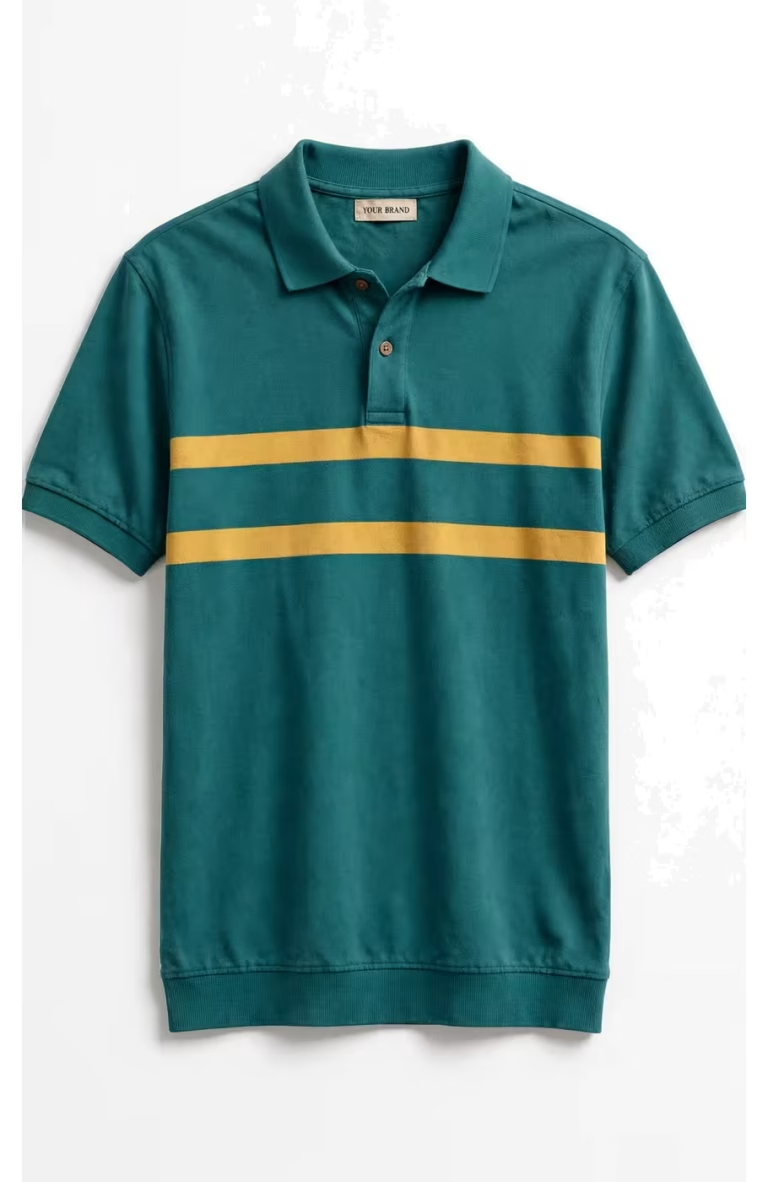
Looking for a Knitted Mens Striped Polo Shirt Bangladesh Made programme where the stripes are part of the cloth, not a print? We knit and sew polo shirts to order at our facilities in Bangladesh, and the proof garment is a teal green pique polo with two mustard stripes knitted into the chest. Buyers approve every sample on the real pique before bulk knitting begins. Moreover, every programme is planned backwards from your selling season. Your label sits inside every polo, and no other name appears anywhere.
- Our facilities are in Bangladesh, stated plainly from the first line.
- Teal green striped pique polos as the proof garment.
- Stripes knitted into the cloth, never printed on.
- Your woven label inside every polo, with no other name shown.
- Samples approved on the actual pique before bulk knitting begins.
- Production planned at our Bangladesh facilities around your season.
- Packed by colour, size and store for fast warehouse intake.
Simply The Best
PORTFOLIOS











Product Details
Knitted Mens Striped Polo Shirt Bangladesh Made
Striped Polos Knitted to Order in Bangladesh
Buyers who search for a Knitted Mens Striped Polo Shirt Bangladesh Made programme usually want the stripe inside the cloth, not on top of it. We knit and sew polo shirts to order at our facilities in Bangladesh, and the stripes are knitted in from coloured yarn. The proof garment is a teal green pique polo with two mustard stripes across the chest. Moreover, every programme is planned backwards from your selling season. Your label sits inside every polo, and no other name appears anywhere.
- Teal green striped pique polos as the proof garment.
- Also, stripes knitted in, never printed on.
- Next, samples are approved on the real pique first.
- Your label inside every polo.
- Cartons packed by colour, size and store.
Seven Steps from Brief to Packed Polos
Every programme moves through the same seven steps, from the first brief to packed cartons. Polo buyers test these steps hardest, because a stripe that drifts between sizes ruins a whole range. Each step is recorded in the programme file, from yarn to carton.
Step 1: The Brief Fixes the Stripe Map
First, the brief fixes stripe widths, positions, colours and size curves. The stripe map is drawn to scale for every size at this stage. In addition, the brief records your artwork for labels and any chest embroidery. Clear briefs prevent slow sampling rounds later.
Step 2: The Yarn Is Dyed to the Approved Shade
Second, the yarn is dyed to your approved shades before knitting starts. Teal and mustard yarn lots are checked against lab dips under standard light. Yarn that drifts is held back, never knitted quietly. Only then do the cones move to the knitting machines.
Step 3: The Sample Is Approved on Real Pique
Next, one polo in each size break is knitted and sewn as the approval sample. Your team checks stripe position, fit and shade on the real pique. Changes are written into the file at this stage. Bulk knitting never starts before this approval.
Step 4: Panels Are Knitted to the Stripe Map
Then, front panels are knitted so the stripes land at the mapped chest height. Backs and sleeves are knitted plain in the ground shade. Knitted panels are measured against the map before cutting. Bundle tickets keep every size and colourway separate.
Step 5: Sewing Runs with Stripe Checks
After approval, sewing runs with checks at every operation. Supervisors inspect stripe matching at the side seams, collars, plackets and cuffs as the line moves. Faults are corrected on the same bundle, not at the end. Colourway bundles stay separate throughout.
Step 6: Finishing Adds Labels and Embroidery
Next, finishing adds your labels and any embroidery your file carries. The pictured polo carries no embroidery at all, and logos are added only from your artwork. Pressing follows the standard for knitwear. Folding then matches your retail presentation.
Step 7: Packing Splits by Colourway and Store
Finally, packing splits cartons by colourway, size and store. Carton lists are shared before the goods leave our floor. Shipping documents follow on the same file. Your team can book polos into the warehouse on arrival.
The Teal and Mustard Polo in Our Pictures
The pictured polo is a teal green mens polo in cotton pique with two mustard yellow stripes across the chest. The stripes are knitted into the fabric from dyed yarn, and the fabric close-up shows them sitting inside the knit. The back is plain teal with no stripes at all. Moreover, the polo carries a knitted flat collar, a two button placket and ribbed sleeve cuffs. The polo is made for OEM ranges that carry branding only from the buyer file. No logo or embroidery appears anywhere on the garment.
- Teal green pique with mustard chest stripes.
- Stripes knitted in from dyed yarn.
- Also, plain teal back with no stripes.
- Knitted collar and two button placket.
- No logo or embroidery anywhere.
Knitted In, Never Printed: How the Stripes Are Made
A printed stripe sits on the surface and cracks, fades and peels with washing. A knitted stripe is the cloth itself, made by our factory on the knitting machines that form the panel. The colour runs through the full thickness of the fabric. Moreover, the stripe edges stay sharp after repeated laundering. Buyers who handle the fabric close-up can feel no print film at all.
- Colour through the full cloth thickness.
- Also, no print film to crack or peel.
- Stripe edges stay sharp after washing.
- The same hand feel across stripe and ground.
- Panels knitted to the mapped position.
Striped Polo Shirt Manufacturer in Bangladesh for USA Teamwear
USA teamwear buyers often run striped polos across clubs, schools and company leagues. They send stripe maps per colourway, and our team answers with knitted panels matched at every size. Delivery plans are built backwards from the season start. Moreover, carton data matches the format their receiving teams already use. The same file discipline serves every market we ship to.
- Stripe maps answered per colourway.
- Also, panels matched at every size.
- Carton data in the buyer format.
- Reorders repeat the approved file exactly.
The Pique Behind the Polo
Pique knits a fine honeycomb texture that holds air and keeps its shape on the body. The pictured cloth is a cotton pique with a firm, breathable hand. The teal ground and mustard stripes are dyed as yarn before knitting, so the shades sit inside the cloth. Moreover, each yarn lot is checked for shade under the same light. A lot that drifts is held back, never knitted quietly. Shrinkage is tested before the panels are planned, so polos keep their fit after washing. The cloth is made for manufacturer programmes that need breathable knitwear with a firm hand. Buyers receive the cloth standard with the sample, and bulk yarn is matched against that same standard every time.
- Honeycomb pique texture with a firm hand.
- Also, shades dyed as yarn before knitting.
- Shrinkage tested before knitting begins.
- Yarn lots checked under standard light.
Stripe Position Across Every Size
A chest stripe must sit at the same visual height on a small and on an extra large. We grade the stripe map with the pattern, size by size, rather than stretching one map. Sample polos are checked across the size break before bulk knitting. Moreover, side seam matching is inspected on finished garments, not assumed. Your range then photographs as one family on the rail.
- Stripe maps graded size by size.
- Also, samples checked across the break.
- Side seam matching inspected, not assumed.
- One family look on the rail.
- Photographs match across sizes.
Polo Shirt Exporter in Bangladesh for Germany Retailers
Germany retailers often combine striped polos with plain pique basics in one shipment. Our exporter desk plans mixed cartons by colourway, size and store. Selling seasons are worked backwards from the vessel date. Moreover, every carton list is shared before loading. Retailers can then book polos into the warehouse on arrival.
- Mixed colourways planned in one shipment.
- Also, carton lists shared before loading.
- Season dates worked backwards from sailing.
- Repeat shades held to the same standard.
Sizing and Grading for Polo Programmes
Polos fail when sizing is guessed. We grade from your own charts and fit blocks, size by size. Chest, length and sleeve measures are recorded against the approved sample. Moreover, sample sets are tried by your team before bulk knitting. Size sets are made by our factory sample room before bulk knitting starts. Spare ratios per size are then agreed in writing, so replacements never wait for a new pattern.
- Grading from your charts, size by size.
- Also, sample sets tried before bulk.
- Measures recorded against the sample.
- Spare ratios agreed in writing.
Your Label and Chest Branding
Your woven label sits inside every polo, as the label picture shows at the neck. The pictured polo carries no chest embroidery, and we state that plainly. Production embroidery is added only from your own artwork, placed where your file sets it. Woven labels are made to OEM artwork files and sewn in before pressing. Moreover, swing tags, stickers and polybags follow your brand file. No house name appears on any garment or carton.
- Woven labels inside every polo.
- Also, embroidery only from your artwork.
- Placement set by your brand file.
- Swing tags printed from your artwork.
- Polybags and stickers follow your file.
Testing, Compliance and Open Paperwork
Polo programmes carry colourfastness, shrinkage and seam strength testing on the actual cloth. Test reports join the programme file before bulk knitting. Test pieces are made by our factory from the actual cloth, never from a substitute roll. Our compliance paperwork is open to buyers at any stage. Moreover, our audits follow recognised industry schemes. You can read about the OEKO-TEX approach at OEKO-TEX and compare it with our file.
- Colourfastness tests on real cloth.
- Also, reports filed before bulk knitting.
- Audit paperwork open on request.
- No claim is made without a document.
What a Polo Programme File Contains
Buyers often ask what the programme file actually holds. It holds the brief, the stripe map and every graded pattern version. These garments are made by our factory teams, and the file shows their line checks and shade approvals. Test reports and packing lists sit in the same place. Finally, the file closes with the carton list and the shipping documents for the order.
- Briefs and stripe maps in one place.
- Also, pattern versions dated and numbered.
- Shade standards with photographs.
- Test reports and packing lists together.
- Carton lists and shipping documents last.
Colourfastness for Repeated Washing
Polos are washed often, and knitted stripes must hold both shades together. The teal and mustard yarns are tested for colourfastness side by side before bulk. Yarns that bleed into each other are rejected at the dyeing stage. Moreover, replacement runs are dyed to the retained standard, not to a fresh guess. Replacement yarns are made for wholesale reorders to that same standard. A polo bought next season then matches the one bought this season.
- Both shades tested side by side.
- Also, bleeding yarns rejected early.
- Replacements matched to the standard.
- Ranges stay matched across seasons.
What Bangladesh Made Means on a Polo Programme
Bangladesh made, on this page, is a production promise with paperwork behind it. Every polo is made for wholesale buyers against an approved sample, never pulled from a shelf. Panels are made by our factory knitters to a graded stripe map. Stripes are made to OEM specifications, so position and width hold across sizes. Finished polos are made for exporter programmes with carton data in the buyer format. Each run is recorded, so a reorder is made by the manufacturer team that sewed the first batch.
- Made for wholesale ranges, never from stock.
- Also, stripe maps made to OEM specifications.
- Records kept for every run.
- Reorders made by our factory teams.
- Cartons made for supplier programmes by market.
Made for the Buyer: Checks at Every Stage
A made programme is checked at the points where polos usually fail. Buyers receive samples made by our factory before any bulk commitment. Bulk panels are made for factory line checks at every operation. Every carton is made for wholesale intake, split by colourway, size and store. When a shade drifts, the run is held and the buyer reads the record, because garments made for supplier programmes carry the buyer name in the file.
- Samples made by our factory first.
- Also, cartons made for exporter intake.
- Line checks on every operation.
- Shade records shared with the buyer.
- Top-ups made for wholesale buyers.
How Buyers Compare Striped Polo Offers
Careful buyers compare offers on evidence, not on promises. They start with how the stripe is made: a factory that knits stripes in will say so plainly, while printed offers fade faster. Buyers then read sampling records for programmes made for wholesale ranges. Moreover, they check how a maker answers a drifting shade. They favour ranges made for exporter markets with documented shade control. A factory that documents its faults is safer than one that hides them.
- Stripe method compared first.
- Also, test scope named in writing.
- Reorder history asked for directly.
- Problem batches answered in documents.
- Evidence favoured over promises.
Reorders and Repeat Colourways
Reorders repeat the approved stripe map, yarn shades and packing without new sampling. Most enquiries for polos made for exporter programmes arrive as reorders after a first season sells through. The file already holds every approval, so the second run starts faster. Moreover, new colourways are knitted from the same map with fresh lab dips. Capacity is then held for the ranges that already sell.
- Reorders repeat the approved file exactly.
- Also, no new sampling on proven styles.
- New colourways from the same map.
- Yarn standards held across every run.
What OEM Buyers Ask Before Sampling
Serious buyers ask structured questions before the first sample. They ask how the stripes are made, by which factory process, and whether the map is graded. They then ask for references from polo programmes made for wholesale buyers in their own market. Moreover, they read sampling records to see how rounds are handled. Buyers also ask who answers when a yarn shade drifts. Clear answers at this stage predict a calm bulk run.
- Stripe method and grading first.
- Also, references from comparable programmes.
- Sampling records read in full.
- Named answers for shade problems.
- Questions answered in writing.
Reading a Polo File Before You Commit
A programme file tells you more than a sales call ever will. Export documents show whether garments made by a factory arrive with clean paperwork. Buyers read factory answers to earlier problems with care. Moreover, they compare files across two or three makers of garments made for supplier programmes before choosing. The file with dates, photos and test reports usually wins. That is the file we work to build for every range.
- Paperwork quality read closely.
- Also, past problem answers reviewed.
- Files compared across factories.
- Dates and photos on every claim.
- Test reports filed before bulk.
Replacement Runs and Season Top-Ups
Good polo ranges sell out mid season, and top-ups must match the first delivery exactly. Top-up polos are made by the manufacturer team that ran the original order, from the same yarn standards. Our records hold the stripe map beside the first run. Moreover, shade checks compare new panels against retained samples under standard light. Your rail then shows one range, not two near matches.
- Top-ups matched to the first delivery.
- Also, same yarn standards every run.
- Stripe maps kept beside the first run.
- Panels compared with retained samples.
- One range on the rail, not two.
- Carton lists confirm every top-up batch.
Questions Polo Buyers Ask Us
Are the stripes printed onto the polo?
No, and the fabric close-up proves it. The stripes are knitted into the pique from dyed yarn, so the colour runs through the cloth. There is no print film to crack, fade or peel. Your own stripe maps are knitted the same way.
Is the pictured polo the exact one we would receive?
The pictured polo shows the construction and cloth honestly. Your polos follow your own stripe map, colours and branding file. The teal polo carries no embroidery, and yours would carry only your artwork. Samples prove your exact version before bulk.
Can the stripe sit at the same height in every size?
Yes, because the stripe map is graded with the pattern, size by size. Samples are checked across the size break before bulk knitting. Side seam matching is inspected on finished garments. Your range then photographs as one family.
Which markets do you ship striped polos to?
We ship to wholesale buyers, brands and retailers across the USA, UK, Germany, Canada and Australia. Every market run is made for wholesale intake with the same programme file. Cartons are packed by colourway, size and store. Carton lists and documents are shared before loading. Delivery planning starts from your season date.
How do shipments leave Bangladesh?
Shipments load at Chattogram in Bangladesh and travel by sea to your port of entry. Your freight agent receives the same carton lists and documents as our desk. Reorders and top-ups follow the same route. Every batch is confirmed in writing before loading.
Looking for a Knitted Mens Striped Polo Shirt Bangladesh Made?
Send us your stripe map, colours and size curves, and we will answer with yarn options and a sampling plan. You can reach the team through our contact page or read common answers on the FAQ page first. Every enquiry is answered with a dated next step. We look forward to proving the file on your first colourway.