
Custom Fit Shirt Manufacturing
Custom Fit Stylish Shirt Manufacturers in Bangladesh
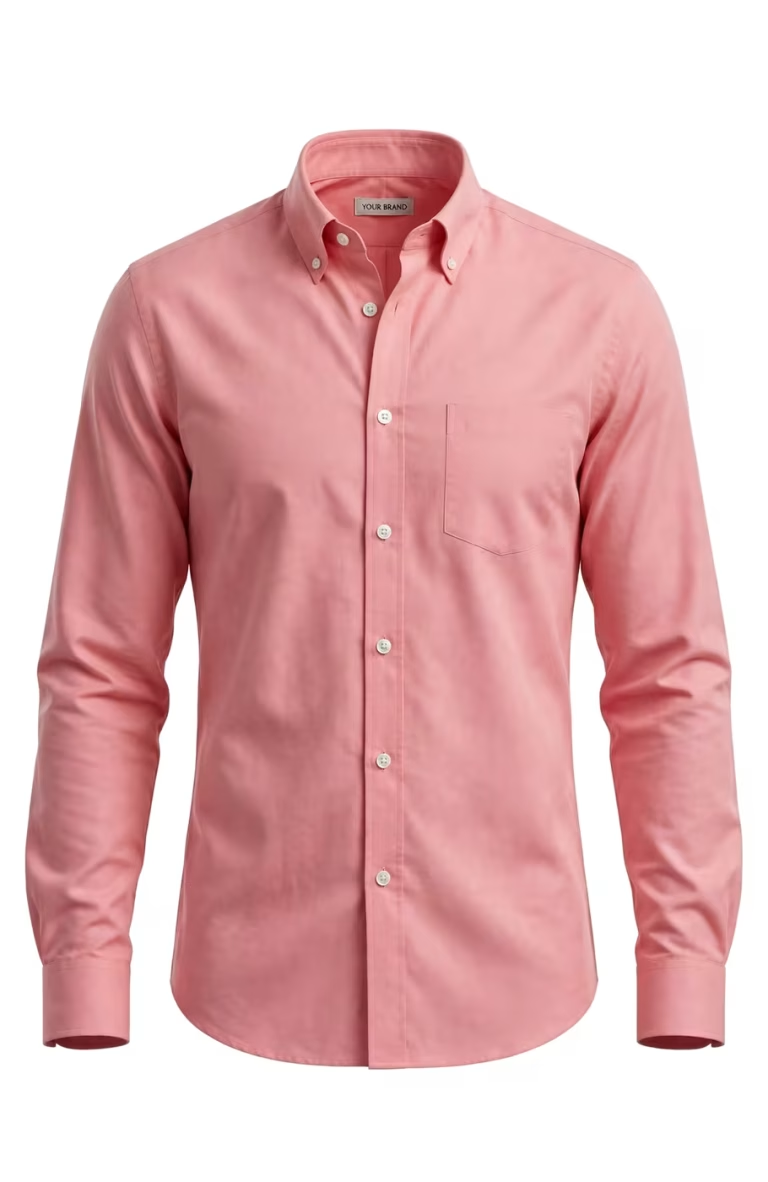
Looking for a Custom Fit Stylish Shirt Manufacturers in Bangladesh programme where the fit is the whole point? We cut and sew fitted shirts to order at our facilities in Bangladesh, and the proof garment is a salmon pink cotton oxford shirt with a button-down collar and a shaped body. The pictured shirt is completely plain, with no print or embroidery anywhere. Moreover, every programme is planned backwards from your selling season. Your label sits inside every collar, and no other name appears anywhere.
- Our facilities are in Bangladesh, stated plainly from the first line.
- Salmon pink fitted oxford shirts as the proof garment.
- The pictured shirt is shown completely plain.
- Your woven label inside every collar, with no other name shown.
- Samples approved on the wearer before bulk cutting begins.
- Fitted shirts for wholesale retail ranges, graded size by size.
- Packed by colour, size and store for fast warehouse intake.
Simply The Best
PORTFOLIOS












Product Details
Custom Fit Stylish Shirt Manufacturers in Bangladesh
A Salmon Pink Oxford Shirt, Fitted Through the Body
Buyers who search for a Custom Fit Stylish Shirt Manufacturers in Bangladesh programme usually care about the silhouette first and the cloth second. We cut and sew fitted shirts to order at our facilities in Bangladesh. The proof garment is a salmon pink cotton oxford shirt with a button-down collar, white buttons and a shaped body. It is shown completely plain, with no print or embroidery anywhere. Moreover, every programme is planned backwards from your selling season. Your label sits inside every collar, and no other name appears anywhere.
- Salmon pink fitted oxford shirts as the proof garment.
- Also, the pictured shirt is shown completely plain.
- Next, samples are approved on the wearer first.
- Your label inside every collar.
- Cartons packed by colour, size and store.
Seven Steps from Fit Block to Packed Shirts
Every programme moves through the same seven steps, from the first brief to packed cartons. A fitted shirt wholesale run tests these steps hardest, because a shaped body shows every grading error at once. Each step is recorded in the programme file, from cloth lot to carton. So nothing depends on memory, and every repeat order follows the same written route.
Step 1: The Brief Fixes the Fit Block
First, the brief fixes the fit block, the collar style, the colour and the size curve. Shirt supplier programmes also fix the label artwork and button choice at this stage. In addition, the brief records your packaging artwork. Clear briefs prevent slow sampling rounds later.
- Fit block and collar written into the file.
- Button colour chosen against the cloth.
- Your label artwork approved before sewing.
Step 2: The Oxford Cloth Is Matched and Checked
Next, the oxford cloth is matched against your master swatch under standard light. Shirt factory buyers care about this step, because salmon shades drift easily between dye lots. Also, the cloth is checked for weaving faults before it rests. Only approved rolls move to the cutting table.
- Shade matched roll by roll.
- Weaving faults marked and cut out.
- Cloth rested before cutting begins.
Step 3: The Cloth Sample Shirt Is Approved
Then one shirt is sewn in the actual oxford cloth. You check the hand feel, the shade and the collar roll on a real garment. Meanwhile, our team measures that sample against your size chart. Changes are written into the file before any fit sample is cut.
- One shirt sewn in the production cloth.
- Hand feel and shade judged on the garment.
- Every change recorded in writing.
Step 4: The Fit Sample Is Approved on the Body
After that, a complete fit sample is tried on the body or the stand. Shirt exporter programmes rely on this sample, because the waist shaping becomes the sewing standard for bulk. In addition, sleeve length and hem curve are checked in motion. Your written approval closes this step.
- Fit sample tried and measured.
- Waist shaping checked against the block.
- Approval recorded on the file.
Step 5: Cutting Follows the Fitted Pattern
Next, cutting follows the graded fitted pattern size by size. Shirt manufacturer lines cut collar, cuff and pocket pieces from the same roll as the body. As a result, shade stays even across every panel. Cut bundles are numbered, so any shirt can be traced back to its roll.
- All panels cut from one roll per bundle.
- Bundles numbered for traceability.
- Collar and cuff pieces cut with the body.
Step 6: Sewing Runs Collar, Placket and Cuff
Then sewing runs in a fixed order, from collar to placket to cuff. Shirt wholesale quality depends on this order, because the collar sets the whole front. Also, the shaping seams are pressed open before the side seams close. In-line checks run through every shift, so faults are caught at the machine.
- Collar set before the placket closes.
- Shaping seams pressed before closing.
- In-line checks through every shift.
Step 7: Packing Splits by Size and Store
Finally, finished shirts are pressed, folded and packed to your plan. Shirt supplier cartons carry clear size marking on every box. Also, your labels, tags and barcodes are applied before sealing. The file stays open after dispatch, ready for the repeat order.
- Pressed and folded to your plan.
- Size ratios packed as your plan sets out.
- Barcodes applied before sealing.
The Salmon Pink Shirt in Our Pictures
The gallery shows one anchor garment, described exactly as it is. The front view shows a salmon pink long-sleeve shirt in cotton oxford, with a button-down collar, white buttons, one chest pocket and a shaped body. The back view shows a yoke with a centre pleat. In addition, the fabric close-up shows the oxford basket weave. The label close-up shows our woven neck label inside the collar. The shirt is shown completely plain, with no print, embroidery or lettering anywhere.
A Button-Down Collar with White Buttons
The collar buttons down at both points, so it sits flat all day. The buttons are white, set against the salmon cloth as a deliberate contrast. Moreover, the placket is stitched flat and even. A shirt factory sample proves this front before bulk sewing begins.
- Button-down collar, fixed at both points.
- White buttons down the front.
- Placket stitched flat and even.
A Shaped Body and a Curved Hem
The body is shaped through the waist, rather than hanging straight. The hem curves, so the shirt sits neatly worn out or tucked. Also, the shaping is graded, so larger sizes keep the same line. Shirt manufacturer checks compare every size against the fit block.
- Waist shaped on the pattern.
- Curved hem, front and back.
- Shaping graded across the curve.
A Yoke and Centre Pleat at the Back
The back carries a yoke across the shoulders. Below it, one centre pleat gives room across the back without losing the fitted line. In addition, the cuffs close with a single button each. Shirt exporter buyers often ask for this back, because it keeps a sharp front and a comfortable back together.
- Shoulder yoke across the back.
- Centre pleat below the yoke.
- Single-button cuffs on both sleeves.
Shirt Supplier in Bangladesh for Spain Boutiques
Spanish boutiques order fitted shirts for sharp, small retail ranges. Our lines sew to your tech pack, your size chart and your approved sample. In addition, care labelling is set in Spanish where your file asks for it. A shirt supplier file stays open season after season. So your buyers reorder against the same cloth, the same shade and the same fit.
- Tech packs followed line by line.
- Spanish labelling set on your file.
- Season repeats sewn to the same standard.
- Fitted shirts for wholesale boutique runs packed by store.
Fit Blocks: Slim, Regular and Relaxed
One pattern family can carry three fits. The slim block follows the body closely, as the pictured shirt shows. The regular block adds room at the waist and chest. The relaxed block hangs straighter, with a longer body. Moreover, each block is graded separately, so the fits never blur into each other. Shirt manufacturer files hold all three blocks under one programme.
- Three blocks on one pattern family.
- Each block graded separately.
- Fit names recorded in your wording.
- Blocks sampled on the body first.
- Workplace standards, including Sedex membership documentation, available on your file.
Shirt Exporter in Bangladesh for Italy Chains
Italian chains take fitted shirts for coordinated store ranges. Size and labelling files follow your approved wording in Italian or English. Also, freight planning starts when the order opens, not when cartons close. A shirt exporter programme clears the same gates on the first order and on every repeat. Therefore the carton that lands in Milan reads the same as the carton that opened the season.
- Italian routing planned from the start.
- Labelling set in your approved wording.
- Same gates on first orders and repeats.
- Shirts for wholesale chain ranges packed by size run.
Grading a Fitted Shirt Without Losing the Shape
Fitted grading is the hardest part of the programme. Chest, waist and hip move by different amounts on the grade. If they moved together, small sizes would pinch and large sizes would balloon. Also, the pocket position scales with the chest, so every size stays balanced. A shirt supplier grading file records every increment, size by size.
- Chest and waist graded separately.
- Pocket position scaled with size.
- Increments recorded in the file.
- Every size checked against the block.
Collar Styling and Button Choices
Styling details let one block serve many ranges. The pictured button-down collar suits casual and smart-casual ranges. Point, cutaway and band collars run on the same block. Buttons can match the cloth, contrast like the pictured white set, or carry your own specification. Shirt factory samples prove each combination on the actual cloth first.
- Four collar styles on one block.
- Tonal or contrast button sets.
- Combinations sampled before bulk.
- Styling recorded in the programme file.
The File Behind a Fitted Shirt Programme
Every programme runs on one written file. The file holds your cloth, shade, fit blocks, size curve and packing plan. Also, it records every approval, from cloth sample to fit sample. Buyers of a fitted shirt factory programme can ask what was checked and when. In short, the standard is a record, not a promise. Your file stays open after dispatch, so repeats start from evidence.
- Cloth, shade and blocks in one file.
- Approvals recorded step by step.
- Gate records held for your review.
- Repeats cleared against the same file.
From Chattogram to Your Port of Entry
Freight follows the routing on your file. Sea freight serves Chattogram departures to your port of entry, with road legs at both ends. Also, air freight stays available for urgent top-ups. Shirt exporter dispatch papers are prepared while cartons are packed, so nothing waits at the end. As a result, the order you place is the order that arrives.
- Sea freight from Chattogram.
- Road legs arranged to your warehouse.
- Air freight held for urgent top-ups.
- Dispatch papers prepared during packing.
Pressing and Presentation for Retail Rails
A fitted garment shows every crease, so presentation is part of the programme. Each piece is pressed on the block shape, not flat on a board. Collar and cuffs are finished by hand before folding. Also, tissue and collar supports can be added where your retail plan asks for them. The presentation standard is written on the programme file, beside the approved sample.
- Pressed on the block shape.
- Collars and cuffs finished by hand.
- Supports added where your plan asks.
- Every carton checked against the packing list twice.
One Block Across a Whole Season
A proven fit block carries a full season of styling. Spring ranges run pale shades and lighter oxford cloths on the same block. Autumn ranges run deeper shades and heavier cloths without touching the fit. Moreover, your customers learn the fit once and trust it across colours. That trust is the commercial value of a stable block, and the file protects it.
- Same block across spring and autumn.
- Cloths and shades change, fit stays.
- Customer fit trust recorded as an asset.
- Block changes only through new samples.
- Season reviews compare sales sizes against the curve.
- Fit notes from your stores feed directly into the next sample round.
Questions Buyers Ask Us
Is the pictured shirt printed or patterned?
No. The salmon pink oxford shirt in our gallery is shown completely plain, with no print, embroidery, logo or lettering anywhere on it. The gallery garment shows the fit, the collar and the cloth only. Branding is your own programme, applied to your approved artwork on your own orders.
How fitted is the pictured shirt?
The pictured shirt follows our slim block, shaped through the waist with a curved hem. It is a retail fit, not a compression fit. Your own block can sit anywhere between slim and relaxed. The fit sample proves your chosen line on the body before bulk cutting.
Can the same block run a regular fit?
Yes. The regular and relaxed blocks share the same collar, pocket and cloth. Each block is graded and sampled separately. Shirt wholesale ranges often run slim and regular together, packed as separate styles on one file.
Can the collar and buttons change?
Yes. Collar style and button colour are brief items, fixed before sampling. The pictured white buttons can become tonal, and the button-down collar can become a point or cutaway. Each combination is sampled on the actual cloth first.
How is fit checked in bulk?
Finished garments are measured against the fit block, size by size. In addition, finished shirts pass stitching and shade gates before packing. A batch that fails a gate is held and reworked, never packed quietly. The gate record stays on your file.
What does the programme file record?
The file records your cloth, shade, fit blocks and size curve. It also holds every approval, from the first cloth sample to the final fit sample. Gate results are added as production runs. So your team can audit the whole programme from one document.
Can ladies fits run on the same programme?
Yes. A ladies block can be graded and sampled beside the men's block on the same cloth. Collar and button styling follow your range plan for each block. The two blocks are recorded as separate styles, so packing never mixes them.
How do shipments leave Bangladesh?
Cartons leave by sea from Chattogram, following the routing on your file. Dispatch papers travel with the packing list. Also, your file stays open after dispatch. So the repeat order starts from the same cloth, shade and fit block.
Looking for a Custom Fit Stylish Shirt Manufacturers in Bangladesh?
Send us your fit block, your cloth choice and your size curve, and we will answer with a fitted sample and a sampling plan. You can reach the team through our contact page or read common answers on the FAQ page first. Every enquiry is answered with a dated next step. We look forward to proving the fit on your first shirt.