
Childrens Clothing Manufacturing
Childrens Clothing Manufacturers Bangladesh
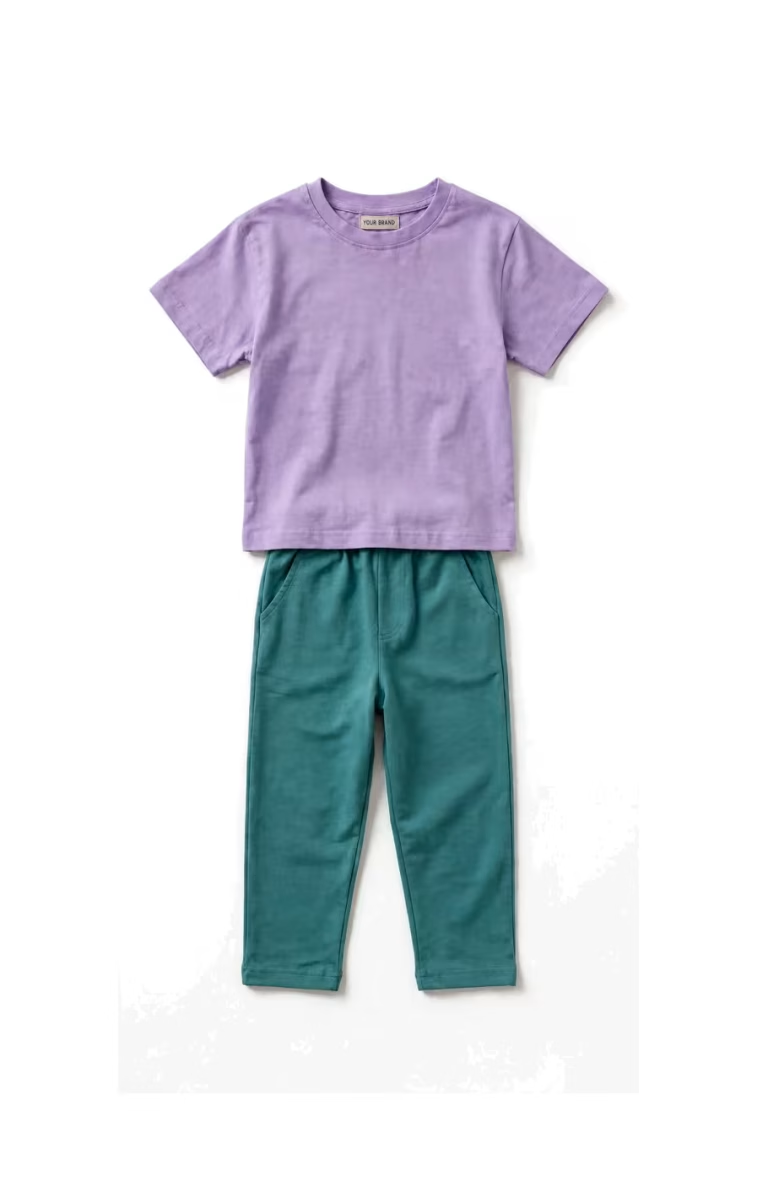
Looking for a Childrens Clothing Manufacturers Bangladesh programme where tops and bottoms arrive as one outfit? We sew children's outfits to order at our facilities in Bangladesh, and the proof outfit is a lilac tee with teal trousers. Both pictured pieces are completely plain. Moreover, every age is graded from your own chart. Clothing manufacturers on one file keep one standard, and your label sits inside every neck.
- Our facilities are in Bangladesh, stated plainly from the first line.
- Lilac tee and teal trousers as the proof outfit.
- Both pictured pieces are shown plain and unprinted.
- Your woven label inside every neck, with no other name shown.
- Samples approved on both cloths before bulk cutting begins.
- Outfits sewn by clothing manufacturers to one chart.
- Packed as matched outfits by age for fast intake.
Simply The Best
PORTFOLIOS












Product Details
Childrens Clothing Manufacturers Bangladesh
A Lilac Tee With Teal Trousers, One Children's Outfit
Our proof outfit for this page is a children's two-piece set. The short-sleeve T-shirt is lilac, with a round neck and a completely plain body. The matching bottoms are teal long trousers with slanted front pockets. Every Childrens Clothing Manufacturers Bangladesh programme starts from an outfit described this exactly. Both pieces are shown completely plain, with no print, logo or embroidery anywhere. So the outfit you see is the retail product, ready for your own labels.
- Lilac tee and teal trousers as the proof outfit.
- Round neck with short sleeves.
- Slanted pockets on the trousers.
- Elasticated waist at the back.
- Your woven label inside the tee neck.
- Outfits built as matched sets.
Seven Steps From Range Plan to Packed Outfits
Every children's order follows the same seven steps, from range plan to packed cartons. First, the outfit is approved as one set. Then each stage is checked against your file. As a result, the top and bottoms arrive as one outfit, not two loose garments.
Step 1: Plan the Outfit Range
Your brief fixes the outfit pairings, the age grading and the colour stories. Also, the brief records your label wording and your care wording. So the whole range reads from one page. Outfits planned with clothing manufacturers at this stage rarely need rescue later.
- Pairings and ages recorded.
- Age grading fixed in writing.
- Label and care wording noted.
Step 2: Approve the Outfit Sample
The sample outfit is sewn complete, tee and trousers together. In addition, both shades are checked side by side under standard light. Then your approval is held as the range standard. Sample outfits a clothing factory sews are measured against your chart before approval.
- Complete outfit sewn for approval.
- Shades checked side by side.
- Your approval held as the standard.
Step 3: Grade the Age Set
Ages are graded from your own chart, size by size. Meanwhile, the trouser waist and leg lengths are graded with the tee. So every age reads as the same outfit. A graded clothing for wholesale ranges keeps its proportions at every age.
- Ages graded from your chart.
- Waist and leg graded together.
- Age set written on the file.
Step 4: Confirm the Order in Writing
The order is confirmed with cloths, pairings, ages and packing on one file. Also, the production slot is booked against your selling season. As a result, delivery lands before your range launch. Written files keep clothing from our supplier benches identical across every drop.
- Order terms written on one file.
- Production slot booked in writing.
- Launch window fixed at confirmation.
Step 5: Cut and Sew Both Pieces
Panels are cut to the approved patterns, piece by piece. In addition, in-line checks watch the seams, the pockets and the waist elastic. Then faulty panels are rejected at the table, not at the carton. Careful sewing keeps clothing for exporter ranges at one standard across ages.
- Panels cut to approved patterns.
- Pockets and waist checked in line.
- Faulty panels rejected early.
Step 6: Pass the Finishing Gates
Finished outfits pass measurement, stitching and shade gates. However, an outfit that fails a gate is held and reworked, never packed quietly. So only outfits that match your file reach the carton stage. Gate records for clothing on OEM files stay available for your audits.
- Measurement and stitching gates.
- Shade gates on both pieces.
- Gate results recorded on your file.
Step 7: Pack as Outfits and Dispatch
Outfits are folded together and packed by age and pairing. Finally, dispatch follows the routing on your file, by sea from Chattogram. Packed clothing from manufacturer programmes carries your labels already applied.
- Outfits folded and packed together.
- Ages packed as planned.
- Packing lists matched to cartons.
The Lilac and Teal Outfit in Our Pictures
A Plain Lilac Tee, Front View
The front view shows the lilac tee with its round neck and short sleeves. Also, the teal trousers below carry slanted front pockets. Both pieces are completely plain, as the pictures show.
- Round neck with short sleeves.
- Slanted pockets on the trousers.
- No print, logo or embroidery.
Back Pockets and Turn-Up Cuffs
The back view shows the tee's plain back and the trousers' elasticated waist. Moreover, two patch pockets sit on the back of the trousers, above turn-up cuffs. The outfit reads as one set from both sides.
- Plain back on the tee.
- Two back patch pockets.
- Turn-up cuffs on the legs.
Lilac Jersey and Your Label, Shown Close
The close views show the tee's jersey itself and the label inside the neck. First, the fabric view shows the fine lilac single jersey knit. Then the label view shows our cream woven label at the back neck. Your own label replaces it on your runs.
- Fine single jersey, shown close.
- YOUR BRAND woven label inside the neck.
- Cream label at the back neck.
Childrens Clothing Manufacturer in Bangladesh for Canada Brands
Canadian children's brands buy outfits as planned ranges, not loose pieces. First, the range is built around pairings that share one cloth file. Also, every age repeats the same outfit from the same file. As a result, a brand's smallest and largest stores open the season with matching sets. Brands hold clothing with manufacturers on files that never change mid-season.
- Ranges built as pairings.
- Same outfit at every age.
- Your labels inside every neck.
- Pairing files kept open.
- Season repeats on one file.
Childrens Clothing Supplier in Bangladesh for Denmark Retailers
Danish retailers take children's outfits in coordinated drops. In addition, their files carry Danish care wording where the range asks for it. So our programme plans pairings and ages around retail drops. Retailers receive clothing from supplier programmes that matches the approved sample outfit exactly.
- Danish care wording where asked.
- Ages graded from your chart.
- Matched outfits in every carton.
- Pairings held per range.
- Reorders cleared on the same file.
Documents Behind a Children's Range
Children's ranges stand on their documents as much as their cloth. First, care and fibre wording is set exactly as you approve it. Also, buyers nominate the test documents their market requires, through bodies such as Sedex, and those documents are arranged per buyer file. In addition, size and barcode data are checked against your range file before packing. We claim no certification that your file does not hold.
- Care wording set as approved.
- Documents arranged per buyer file.
- Barcode data checked before packing.
- No certification claimed loosely.
- Range data held on one file.
Childrens Clothing Exporter in Bangladesh for Japan Importers
Japanese importers take children's outfits with exacting pack standards. Moreover, their cartons carry age ratios planned per channel. Then repeats run against the same open file through the season. Importers hold clothing for exporter programmes on files that record pairings and ages together.
- Age ratios per channel.
- Pairings and ages recorded together.
- Season repeats on one standard.
- Your barcodes applied before sealing.
- Cartons marked for your warehouse.
Quality Gates From Cloth to Carton
Quality on a children's outfit is a chain of gates, not a final glance. Both cloths are checked on arrival, and panels are checked at cutting. In addition, sewing is checked in line through every shift. Then finished outfits pass measurement, stitching and shade gates before packing. However, any outfit that fails a gate is held and reworked. So the standard is a record, not a promise.
- Both cloths checked on arrival.
- In-line sewing checks daily.
- Measurement gates on finished outfits.
- Shade gates on both pieces.
- Held outfits reworked and rechecked.
- Gate records kept on your file.
Age Grading That Stays True Across the Set
A children's range fails when its grading drifts between ages. First, every age is graded from your own chart, top and bottoms together. Also, each age is measured against the chart at the same points. As a result, the oldest age matches the youngest in proportion. A true clothing wholesale curve keeps every age stocked in balance.
- Grading by age from your chart.
- Both pieces graded together.
- Tolerances written on the file.
- Age tabs matched to your wording.
- Curve held open for repeats.
Outfits Packed as One, Ready for the Rail
Children's outfits should reach the rail as one set, not two searches. So each outfit is folded together with its age tab showing. In addition, cartons carry your labels, tags and barcodes before sealing. As a result, stock moves from container to rail in one motion. Shelf-ready clothing for wholesale cartons is counted outfit by outfit at the packing gate.
- Each outfit folded as one set.
- Age tab visible on the fold.
- Mixed ages packed as planned.
- Packing lists matched exactly.
- Cartons marked for your warehouse.
Questions Children's Buyers Ask
Children's outfit ranges raise the same questions each season. So we answer the common ones here, in the open.
- Every answer refers to your own file.
- Claims stay tied to the pictures.
What exactly is in the pictured outfit?
The pictured outfit has two pieces. The top is a lilac short-sleeve T-shirt with a round neck. The bottom is a pair of teal long trousers with front and back pockets and an elasticated waist. Both pieces are completely plain, with no print or lettering.
Which ages can one range cover?
Ages follow your own chart and your range plan. Each age is graded and proved against the approved sample outfit. Also, age ratios are planned on your store split and written on your file. No house curve is imposed on your range.
What documents cover children's clothing?
Documents follow your market and your specification. Buyers nominate the test documents their range needs, and those documents are arranged against your file. In addition, care and fibre wording is set exactly as you approve it. We claim no certification that your file does not hold.
Can the pairings change on our run?
Yes. The lilac and teal pairing is the pictured sample story. Your run can pair any tee shade with any trouser shade on your file. Also, each pairing is approved side by side before sampling. Retail stories often run three or four pairings on one file.
How fast can a winning outfit repeat?
Repeats run from the open file, with cloth, shades and ages already recorded. First, the slot is booked against your remaining season. Then the repeat sews to the same approved standard. So a winning clothing for wholesale ranges returns while the season still runs.
How do shipments leave Bangladesh?
Bulk outfits leave by sea from Chattogram on the routing your file confirms. Air freight stays available for urgent top-ups. Finally, your file stays open after dispatch, ready for the repeat order.
Repeats While the Season Runs
Outfit winners need fast repeats, and fast repeats need an open file. First, your pairings, age curve and shades reopen exactly as recorded. Also, the approved sample outfit is still held on our side. As a result, a mid-season repeat matches the stock already on your shelves. Brands reorder clothing from manufacturer files without rebuilding the range each time.
- Same pairings, ages and shades.
- Sample outfit held between orders.
- Only changed lines are recosted.
- In-season windows booked early.
- Gate records carried forward.
Wash and Wear Checks Before Bulk
Children's clothes are washed constantly, so the sample outfit proves the wash first. First, both pieces are washed together and remeasured against your age chart. Also, the waist elastic is checked after washing, because fit must survive the wash. In addition, both shades are compared with the unwashed standard. So the outfit your stores sell matches the outfit we approved. Every clothing on supplier files is wash-tested at sample stage.
- Both pieces washed as a pair.
- Waist elastic checked after washing.
- Shades compared after the wash.
- Shrinkage measured per age size.
- Wash results recorded on your file.
- Failed cloth never reaches cutting.
Second Drops and Range Extensions
Strong children's ranges rarely end with the first drop. First, a winning outfit earns a second colour story in the same season. Also, a new pairing can join the range without a new file. In addition, age ratios are rebalanced from your first drop's sales pattern. So extensions extend the standard, not the paperwork. A proven clothing for wholesale extensions returns on the same open file.
- Second stories join the same file.
- Ratios rebalanced from real sales.
- Same standard across every drop.
- Extensions booked on early slots.
- Gate records carried forward.
- Range data held in one place.
Pairings That Grow With the Range
A children's range grows by pairing, not by loose pieces. First, one outfit proves the pairing logic for the whole range. Also, new pairings then join the same file with the same age curve. In addition, every pairing is approved side by side before sampling. So a range of eight outfits still reads as one story in store. Pairings added through clothing manufacturers on one file keep the range coherent as it grows.
- Growth by pairing, not pieces.
- New pairings join the same file.
- Same age curve on every outfit.
- One story across the range.
- Pairings approved before sampling.
Season Close and File Handover
A well-run range ends as cleanly as it opens. First, unsold ages are reviewed against your next season's plan. Also, the range file is closed with its gate records and packing lists intact. In addition, your labels and barcode data stay on file for the next order. So the next season starts from a proven base, not from memory. Brands close a clothing wholesale season with every record still readable. Then the range team plans the next season from evidence, not guesswork.
- Ages reviewed at season close.
- Gate records archived with the file.
- Label data held for next season.
- Lessons recorded for the next range.
- Files reopened without rebuilding.
- Next season planned from proven data.
- One standard across seasons.
Looking for a Childrens Clothing Manufacturers Bangladesh?
Tell us your pairings, your age curve and your store split, and we will open a file for your children's programme. As a Childrens Clothing Manufacturers Bangladesh desk, our facilities sew outfits to your approved sample, with your own labels on every set. Talk to our team through the contact page or read the buyer questions first. Then your first sample outfit will prove the range before any bulk is cut.
- Start with a sample outfit on your spec.
- Bring a range plan or a target outfit.
- Ask for the pairing options.
- Every outfit checked as one set.